

Recently I read the “Gospel of Pseudo-Matthew”, which is a text that combines the “Protoevangelium of James” and “Infancy Gospel of Thomas” but bridges the two with a flight into Egypt narrative. With this post I would like to highlight that middle storyline. The other two stories will be covered on this blog at some other point.
Just a quick note, I am using the edition that was edited by James Orr.
Chapter 17 is where the Egyptian flight narrative begins. It has Herod being extremely mad at the Magi for not returning to him, which results in the “slaughter of the innocents.” Joseph was warned in his sleep to flee to Egypt with Mary and the child.
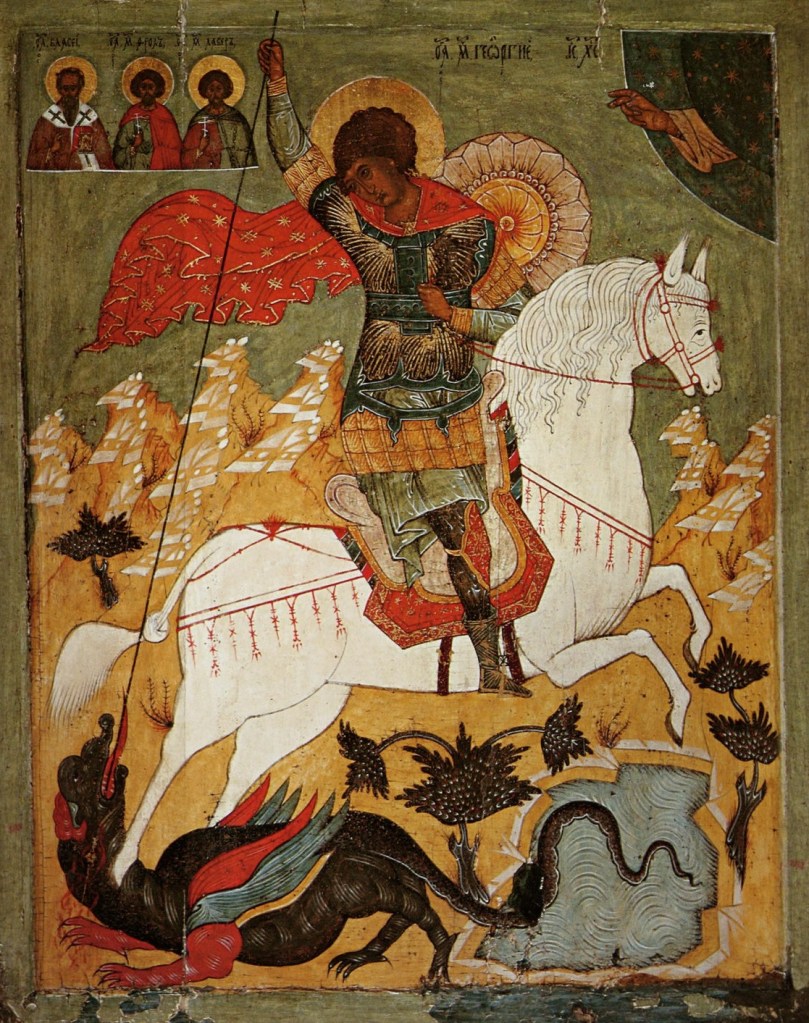
Chapter 18 has the crew (Joseph, Mary, Jesus, three other boys and a girl) taking a break in front of a cave entrance. Out from the cave emerges “many dragons”! Not sure what type of dragons these are but I like to believe they were dragons that are similarly associated with St. George iconography, see pic below.
Here is artwork from the Klosterneuburger Evangelienwerk that depicts this scene. The dragons do appear somewhat similar!
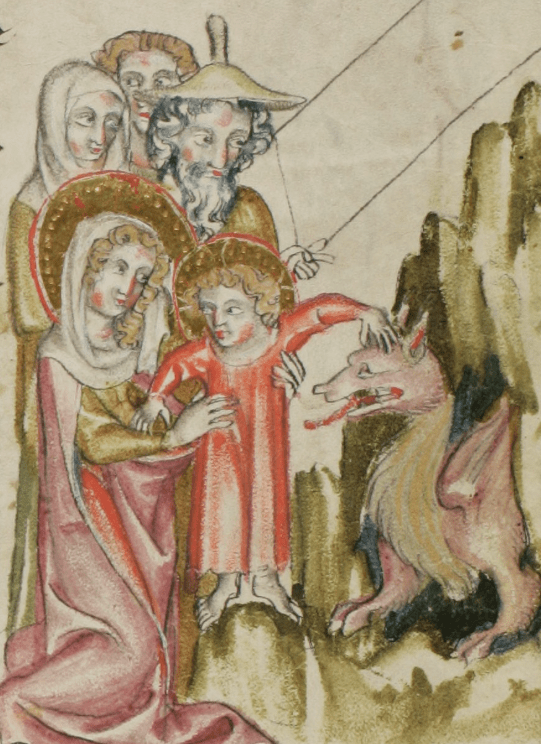
Everyone was afraid of these beasts except for Jesus. He went from the bosom of his mother and stood before the dragons. This caused the dragons to fall into adoration and eventually retreated. To calm everyone, Jesus said to them “Do not be afraid, and do not consider me to be a little child; for I am and always have been perfect; and all the beasts of the forest must needs be tame before me.” Keep in mind, this is an infant Jesus doing this. I understand what the author of the text is trying to get across, but imaging an infant doing this, no matter if he’s divine or not, paints an…..interesting, if somewhat humorous, image in one’s mind. This interaction between Jesus and the dragons refers to Psalms 148:7:
Praise the Lord from the earth, ye dragons, and all deeps. (KJV)
Chapter 19 has more beasts submitting to Jesus. As the group travels through the desert, lions and panthers come to adore Jesus and then walk beside him. Other animals merged with the group but no person or beast were harmed. This chapter is set up to portray Isaiah 65:25:
The wolf and the lamb shall feed together, and the lion shall eat straw like the bullock: and dust shall be the serpent's meat. They shall not hurt nor destroy in all my holy mountain, saith the LORD. (KJV)
Chapter 20 deals with the miracle of the palm tree. If you read my posts on the “Book of Mary’s Repose“, this is going to sound familiar. I just love how these books interconnect with each other. While in the desert, Mary becomes fatigue. Joseph sits her down underneath a palm tree in the shade. She looks up and sees fruit hanging from the tree. She wishes to have some, but since it’s up so high, Joseph is unable to grant her request. Jesus steps in and says “O tree, bend thy branches, and refresh my mother with thy fruit.” So what does the tree, why bend over to the feet of Mary! The tree remains down until Jesus commands it to stand tall and from its roots, to gush out water from the earth. The tree does what is commanded of it and water flows from out of the ground.
Chapter 21 continues with the palm tree. Jesus turns to the tree and says “This privilege I give thee, O palm tree, that one of thy branches be carried away by my angels and planted in the paradise of my Father. And this blessing I will confer upon thee, that it shall be said of all who conquer in any contest, you have attained the palm of victory.” After saying this, an angel descends and takes a branch off the tree and ascends back into heaven. The tree falls over dead instantly which terrifies the group. Jesus reassures them that the palm tree has been transferred to paradise. An interesting story showing how one, even if it’s a plant, is able to ascend due to the words of Jesus.
Chapter 22 starts with Joseph complaining to Jesus about the distance the group must still endure while in the blistering heat. This journey has 30 days left. Jesus instantly shortens the journey from 30 to just one day. As the two were speaking to each other, the city they were heading towards start to appear in the distant horizon. Upon entering the city, they went to a temple to seek hospitality. This temple had 350 idols which the locals would pay daily tribute. The narrative continues into chapter 23. Mary enters the temple with the infant Jesus and all the idols fall onto the ground, breaking into pieces. This is another prophecy from the Old Testament that is fulfilled, Isaiah 19:1:
The burden of Egypt. Behold, the Lord rideth upon a swift cloud, and shall come into Egypt: and the idols of Egypt shall be moved at his presence, and the heart of Egypt shall melt in the midst of it. (KJV)
In chapter 24, Affrodosius (Governor of the city) hears of the broken idols and assembles his army to go to the temple to see what is happening. Upon entering the temple, he sees Mary holding the infant. Affrodosius proclaims that their gods would have only fallen down in front of the true God. He admits that this is the work of the true God and does not want to repeat what happened to the Pharaoh King and the army that was drowned at sea. This of course is another callback to an Old Testament story, that being the Moses/Exodus tale. Chapter 25 ends the Egyptian narrative as an angel calls Joseph back to the land of Judah.
There you have it, the flight into Egypt! I am not sure of the source of this story is from. Was it made by the person(s) who assembled this Pseudo-Matthew gospel or did it originate from a story that no longer survives on it’s own? And if it was on it’s own, was it longer? I would like to believe the family spent some time there before returning so soon. I know I would have!
St. George iconography is traditional artwork. The other artwork featured on the post is from the klosterneuburger evangelienwerk, which can be viewed online at: https://www.e-codices.unifr.ch/en/searchresult/list/one/sbs/0008
bP
 Culmination of Wisdom