
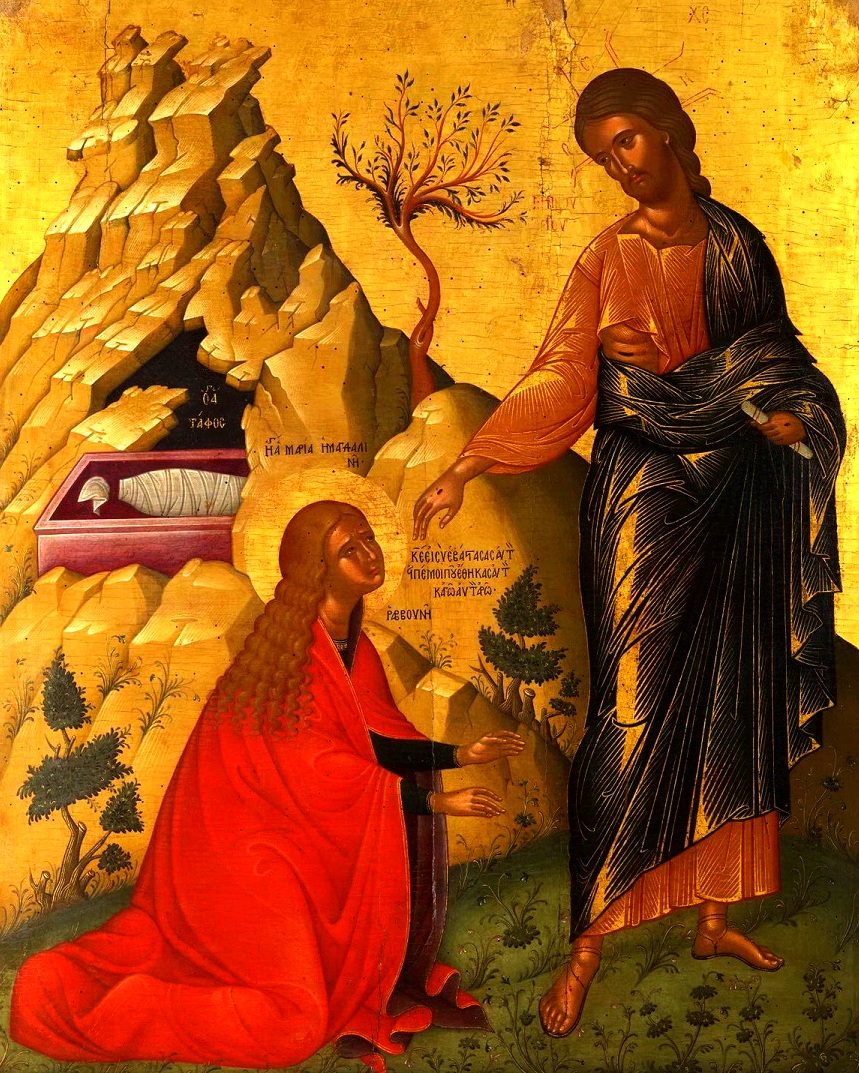
With this post, I wanted to compare all the instances where Mary Magdalene meets the resurrected Christ. There have been countless articles / books on the importance of how this plays out, but for me, it shows the importance of Mary. She is the first to see the resurrected Christ, which in turn, will be the first to announce to the apostles of the resurrection (i.e. the Apostle to the Apostles). I will not delve into the conspiracy theories of the relationship between Jesus and Mary but will state she obviously was an important person to Jesus. Everyone has a role to play (even Judas). With Mary’s huge inclusion in the “gnostic” / non-canonical texts, she was definitely seen as important to early Christian groups in the first few centuries of the common era. This post will include the Gospels of Matthew, Luke, John, Peter and the Epistula Apostolorum. I am not including Mark 16:9 – 11. I am of the opinion, as are many other scholars and evidence, that Mark ended at 16:8 and the “extended ending” was added later (it’s rather apparent this is the case). I will be using the ESV translation of the canonical gospels. Up first is Matthew 28:1-10:
Now after the Sabbath, toward the dawn of the first day of the week, Mary Magdalene and the other Mary went to see the tomb. And behold, there was a great earthquake, for an angel of the Lord descended from heaven and came and rolled back the stone and sat on it. His appearance was like lightning, and his clothing white as snow. And for fear of him the guards trembled and became like dead men. But the angel said to the women, “Do not be afraid, for I know that you seek Jesus who was crucified. He is not here, for he has risen, as he said. Come, see the place where he lay. Then go quickly and tell his disciples that he has risen from the dead, and behold, he is going before you to Galilee; there you will see him. See, I have told you.” So they departed quickly from the tomb with fear and great joy, and ran to tell his disciples. And behold, Jesus met them and said, “Greetings!” And they came up and took hold of his feet and worshiped him. Then Jesus said to them, “Do not be afraid; go and tell my brothers to go to Galilee, and there they will see me.”
Luke 24:1 – 12:
But on the first day of the week, at early dawn, they went to the tomb, taking the spices they had prepared. And they found the stone rolled away from the tomb, but when they went in they did not find the body of the Lord Jesus. While they were perplexed about this, behold, two men stood by them in dazzling apparel. And as they were frightened and bowed their faces to the ground, the men said to them, “Why do you seek the living among the dead? He is not here, but has risen. Remember how he told you, while he was still in Galilee, that the Son of Man must be delivered into the hands of sinful men and be crucified and on the third day rise.” And they remembered his words, and returning from the tomb they told all these things to the eleven and to all the rest. Now it was Mary Magdalene and Joanna and Mary the mother of James and the other women with them who told these things to the apostles, but these words seemed to them an idle tale, and they did not believe them. But Peter rose and ran to the tomb; stooping and looking in, he saw the linen cloths by themselves; and he went home marveling at what had happened.
Both of those accounts are pretty similar, though Luke does add a bit more dialogue and a few more characters in the mix. John mixes this up a bit by eliminating some characters and re-arranging the events. However, Mary Magdalene is still prominently featured. John 20:1 – 18:
Now on the first day of the week Mary Magdalene came to the tomb early, while it was still dark, and saw that the stone had been taken away from the tomb. So she ran and went to Simon Peter and the other disciple, the one whom Jesus loved, and said to them, “They have taken the Lord out of the tomb, and we do not know where they have laid him.” So Peter went out with the other disciple, and they were going toward the tomb. Both of them were running together, but the other disciple outran Peter and reached the tomb first. And stooping to look in, he saw the linen cloths lying there, but he did not go in. Then Simon Peter came, following him, and went into the tomb. He saw the linen cloths lying there, and the face cloth, which had been on Jesus' head, not lying with the linen cloths but folded up in a place by itself. Then the other disciple, who had reached the tomb first, also went in, and he saw and believed; for as yet they did not understand the Scripture, that he must rise from the dead. Then the disciples went back to their homes.

Jesus Appears to Mary Magdalene
But Mary stood weeping outside the tomb, and as she wept she stooped to look into the tomb. And she saw two angels in white, sitting where the body of Jesus had lain, one at the head and one at the feet. They said to her, “Woman, why are you weeping?” She said to them, “They have taken away my Lord, and I do not know where they have laid him.” Having said this, she turned around and saw Jesus standing, but she did not know that it was Jesus. Jesus said to her, “Woman, why are you weeping? Whom are you seeking?” Supposing him to be the gardener, she said to him, “Sir, if you have carried him away, tell me where you have laid him, and I will take him away.” Jesus said to her, “Mary.” She turned and said to him in Aramaic, “Rabboni!” (which means Teacher). Jesus said to her, “Do not cling to me, for I have not yet ascended to the Father; but go to my brothers and say to them, ‘I am ascending to my Father and your Father, to my God and your God.’” Mary Magdalene went and announced to the disciples, “I have seen the Lord”—and that he had said these things to her.
The Gospel of John scene is the one that has been romanticized throughout history in art and other works. The emotions expressed in this section are very powerful. One can really feel the excitement Mary has once Jesus reveals himself to her. Now we move onto the non-canonical sources. The first one is the Gospel of Peter, and if you have not read that gospel, I highly recommend you do so! It features an account of the actual resurrection of Jesus in the tomb, an account not told elsewhere (unless I am mistaken). Peter 50-57:
Now at the dawn of the Lord's Day Mary Magdalene, a female disciple of the Lord (who, afraid because of the Jews since they were inflamed with anger, had not done at the tomb of the Lord what women were accustomed to do for the dead beloved by them), having taken with her women friends, came to the tomb where he had been placed. And they were afraid lest the Jews should see them and were saying, 'If indeed on that day on which he was crucified we could not weep and beat ourselves, yet now at his tomb we may do these things. But who will roll away for us even the stone placed against the door of the tomb in order that, having entered, we may sit beside him and do the expected things? For the stone was large, and we were afraid lest anyone see us. And if we are unable, let is throw against the door what we bring in memory of him; let us weep and beat ourselves until we come to our homes.'

And having gone off, they found the sepulcher opened. And having come forward, they bent down there and saw there a certain young man seated in the middle of the sepulcher, comely and clothed with a splendid robe, who said to them: 'Why have you come? Whom do you seek? Not that one who was crucified? He is risen and gone away. But if you do not believe, bend down and see the place where he lay, because he is not here. For he is risen and gone away to there whence he was sent.' Then the women fled frightened.
The Gospel of Peter does not currently survive intact. It cuts off before Jesus appears to any of his disciples. However, technically Jesus appear in front of some Roman guards right after his resurrection. Below are chapters 35 – 42 from Peter:
But in the night in which the Lord's day dawned, when the soldiers were safeguarding it two by two in every watch, there was a loud voice in heaven; and they saw that the heavens were opened and that two males who had much radiance had come down from there and come near the sepulcher. But that stone which had been thrust against the door, having rolled by itself, went a distance off the side; and the sepulcher opened, and both the young men entered. And so those soldiers, having seen, awakened the centurion and the elders (for they too were present, safeguarding). And while they were relating what they had seen, again they see three males who have come out from the sepulcher, with the two supporting the other one, and a cross following them, and the head of the two reaching unto heaven, but that of the one being led out by a hand by them going beyond the heavens. And they were hearing a voice from the heavens saying, 'Have you made proclamation to the fallen-asleep?' And an obeisance was heard from the cross, 'Yes.'
Yes, you read that right, the cross TALKED! That point aside, the two angels, who are carrying out Jesus, reach into the heavens but Jesus himself is even larger. This is such a visual awkward scene. Like I have mentioned before, one can never take esoteric texts literally. But if you do, this is quite the image! The Mary Magdalene aspect from Gospel of Peter is very similar to Matthew and Luke, as it is. We do not have the ending to this text, so unfortunately, we do not know if Jesus actually speaks to her first or another disciple (or disciples).
Finally, we come to the “Epistula Apostolorum”, a second century text that is pretty anti-gnostic. I will dive into those aspects at some point in the future. This text is pieced together from Coptic and Ethiopic fragments, so names get mixed up as you will see. Here are chapters 9 – 12:
Concerning whom we testify that the Lord is he who was crucified by Pontius Pilate and Archelaus between the two thieves (and with them he was taken down from the tree of the cross, Eth.), and was buried in a place which is called the place of a skull (Kranion). And thither went three women, Mary, she that was kin to Martha, and Mary Magdalene (Sarrha, Martha, and Mary, Eth.), and took ointments to pour upon the body, weeping and mourning over that which was come to pass. And when they drew near to the sepulcher, they looked in and found not the body (Eth. they found the stone rolled away and opened the entrance).

And as they mourned and wept, the Lord showed himself unto them and said to them: For whom weep ye? weep no more, I am he whom ye seek. But let one of you go to your brethren and say: Come ye, the Master is risen from the dead. Martha (Mary, Eth.) came and told us. We said unto her: What have we to do with thee, woman? He that is dead and buried, is it possible that he should live? And we believed her not that the Saviour was risen from the dead. Then she returned unto the Lord and said unto him: None of them hath believed me, that thou livest. He said: Let another of you go unto them and tell them again. Mary (Sarrha, Eth.) came and told us again, and we believed her not; and she returned unto the Lord and she also told him.

Then said the Lord unto Mary and her sisters: Let us go unto them. And he came and found us within (sitting veiled or fishing, Eth.), and called us out; but we thought that it was a phantom and believed not that it was the Lord. Then said he unto us: Come, fear ye not. I am your master, even he, O Peter, whom thou didst deny thrice; and dost thou now deny again? And we came unto him, doubting in our hearts whether it were he. Then said he unto us: Wherefore doubt ye still, and are unbelieving? I am he that spake unto you of my flesh and my death and my resurrection. But that ye may know that I am he, do thou, Peter, put thy finger into the print of the nails in mine hands, and thou also, Thomas, put thy finger into the wound of the spear in my side; but thou, Andrew, look on my feet and see whether they press the earth; for it is written in the prophet: A phantom of a devil maketh no footprint on the earth.

And we touched him, that we might learn of a truth whether he were risen in the flesh; and we fell on our faces (and worshipped him) confessing our sin, that we had been unbelieving. Then said our Lord and Saviour unto us: Rise up, and I will reveal unto you that which is above the heaven and in the heaven, and your rest which is in the kingdom of heaven. For my Father hath given me power (sent me, Eth.) to take you up thither, and them also that believe on me.
In this text, Jesus appears to a group of women and they try to tell the male disciples about the resurrected Christ, and apparently none of the guys are having it. Take from that what you will. Once Jesus goes with the group, then the male disciples believe he has risen. Mary Magdalene’s role here is similar to the other takes, except for John. The Gospel of John’s Mary / Jesus scene takes the encounter to a whole other level. That being said, Mary Magdalene is present in all these accounts and even the addition that was added to Mark still includes her (which could have easily not been the case). There was definitely something special about Mary that these early Christians knew.
UPDATE! Since posting this, I have come across another source of Mary and the resurrected Christ story and that is the 4th century Manichaean Psalms of the Lord Heracleides. I have posted that entire psalm collection on my blog (see link below), but will provide the post resurrection scene below:
Mariam, Mariam, know me: do not touch me.

Stem the tears of thy eyes and know me that I am thy master.  Only touch me not, for I have not yet seen the face of my Father.

Thy God was not stolen away, according to the thoughts of thy littleness: thy God did not die, rather he, mastered death.

I am not the gardener: I have given, I have received the ....... I appeared not to thee, until I saw thy tears and thy grief .... for me.

Cast this sadness away from thee and do this service: be a messenger for me to these wandering orphans.

Make haste rejoicing, and go unto the Eleven.  Thou shalt find them gathered together on the bank of the Jordan.

The traitor persuaded them to be fishermen as they were at first and to lay down their nets with which they caught men unto life.

Say to them, 'Arise, let us go, it is your brother that calls you'.  If they scorn my brotherhood, say to them, 'It is your master'.

If they disregard my mastership, say to them, 'It is your Lord'.  Use all skill and advice until thou hast brought the sheep to the shepherd.

If thou seest that their wits are gone, draw Simon Peter unto thee; say to him, 'Remember what I uttered between thee and me.

'Remember what I said between thee and me in the Mount of Olives: "I have something to say, I have none to whom to say it".'

Rabbi, my master, I will serve thy commandment in the joy of my whole heart.

I will not give rest to my heart, I will not give sleep to my eyes, I will not give rest to my feet until I have brought the sheep to the fold.

Glory to Mariam, because she hearkened to her master, she served his commandment in the joy of her whole heart.
Read the Gospel of Peter at: http://www.earlychristianwritings.com/text/gospelpeter-brown.html
Read the Epistula Apostolorum here: https://en.wikisource.org/wiki/The_Apocryphal_New_Testament_(1924)/Epistles/The_Epistle_of_the_Apostles
Read the Psalms of the Lord Heracleides here: https://culminationofwisdom.org/2025/05/05/mary-magdalene-in-the-psalms-of-the-lord-heracleides/
bP
 Culmination of Wisdom