
Once again, I invoke the writings of Epiphanius (the Panarion) of the Borborites. The lost text I am writing about today is the “Greater Questions of Mary”. A few lines are quoted by Epiphanius but most of it is his commentary. I will warn you, the content can get pretty explicit.
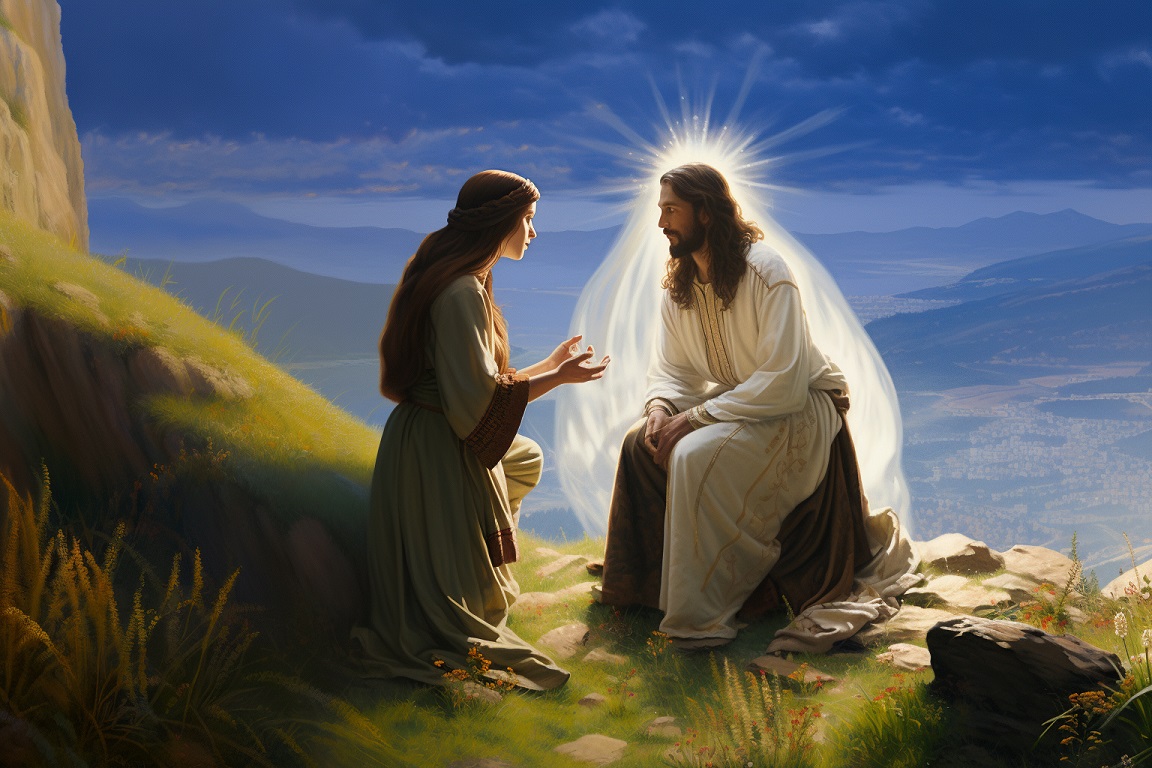
Epiphanius gives a few lines to this lost text. I will follow along with how he describes it since this is the only source that is known to exist. He states that the GQM involves Jesus taking Mary (I presume Mary Magdalene, but it does not specifically say; I sure hope it’s not his mother! lol) up a mountain to pray. While there, Jesus produces a woman from his side, whom he then haves sex with and eventually this woman partakes of his “emission”. This act is in reference to the quote “Thus we must do, that we may live.” This act causes Mary to fall to the ground. Jesus helps her up and says “O thou of little faith, wherefore didst thou doubt?” Epiphanius states that the text is in reference to John 3:12 (I have spoken to you of earthly things and you do not believe; how then will you believe if I speak of heavenly things?) and John 6:62 (Then what if you see the Son of Man ascend to where he was before!), but I’m going to go a step further and include John 6:61 (Aware that his disciples were grumbling about this, Jesus said to them, “Does this offend you?). Epiphanius also relates this text to the John 6:53 saying (Jesus said to them, “Very truly I tell you, unless you eat the flesh of the Son of Man and drink his blood, you have no life in you). This scene being described is obviously an allegory for the Eucharist. With not much else to go on, it is really hard to tell what this scene is trying to portray. If we take it as Epiphanius describes, in a literal context, then yes, I can see it being a perverse allegory of the Eucharist. Mary falling down after witnessing the sex act, it is stated that the Borborites believed this to be the same as when the disciples of Christ found his teaching of the Eucharist to be a “hard teaching” (John 6:60 On hearing it, many of his disciples said, “This is a hard teaching. Who can accept it?”). Mary can’t believe this teaching just as the disciples could not believe the teaching.
The next paragraph in the Panarion will refer to Psalms 1:3 (He is like a tree planted by streams of water that yields its fruit in its season, and its leaf does not wither. In all that he does, he prospers) and Proverbs 5:15 (Drink water from your own cistern, flowing water from your own well). It is stated that the Psalms 1:3 refers to a man’s “dirt (emission)” and that the outpouring from it’s fruit is an allegory for climaxing. The leaf not withering is in reference to another consuming this emission, hence not wasting it. Epiphanius provides no quotation from the GQM for this explanation. The proverbs mention is in reference to a section of the GQM that Epiphanius does not quote either, as he does not want to bring any more harm to the reader, but he states: “When it says that Rahab put a scarlet thread in her window, this was not scarlet thread, they tell us, but the female organs. And the scarlet thread means the menstrual blood, and ‘Drink water from your cisterns’ refers to the same.”
In the final paragraph, I am not sure if this is in reference to the GQM or if it’s just a belief of the Borborites. Regardless, I am going to include it here as it is quite an interesting read. It is stated that the flesh must perish and cannot be raised as it belongs to the archon. However, the power of the soul is within everything, be it man, animal, plant, insect, bread, etc…. so we are doing a favor by eating any and all of this, as it will then elevate the soul of that entity to the heavens with us. A form of mercy is shown by doing this. This sort of reminds me of saying 7 from the Gospel of Thomas (Jesus says: “Blessed is the lion which a man eats so that the lion becomes a man. But cursed is the man whom a lion eats so that the man becomes a lion!”). Epiphanius being in line with orthodox tradition would believe in the resurrection of the flesh, so I can see how he would be at odds with the statement, but if one was in the Gnostic tradition and did not believe in that concept, this “gathering of souls” to ascend with you into the heavens makes sense. I like it!
While this fragment of the GQM may be shocking upon first reading it, looking at it through a different interpretation, it makes sense whether you believe in their line of thinking. Personally I wouldn’t get so graphic with my interpretation and allegorical use, but I understand what the group was trying to convey.
Read the Panarion section on the GQM: https://www.earlychristianwritings.com/questionsmary.html
Artwork is Midjourney AI created.
bP
 Culmination of Wisdom