
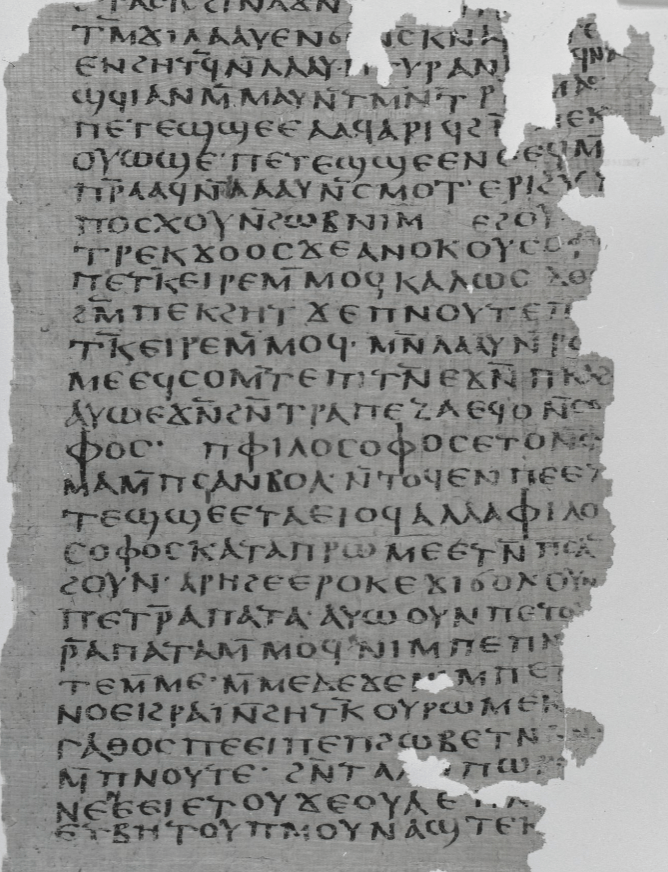
A previous entry on my blog was a sample from the “Sentences of Sextus”, a fragmented wisdom collection that was in the Nag Hammadi library, but also survives complete in other manuscripts. If you only read the NHL version, I highly suggest obtaining a copy of the complete work. Not too long ago I picked up a copy by Richard A. Edwards & Robert A. Wild that includes the full version in a handy booklet paperback format. The SoS is presumed to be from an early Christian writer, but some of the sayings definitely predate Christianity. Like all things in the early days of Christianity, there was a lot of fluidity between various spiritual practices.
What does this have to do with Jesus? I recently picked up a book titled Extracanonical Sayings of Jesus by William D. Stroker that collects most of the non-canonical sayings of Jesus except those in larger Gnostic writings such as the Pistis Sophia, Bruce Codex writings, etc… If one were to combine all that, the book would probably be 1000 pages! This Stroker book is amazing. The author does not offer commentary, just the sayings along with parallel quotes. An amazing reference guide takes up the back third of the book and is going to be a great tool for me in the future. I noticed the guide had SoS listed, so with this blog post, I want to go over these four instances:
Sentence 20: Give precisely the things of the world to the world and the things of God to God.
Now this is pretty obvious. The “render to Caesar what is Caesar’s and to God what is God’s” quote appears in various canonical texts as well as the Gospel of Thomas and the Pistis Sophia.
Sentence 179: What you do not want to happen to you, do not do it yourself either.
This phrase here pops up in various canonical texts as well as Gospel of Thomas (6). It is a bit more universal and could just be a generic wisdom saying.
Sentence 316: Where your thought is, there is your goodness.
Sentence 326(a): As your heart is, (so) will be your life.
These last two sayings are parallels with other phrases that pop up in the writings of the church fathers as well as Matthew 6:21 (ESV For where your treasure is, there your heart will be also) and Luke 12:34 (ESV For where your treasure is, there will your heart be also).
Now the question arises, did the author of the SoS use Jesus for these quotes? I am not totally convinced. They do feel a bit too universal and may have been spoken of in wisdom traditions during that time. Sentence 20 does feel like a Jesus saying, though the author of the SoS seems to be recalling it not in full. Then again, is the full SoS even from a single author? That too I highly doubt. It does feel like a pre-Christian text that was “Christianized” later on. Does this even matter though? As we journey along the wisdom tradition, does the source, be it Jesus, the Buddha, whoever, even matter, if one learns from it? Knowledge is the key to salvation!
I will be referencing the Extracanonical Sayings book in the future. I HIGHLY recommend picking this up!!!
bP
 Culmination of Wisdom