
I mentioned in previous blog posts on how important it is to check out various translations of texts. Sometimes it is not possible but when there are multiple translations you should definitely do so! Unless you can read the source manuscript (Coptic, Greek, etc…), you are forced to go by modern (or somewhat modern, i.e. within the past hundred or so years) translations. I thought this would be a good experiment to do with the Gospel of Thomas. This gospel has been translated by numerous people. The Coptic version survives mainly intact but there are also Greek fragments. So in this experiment, I will also be comparing the Greek to English translations, along with the Coptic. Greek would be the main source of Thomas thus the English translation of the Coptic is a 2nd generation translation. So let’s start off with Saying 2.
Here is the Greek to English translation by Thomas O. Lambdin:
Jesus said, “Let the one seeking not stop seeking until he finds. And when he finds he will marvel, and marveling he will reign, and reigning he will rest.”
Here is his translation from the Coptic source:
Jesus said, “Let him who seeks continue seeking until he finds. When he finds, he will become troubled. When he becomes troubled, he will be astonished, and he will rule over the All.”
Here is Marvin Meyer’s translation:
Yeshua said, Seek and do not stop seeking until you find. When you find, you will be troubled. When you are troubled, you will marvel and rule over all.
Stevan Davis translation:
Jesus said, “The seeker should not stop until he finds. When he does find he will be disturbed. After having been disturbed, he will be astonished. Then he will reign over everything. Having reigned, he will rest.”
Stephen Patterson and James Robinson translation:
Jesus says: “The one who seeks should not cease seeking until he finds. And when he finds, he will be dismayed. And when he is dismayed, he will be astonished. And he will be king over the All.”
William D. Stroker translation:
Jesus said: Let him who seeks not cease seeking until he finds. And when he finds he will be troubled, and when he is troubled he will be astonished, and he will rule over the All.
Comparing these all, the first sentence is pretty much the same. It starts with “Jesus said/says”, which is typical of Thomas sayings. Then it proceeds with the seeker seeking and not stopping until said seeker finds. For the most part, all the translations are pretty close. Now the middle and last parts of the saying is where the wording changes up a bit. In the Greek to English translation, we see the word “marvel” appear in the saying. In the Coptic to English translations, “marvel” gets replaced with “disturbed”, “dismayed” and “troubled”. The Greek source is obviously the more “poetic” than the Coptic source. Also, “marvel” is more akin to “astonishment” or in “awe” of something. It has a more positive aspect to the experience. The Coptic to English translations tend to give off a more negative impression. That just goes to show how the Coptic translation from a Greek source has changed up the meaning somewhat of that saying.
Let’s take a look at saying 36.
Here is the Greek to English translation by Thomas O. Lambdin:
Jesus said, “Do not worry from early until late nor from evening until morning. Worry neither for your food, what you will eat, nor for your clothes, what you will wear. You are much greater than the lilies which neither card nor spin. When you have no clothing, what do you wear? Who can add to your time of life? He it is who will give you your clothing.”
Here is his translation from the Coptic source:
Jesus said, “Do not be concerned from morning until evening and from evening until morning about what you will wear.”
Here is Marvin Meyer’s translation:
Yeshua said, From morning to evening and from evening to morning, do not worry about what you will wear.
Stevan Davis translation:
Jesus said: Do not worry from morning to evening or evening to morning about what you are going to wear.
Stephen Patterson and James Robinson translation:
Jesus says: “Do not worry from morning to evening and from evening to morning about what you will wear.”
William D. Stroker translation:
Jesus said: Do not be concerned from morning until evening and from evening until morning about what you will put on.
First off, the Greek version is much longer!! This isn’t the case of a missing fragment from the Coptic version either. The Greek source goes into much more depth on the meaning of the saying and it makes the Coptic version inferior in comparison. Now to compare the first part of the Greek version with the Coptic translations, they are pretty much in agreement. Content wise, the Greek manuscript is the superior source, not just in it’s wording, but the extended explanation.
I invite you to go to gnosis.org (link below) to check out the various Gospel of Thomas translations. They do not list the Stroker translation (I pulled that from a book I have of his) but they do list the others including the Greek sayings. There are much more Greek sayings and I highly recommend reading those if you have not done so.
http://www.gnosis.org/naghamm/nhl_thomas.htm
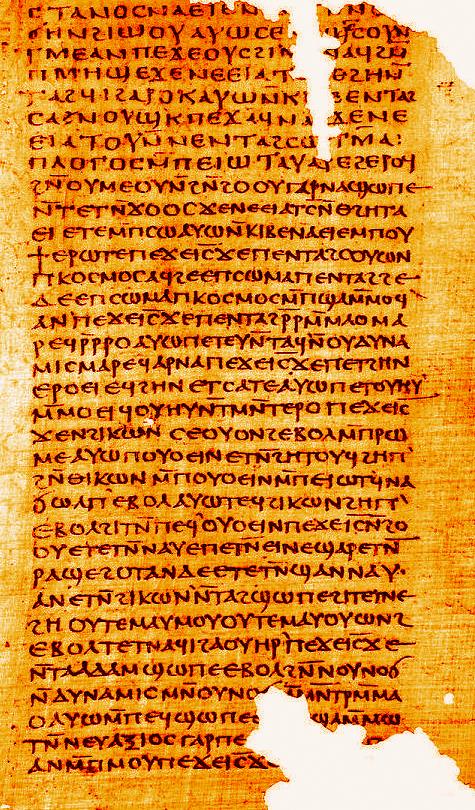
Featured photo is from the Coptic Gospel of Thomas papyri.
bP
 Culmination of Wisdom