
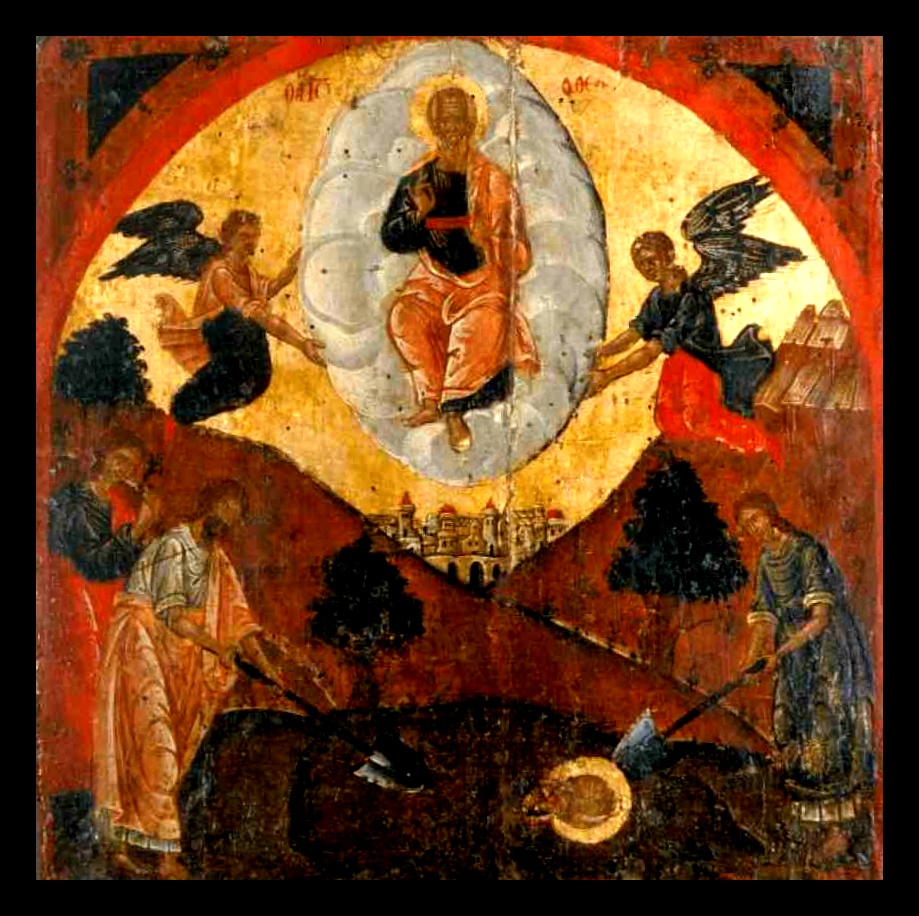
I guess I have Saint John on my mind as I have yet another post on him (and a few more in queue!). My last post was an Ethiopic version of the death of John, this time I have a Coptic tale of this event to share. The manuscript of this story dates to about 990AD. I am not sure of when the story was originally written, so like the previous one, you’ll just have to go with it. And as usual, I use E.A. Wallis Budge’s translation (from 1913) as my basis in this transcription, but have updated some of the words to make it a bit easier to read for the modern viewer.
THE REPOSE OF SAINT JOHN THE EVANGELIST AND APOSTLE OF THE CHRIST. IN THE PEACE OF GOD. AMEN.
The blessed John was in Ephesus with the brethren, rejoicing in the Lord. Now on the first day of the week all the brethren were gathered together, and John began to speak to them, saying “My brethren, my fellow heirs, and my partners in the Christ Jesus, our Lord, know that unto you hath the Lord given from His hand power, and that he had wrought for you very many mighty works, and miracles, and acts of grace. And you know of what kind are the teachings, and the guiding directions, and the refreshing, and the service, and the gracious acts, and the gifts, and all the other things which you see with your eyes, which are given unto you from the hand of our Master. He had never made Himself manifest unto you through the eyes of the body, neither have you hearkened unto Him through the ears of the body, but He had made Himself visible unto you through the integrity of your heart, and by visions, and by works which are holy. Strengthen yourselves, then, in Him, and you shall remember Him at all times; moreover, you shall also remember the mystery and the association which had come unto you, and which our Lord had fulfilled.
And now, O brethren, He made supplication to you through Himself, and He appealed unto you, wishing to make you to cease to grieve Him over much, or to despise Him, or to conspire against Him, for He knows the despising which takes place through you. He knows also the reviling, and He has knowledge of the treachery, and the punishment wherewith you punish Him. When you shall hearken unto His holy commandment to obey it, He will show compassion upon you. Do not make to grieve through you the Good God, the Merciful, the Long-suffering, Him Who is without spot, Him Who is without blemish, the Ineffable, the God Who is One alone, the Unchanging One, Him Who is without guile, Him Who is without wrath, the Name which is above every name which men can comprehend. Let Him but rejoice with you, and you enjoy free and happy citizenship with Him. Let Him but have gladness with you, and you live in happiness and innocence. Let Him but repose in your hearts, and you are turned into beings who rejoice in holiness of life. Let Him but show Himself unmindful of you, and you must live in painful restraint. Let Him but have pleasure in you, and you become participators in good things and in the things which are offered to Him. Let Him but live delicately, and you love Him. Let Him but laugh, and you become ready to follow Him.
I say these things, then unto you, O my brethren, because I hasten to embark on a certain matter which has been laid upon me, and of which the completion shall be unto me by the help of God. For of what kind is the other matter which I shall say unto you, there being for you the pledge of your God? There is for you the pledge of His kingdom, there is for you His presence, which cannot be entreated. If you cease from the habit of sinning from this time onwards, then the deeds which you have committed through want of understanding He will remit to you; but if even after you have had knowledge of Him you continue and persist in the doing of these same works, they shall first of all try you in the judgment, and then they shall deliver you over to the fire.”
Having said these things, Saint John prayed, saying, “Jesus, who did weave the crown which was in Thine own garland. O Thou Who did make the crown of all the saints, and these plants which are of many kinds, and has changed men into Thy flowers which do not wither and fade! O Thou Who has spoken Thy words in our hearts! O Thou Who alone does have a care for Thy servants! O Thou Physician of our bodies, Who does heal them all for nothing! O Thou Who alone does do good unto us! O Thou in Whom there is no pride whatsoever! O Thou Who alone are the Compassionate, and are the Lover of all mankind! O Thou Who alone are the Savior, and the Righteous One, Who exists in every place, Who has existed from everlasting, God, the Christ Jesus! Thou are He Who shelters everyone who puts his hope in Thee, with Thy gift, and with Thy compassion. Thou knows every wile and every craft deed of the Enemy who does wage war against us at all times.”
And when Saint John the Evangelist had made an end of saying these words, he took bread, and he gave thanks unto God in this manner, saying, “What other blessing is there? Or what other word can be spoken? Or what other giving of thanks is there which we can pronounce over this bread which we break, except Thou alone, the Lord Jesus, the Christ?
We ascribe glory unto Thee, O Lord Jesus the Christ, Whose Name has been made manifest by the Father. We ascribe glory unto Thee because of Thy coming in through the door. We ascribe glory unto Thee for Thy holy resurrection from the dead, which has been made know unto us through Thee. We ascribe glory unto Thee, the Way. We ascribe glory unto Thee, the Seed, the Word, the Salt, the True Gem, the Holy Storehouse, the Plough, the Net, the Majesty, Who was sent for the sake of us, the children of men, that He might deliver the race of man. We ascribe glory unto Thee, the Truth, the Rest, the Glory, the Might Power, the Commandment, the Boldness of speech, the Freedom, and our place of refuge.
For Thou are the Lord, the Root of immortality. Thou are the Fountain which cannot be destroyed. Thou are the Strength which endues throughout the Ages. Thy Name has been set upon all these things here, so that we also may make our cry unto Thee through them. For we know Thy Majesty which is invisible, and which does not make itself manifest unto us at this time. When Thou shall have purified us, then we shall see Thee alone in the body which Thou has changed from oldness into newness.”
And as John was breaking the bread, he prayed over each one of his brethren, so that they might be worthy of the Grace of the Lord. Similarly Saint John himself, when he tasted the bread, prayed for himself. John the Theologian spoke after this manner saying, “Let me, even me, have a portion with you, O my beloved.”
Then he said to Pyrrhus, “Take with you two brethren, and let them have baskets in their hands, and digging tools, and follow me.” Now Pyrrhus was not by any means neglectful, and he did according to what he had been commanded by Saint John the Theologian, and the servant of God. And when the blessed John had come forth from his house, he went outside the gate of the city, and he gave orders that the exceedingly great multitude, which were following him and pressing upon him, should be made to withdraw, and to depart from him. And when he had arrived at a place in the region wherein were the tombs, he said to the brethren, “My sons, dig a grave in this place,” and those who were there dug down into the ground. Then John the Theologian was commanding them saying, “Dig the grave very deep.” And he was saying, “Dig down much deeper”; and those who were there dug down deeper still. And he spoke with them, and addressed words to them, and encouraged them, and counselled them unto edification, and he instructed them, and he persuaded them to enter into the Kingdom of God. And he prayed over each one of them.
Now when the young men had finished making the grave in the place wherein they had dug it, they arranged everything connected therewith in a seemly manner, according to what Saint John wished. Now we had no knowledge whatsoever of what he was about to do. Then he took off the clothes which were upon him, and having stripped them off himself, he threw them down into the place which they had dug deep in the ground, and which was in the form of a chamber which spread out. Then John stood on his feet – now the only garment which he had on him was a tunic which came down on both sides – and having spread out his hands he prayed thus saying, “O Thou God, Who has chosen me for Thyself to be an Apostle to the heathen, and has sent me forth into the world, Who has made manifest the Prophets and His Apostles, Who has never ceased from doing that which is good since the foundation of the world, Who delivers everyone who has no strength, Who has made Thyself to be apprehended by every man of reason, unto Whom every living thing ministers through His foreknowledge, Who did make our soul to have longings, and does make it to be tranquil, or solitary and savage, Who does Thyself make it to laugh to scorn its enemy, Who did fashion it like unto Thyself when it was dead, Who did make for it a law which it could distinguish in the abyss of lawlessness, Who did make it to vanquish its enemy by causing it to flee from him; Who did give it Thy hand and did deliver it from Amente; Who did not leave it to become a citizen of this world, who did teach it to escape from its enemy; who did make Thy knowledge to illumine every place; Thou Son of God, Thou Savior, Thou Lord, Thou Orderer of the things which are in the celestial heights, Thou Guardian of the things which are on the earth; Thou Grace and Gladness of those who belong to Thee; receive Thou the soul of John, which belongs to Thee, for it is Thou Who has kept me up to this hour, and I have never at any time polluted myself with women.
Thou did appear unto me at the time when I was wishing to marry a wife in the period of my youth, and Thou did say unto me, ‘John, I have need of you.’ Thou did in the beginning act as the steward of my body, when the desires caused by the sicknesses of the body arose, and it was Thou Who did prevent me from gratifying them on many occasions when I was wishing to marry a wife. Afterwards Thou did speak to me at the third hour of the day on the sea, saying, ‘John, if it be that thou does not in truth belong to Me, I will withdraw Myself from thee. Take thou a wife, and you shall make yourself to become blind in both my eyes; thou shall suffer grief, then thou will pray unto Me.’ Thou it was Who did open my heart three times in the same year, and Thou did graciously bestow upon me other eyes, which did not make themselves visible. Thou it was Who did make the joyful expectation of the contemplation of women to become to me an abomination. Thou it was Who did deliver me from a fleeting fantasy, and did keep me for the life which endures forever. Thou it was Who did make me to become a strange to the madness of evil which arises in the flesh, and did make me to be remote from the death which is bitter. Thou it was Who did deliver me from the second death, that is to say, the Gehenna of fire, and di make me to stand up, being a pure man. Thou it was Who did stop the mouth of the disease which appertained to my soul, and did prevent the committal of the act which appertained thereto, or rather the outward and manifest works which are wont to be performed by the body. Thou it was Who did deliver me, and did cast out from my heart that which disturbed me sorely. Thou it was Who did prepare me to come unto Thee in a state of holiness. Thou it was Who did make my thoughts concerning Thee to be unpolluted. Thou it was who did graciously grant unto me the faith in Thee which was undivided. Thou it was Who did make my thoughts and my counsels to incline ever more and more towards Thee. Thou does give unto each man according to his works. It was Thou who did deposit in my soul the intention not to permit anything whatsoever except Thyself to enter into me. For what can I find which is more choice ore more pure than Thee? And now I have found Thee. And I have fulfilled the stewardship which Thou did commit to me; make me therefore worthy to enjoy rest in Thy holy repose. Do thou bestow upon me graciously the perfection which is in Thee, that is to say, the sinlessness and the salvation, which cannot be described, and which cannot be pried into, and which are beyond the comprehension of man. I come unto Thee, my Lord Jesus, the Christ. Let the fire die down, and let the darkness withdraw itself, and let Chaos become helpless, and let the furnace of blazing fire be without power, and let Gehenna be extinguished, and let the holy angels accompany me, and let the demons shake with fear. Let the holy angels would the Principalities, and let the Powers of darkness withdraw themselves and fall down headlong. Let the Places which are on the right hand stand on their feet. May Diabolos be put to shame, and Satan made an object of ridicule. May his wrath be quenched, and may his raving madness be suppressed. May his honor be disgraced, and his pride wounded; may his sons be dragged downwards, and may all their roots be pulled out. Grant Thou unto me the power to walk, and strengthen me so that I may complete my course without suffering and without trouble. I come unto Thee, my Lord, that I may receive the good things of those who live in holiness.”
And when John the Theologian had said these things, he looked towards the east, and he ascribed glory to God, and stretching out his hands again he prayed, saying, “Be Thou with me, O my Lord Jesus, the Christ.” Then straightway he cast himself down into the pit which they had dug, the place wherein his apparel was spread out, and when he had said to them, “Peace and grace,” he dismissed the brethren, and they departed. And they came out of the city on the morrow, and they could not find him, but they found his sandal, and the newly dug ground in the place where he had gone down into the earth. Finally they remembered the word which the Lord had spoken to Peter, saying, “If I will to make him remain until I come, what is that to thee? Follow thou Me.” And they ascribed glory to the Lord Jesus, the Christ, because of His miracle which took place in the blessed Apostle, and Evangelist, and Theologian, and holy virgin, Saint John, the beloved of the Christ, Jesus our Lord, and our God, and our Savior, to Whom, with the Father and the Holy, and universally vivifying and consubstantial Spirit, all glory is seemly, now, and always, and forever and forever. Amen.
Featured artwork is a Byzantine era icon of John’s repose.
-bP
 Culmination of Wisdom