If you like the North African magic that appeared in the “Book of Mary’s Repose” and the “Lefāfa Ṣedeḳ“, you’re going to love this. I recently obtained an English translation of the text known as “The Prayer of Mary At Bartos.” The booklet I received is just the text with no commentary or history, thus I had to read up on it at NASSCAL (link will be provided at the end of this post). So apparently this text was originally floating around as the prayer itself, in Greek and Coptic (at least), starting around the 6th/7th centuries. A few centuries later, a narrative story of Mary trying to help Matthias was added to the text as well as an ending to make it a more rounded story. This version survives in Ethiopic, Coptic and Arabic. The translation I am going to go over is by Bekele Tesfaye, D.P. Curtin and Rene Basset. This is a new translation, thus in copyright, so I won’t be reprinting it. Their text is available online for relatively cheap. I got a copy on Amazon for $9.
So what does the text speak of? To break it down, it’s a healing / protection prayer. Not just a simple few lines but rather pages of prayers, and within these pages are numerous names that you will have a hard time pronouncing. The text starts by mentioning the Virgin Mary is in the city of Bartos and having delivered Matthias the disciple from prison. Then it jumps to Jesus telling his apostles of this prayer he is about to proclaim. That none of the angelic beings know of this prayer, only him (whom he references himself as Alfa), the Father (whom he references as Ala) and the Holy Spirit (whom is referenced as Arâdyâl). Jesus mentions he will teach to his mother this prayer. She stood up and begged him to save Matthias and began reciting the prayer. The beginning is the typical praising and requesting help. Then it gets to an interesting part where Mary states the sixty names of the Father. She says as such: “Alfã (x7), Iyâèl (x8), Hidâèl (x7), Yodâèl (x6), Ournâèl (x7), Hernâèl (x8), Omis (x8), Dehdi, Neldi-kani, Hehdoudi. And yes, that does not equal 60 names, so either the text was missing names or it was translated incorrectly. I recognize some of the names as they appeared in the Lefāfa Ṣedeḳ, though I am not sure what these names translate to into English, except Alfã (that being Alpha). After announcing these names of the Father, the prayer goes in “hailing” mode and has Mary hailing numerous things and entities. During this section, it seems that it shifts from Mary doing the hailing to the reader. I believe something may be amiss in the translation.
After the end of all the hailing, the Archangel Gabriel begins a dialogue with Mary and then transitions back to praying towards Jesus (it can get a bit confusing, lol). However, when we get to that point, we get some interesting names appearing again. The name given to the blessed Father is “Félëlmyo”, the son is given the name “T’ino T’iqânos” and the Holy Spirit given the name “Kuërkuëryanos”. Now I have no idea where these come from. Mary then refers to the five nails that were driven into Jesus as Sator, Arepo, Tenet, Opera, Rotas. This of course relates to the SATOR square. This is used exactly the same as it is in the Lefāfa Ṣedeḳ, so I find that quite fascinating.
The text continues and the “secret” names keep coming. I am not going to list them all as I really just recommend getting the book as it is truly fascinating if you’re into these magical rituals from the Coptic tradition. I will make mention of some them though. There is a part where Mary is invoking the names of celestial beings, one of which is the morning star that she calls “Bèz”. Traditionally in the west this morning star was called Lucifer, and then that name has been bastardized and came to merge with Satan (that’s a whole other subject onto itself and is really a huge misunderstanding, but I digress). However, Bèz has a secret name and that is “Soufãr”, and it has other beings who walk with it that are named “Aksâr, Mardyâl, Madaryâl, Afeâl, Asëâl, and Aftiàl”. Names are also given to the Sun and the Moon, as well as those entities that walk with it. Yes, it gets crazy with all the secret names!
The next paragraphs include invoking various ArchAngels, then to the twenty four celestial elders. Be familiar with the Apocalypse of John, as this text references it quite a bit. There is one part where Mary starts naming angels who were with her during various events. She calls upon “Yâab, Fâamâ, and Fâyâm”, whom she states were with Jesus while he was in the womb. She calls upon “Sardour, Matouadâi, and Arâdyal” whom were protecting Jesus after his birth. And she calls upon the three angels who guarded the body of Jesus when he was in the tomb, and their names are “Râoul, Fâroul, and Fartěkâ”. Fascinating stuff!
More angelic invocations come about and the prayer ends a few pages later. It’s really hard to explain and give commentary to such a text as it’s just a ritual of invoking NUMEROUS names. I do want to mention a fragment of this text is on the Coptic Magical Papyri site, which you can view by clicking HERE.
I typically don’t provide links to Amazon, but for the sake of this particular post, here is the version I purchased of this text. Amazon link. If you do not wish to buy it off amazon, it is for sale elsewhere, but at least the amazon link will provide you with the technical details of said book. I HIGHLY recommend picking this up. Coptic/Ethiopic Christian magical texts are extremely fascinating and are quite rare in English translations, so you need to get them whenever you can.
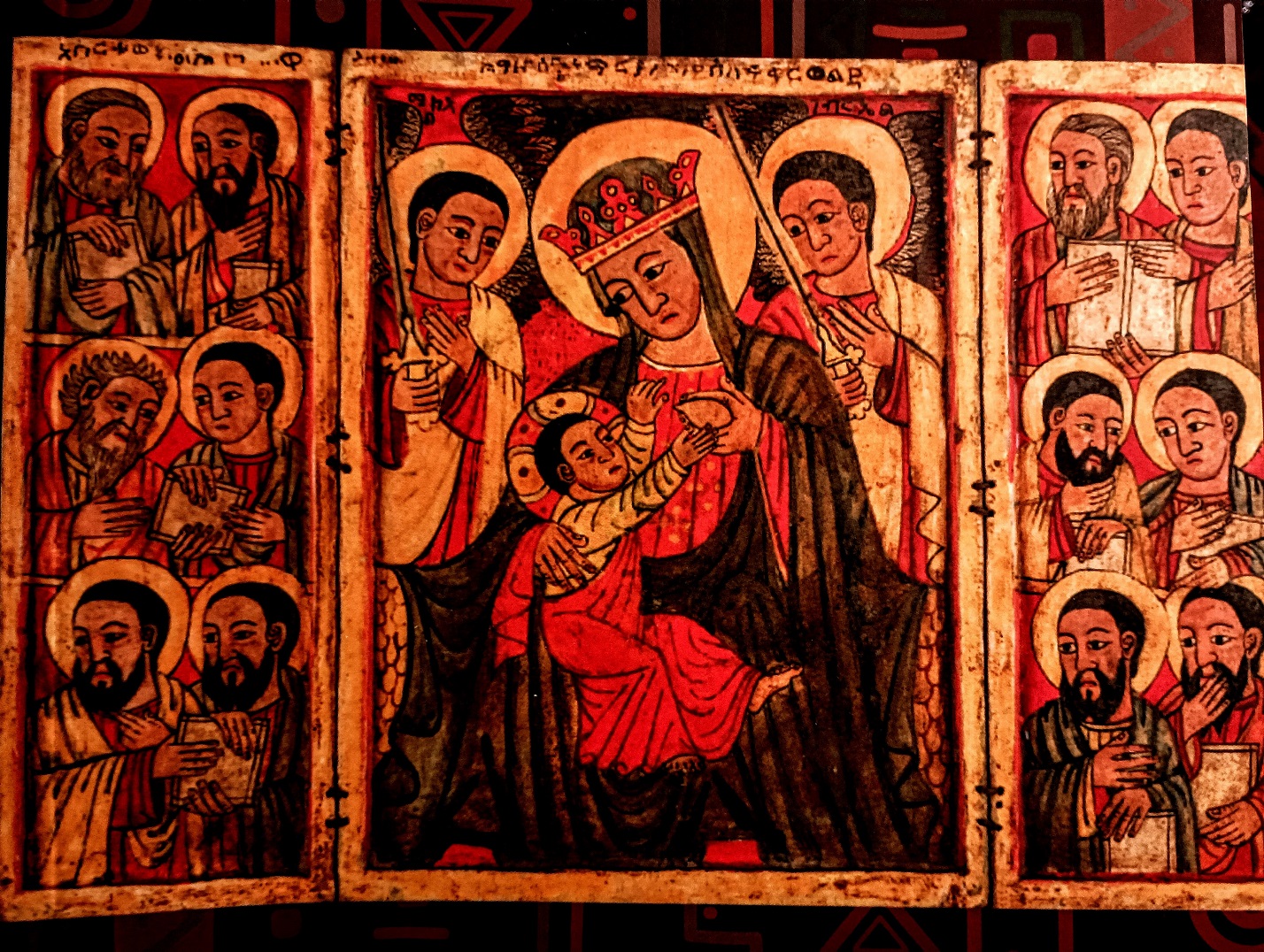
Featured photo is an Ethiopic icon that is on the cover of Prayer of Mary Bartos book I went over.
NASSCAL link: https://www.nasscal.com/e-clavis-christian-apocrypha/prayer-of-mary-at-bartos/
-bP
 Culmination of Wisdom