
Awhile back I was at a local Hispanic store and while browsing through their devotional candles, I found one that really appealed to me with it’s symbolic art. The candle had the name of “Justo Juez”, which translates to “Just Judge” and has Christ being crucified but surrounding him, it had various symbols relating to the Passion. The art work resembled something you’d see on an esoteric art board hanging up at some lodge. Doing a search on google, it appears that the image is popular among Latin American folk Catholicism. Typically this image accompanies a prayer asking for justice and protection. With this blog post, I just want to go through the image and point out the various symbols. Pictures like this really interest me, so one with Christ and the symbols of his Passion, definitely catches my attention!
Here is an example of the Justo Juez artwork:
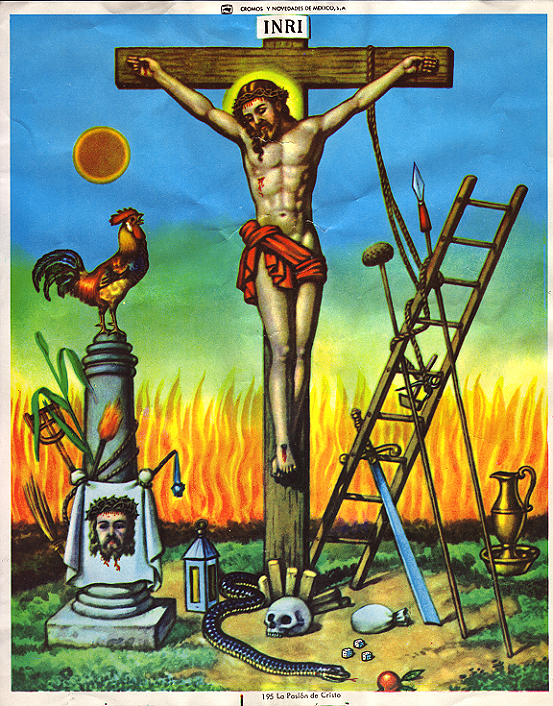
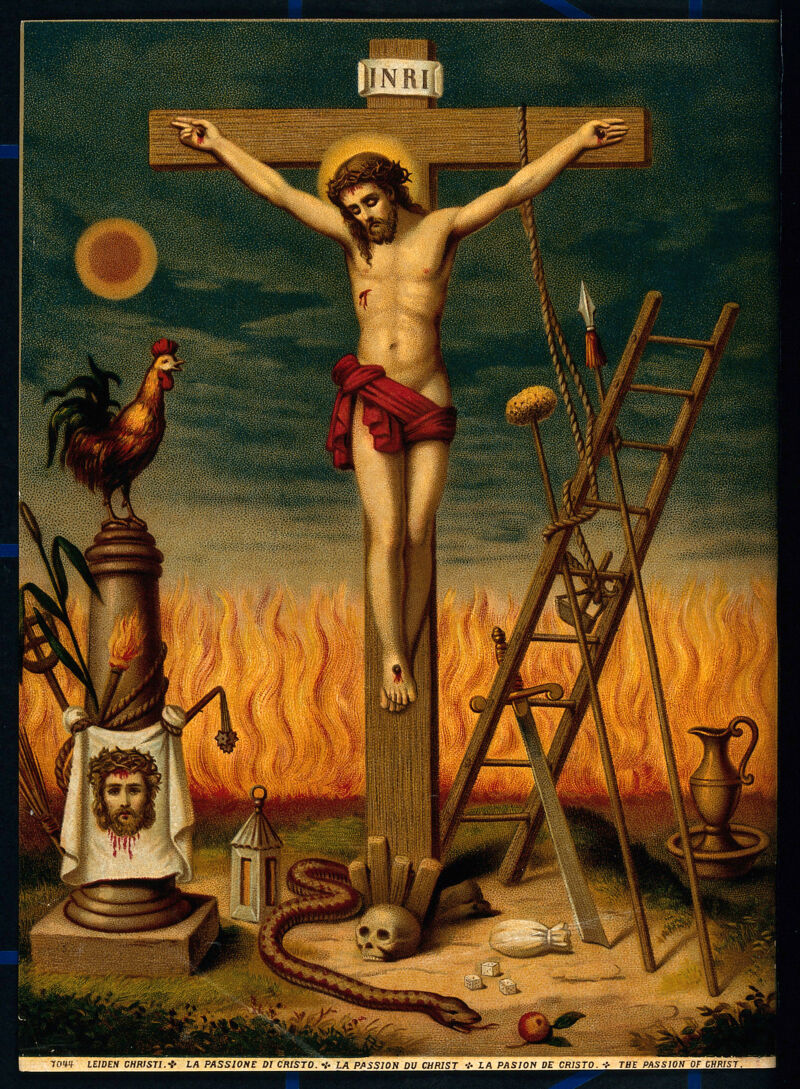
Starting in the middle of image, we have the crucified Christ with INRI (Iesus Nazarenus, Rex Iudaeorum; Jesus of Nazarene, King of the Jews) written across the top. To the top left, you have a sun but with the moon in front of it (an eclipse). Now I have seen variations of this art where it does not seem that the moon is in front and that it’s just the sun, and others where there is no sun at all. Below the sun is the rooster, which harkens to Jesus telling Peter about his three times denial before the cock crows. Speaking of that rooster, there is a very interesting Ethiopian story regarding that fowl creature, which I’ll need to share one day. It’s quite the tale……lol
The rooster is standing on a pillar, which can be ascribed to the pillar in which Christ was tied to while being whipped. Rope around the pillar would go along with that and there is a flail to the right of the pillar, which would have been an instrument during the scourging of Jesus. To the left of the flail is a torch. I don’t believe this is meant to be seen as literal but rather Jesus as the “light” or perhaps it’s a symbol of “passing the torch”.
Below the rooster, we have what appears to be a corn stalk, but historically that would be incorrect since corn, as we now know it, did not exist tin the middle east at the time of Christ. Now “corn” does get mentioned in some translations of the Bible, but that is a misappropriation for grain. Not sure why corn is pictured along with the Passion, as the only main “corn” narrative regarding Jesus is when he told his disciples to plunk ears of corn to eat during the Sabbath. Behind the corn stalk, I am not sure what this item is. An educated guess would be some kind of farming utensil, but really, I have no idea, lol. Below that is a wheat stalk. Wheat is referenced a few times in the gospels.
The last item on the pillar is the veil of Veronica. This is the cloth which a woman wiped the face of Jesus while he was carrying the cross. In the “Acts of Pilate”, the woman is given the name Veronica and church tradition has went with that name ever since. Interesting enough, I came across a “devotion to the Holy Face” in the last few months, which is a devotion dedicated to said image. Both Roman Catholic and Eastern Orthodoxy have iconography and stories relating to the cloth, though in EO it is sometimes referenced as the image of Edessa, which I wrote about awhile back (click HERE). In the future I may write about the Holy Face devotion practice in Roman Catholicism as it has an interesting story originated from the last two hundred years.
Moving to the right, we have a lantern/lamp on the ground, which is referenced quite a bit in the gospels. Next to that is the serpent from Eden and the apple not far from it. Now if we went with a Gnostic slant, this snake would have a different meaning, but being a Roman Catholic image, the snake would represent the devil and the apple being the temptation. The skull at the base of the cross represents death, and typically when at the base, it means Jesus conquering death. It can also represent “Golgotha”, being the place where Jesus was crucified. There is some dice next to the skull and that would be the dice belonging to the Roman soldiers who were casting “lots” for the seamless garment of Jesus. The bag of silver next to the dice represents the 30 pieces of silver Judas received as payment for turning in Jesus.
Before we get to the ladder and what’s on it, all the way to the right on the ground is a pitcher of water and basin that is used to wash the feet of disciples. But in the Passion narrative, it would represent Pilate washing his hands of the death of Jesus.
The ladder was used to take down the body of Jesus after his crucifixion, but the ladder itself could also represent Jacob’s ladder, bridging Heaven and Earth together. On the ladder it self, we first have a sword, which can be seen many ways. Literally, it could be seen as the sword that Peter uses to chop off an ear of one of the guards coming to arrest Jesus. Allegorically, it can represent justice, being that this art print is titled “Just Judge”. In the Gospels, Jesus does mention that “I did not come to send peace, but rather, a sword!”, so in that case, it would mean division/conflict. Next to the sword is the sponge that would be soaked in vinegar and hyssop that was given to Jesus when he requested a drink while hanging on the cross. Slightly behind that is a hammer, which would have been used to hammer in the nails through the body of Christ. The last staff on the ladder is the spear that would have been used to pierce the side of Christ.
I believe that is all the main symbols on this particular print. Some variations may have another item or two, or less. I do want to mention there are usually flames in the background, which would harken back to hellfire.
Google the Justo Juez image and see the various interpretations of the artwork. While browsing such results I seen that Amazon sells a small statue of the Just Judge! Now that is pretty neat.
-bP
 Culmination of Wisdom