
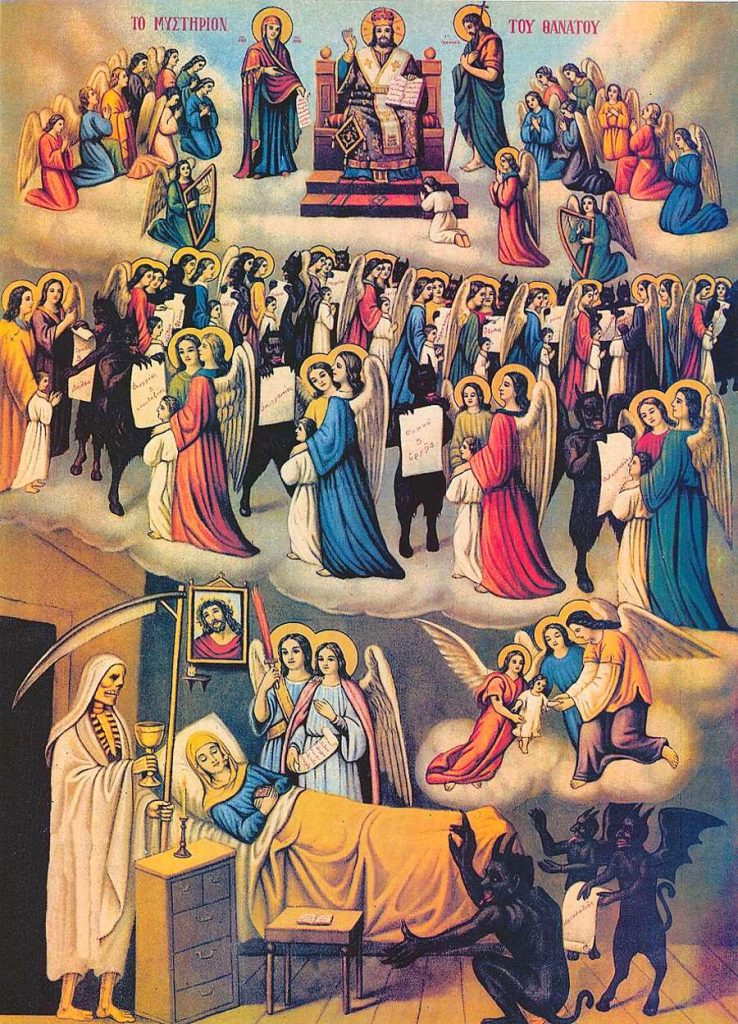
Over the past few months, I’ve been gathering sources on Toll Houses. This is an Orthodox concept regarding souls after they leave the body and their ascent into heaven. Now let it be said, this is not a mainstream belief in modern Orthodoxy. There is much debate in it, but the concept does exist, and it also exists in Gnosticism. So this year I plan on posting various topics relating to the Toll House concept. This will be my first post regarding them and it references the Coptic text “The Apocalypse of Paul” (there is another text with the same name, but is different in content). So what are toll houses? While the soul ascends it meets various toll collectors which will test the soul while your guardian angel defends you. These collectors are various demons of the sins of the world. So think of it as a judgment but on a case by case basis. This is not a new concept and exists in various spiritual traditions. With that being said, let’s take a look at this Revelation to the Apostle Paul.
The text starts with the Apostle Paul traveling to Jerusalem. Along the way, he meets a small child who tells him that he blessed and to open his mind so he can ascend and meet the twelve apostles. This small child is identified as the Holy Spirit.
The Holy Spirit takes Paul to the third heaven, bypassing the first and second heaven for whatever reason. However, the Spirit immediately takes Paul to the fourth heaven, and there is where we first have an encounter. In the fourth heaven, Paul looks down and sees the twelve apostles on earth. But within the fourth heaven, he sees various angels who resemble gods. Then an angel brings forth a soul. Here is the encounter:
These angels took a soul from out of the land of the dead. They brought it to the gate of the fourth heaven, and the angels were lashing it.

The soul spoke and asked, “What sin did I commit in the world?”

In response the toll-collector living in the fourth heaven said, “It was unjust to commit all of those criminal acts found in the world of the dead.”

In response the soul said, “Produce witnesses who will show you in what body I committed criminal acts. Do you want to present only a book from which to read?”

And three witnesses arrived. The first spoke and asked, “Was I not in the body at the second hour [...]? I assaulted you until you fell into anger and wrath and envy.”

And the second spoke and asked, “Did I not dwell in the world? And I entered at the fifth hour, and I saw you and wanted to have you. And so, behold, I now charge you for the murders you committed.”

The third spoke and asked, “Did I not come to you at the twelfth hour of the day, towards the setting of the sun? I delivered you to the darkness, until you committed your sins.”

When the soul heard these things, it looked down, sad. And then it looked up, dejected. The soul which had been thrown down entered into a body prepared for it. And behold, its witnesses were finished testifying.
This here is an example of the Toll House concept. A soul is being put on trial for it’s sins, and in this case, the soul has been found guilty and entered a body prepared for it. Now the text does not go further with this, so does the soul get reincarnated into a new body (hence being stuck in Samsara if we use Buddhist terms), or perhaps a “dead” body which denies it’s entry into heavenly abode?
The Holy Spirit then tells Paul to follow along and they proceed to the fifth heaven, along with the twelve apostles. In that heaven, Paul sees the following:
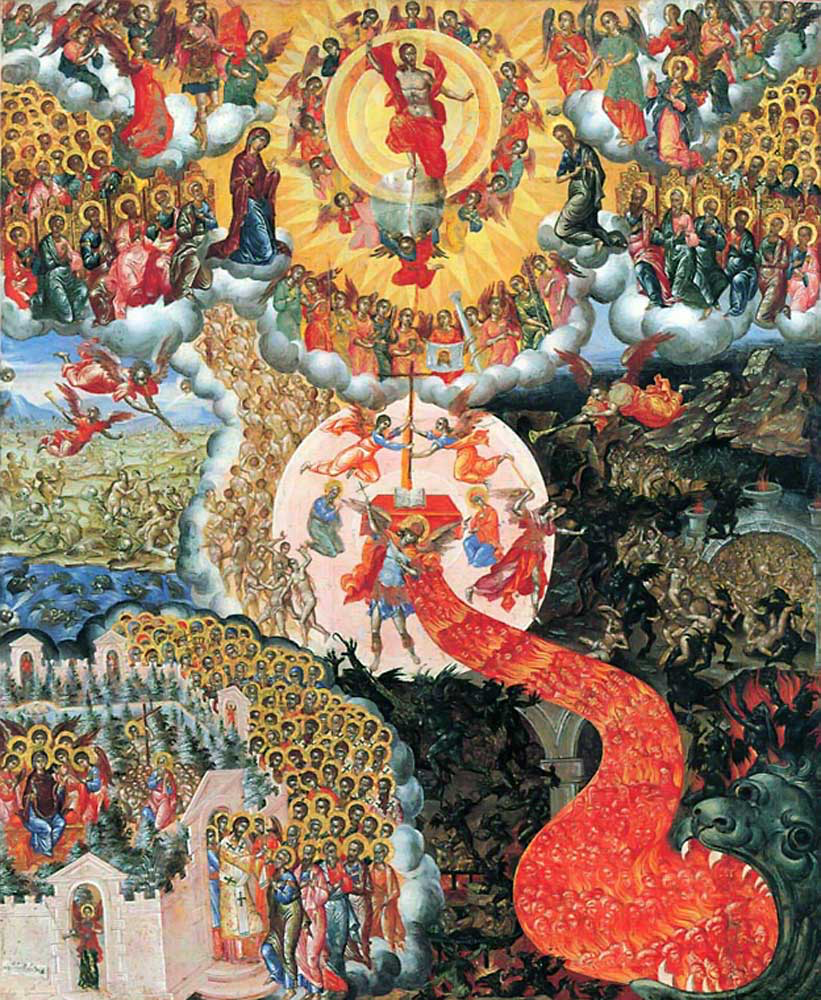
I saw a large angel in the fifth heaven. In his hand he held an iron rod. Three more angels accompanied him, and I gazed intently into their faces. They, however, were challenging each other, whips in their hands, pushing the souls forward to the judgment.
This scene reminds me of the Orthodox icons under the theme of “Last Judgment”, see example below (which is a Leos Moskos painting from 1653).
The Holy Spirit, Paul and the rest of the Apostles went into the sixth heaven, and there was another toll collector there. Paul commanded the collector to open the gateway to the seventh heaven for him, the Holy Spirit and the Apostles, which the collector obliged.
In the seventh heaven, Paul and the rest of the group come face to face with the Ancient of Days.
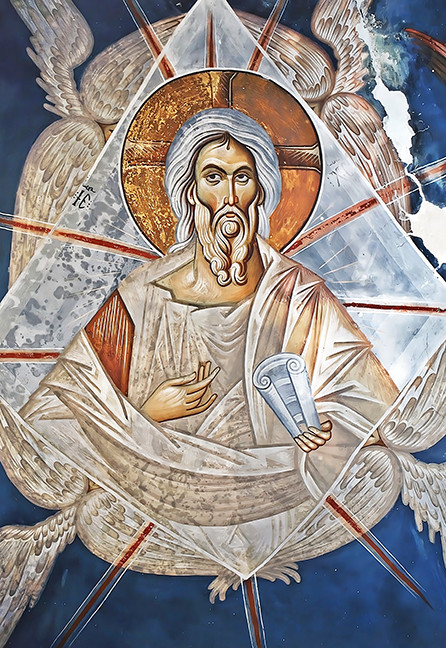
Who is the Ancient of Days? Well, it’s another name for the Godhead. This is referenced in Daniel 7:13-14. NIV translation:
13 “In my vision at night I looked, and there before me was one like a son of man,[a] coming with the clouds of heaven. He approached the Ancient of Days and was led into his presence. 14 He was given authority, glory and sovereign power; all nations and peoples of every language worshiped him. His dominion is an everlasting dominion that will not pass away, and his kingdom is one that will never be destroyed.
In Orthodox iconography, the Ancient of Days is pictured as a white haired Jesus. The Ancient of Days and Paul have this conversation:
The man, ancient of days, spoke and asked me, “Where are you going, O Paul, O blessed one, and the one set apart from his mother’s womb?”

I, however, gazed on the Spirit. And he was shaking his head, saying to me, “Speak to him!”

And in response I said to the man, ancient of days, “I go to the place whence I came.”

And the man, ancient of days, asked me, “Where are you from?”

I, however, said in response, “I descend to the world of the dead to lead captivity captive, that which was led captive in the captivity of Babylon.”

The man, ancient of days, spoke to me and asked, “How can you escape from me? Behold and look on the principalities and authorities.”

The Spirit spoke and said, “Give to him the sign you have, and he will open for you.” And I then gave him the sign. He turned his face down, towards his creation, and to those authorities who belong to him.
What exactly was this sign? No description is given. A secret password? If you’re familiar with the Book of Jeu (a text that will be highlighted in a future Toll house inspired post), you know that souls need to give a secret password to ascend to the next phase of their journey. Perhaps this was the same…? After this, the text mentions the seventh heaven opened and that the group went into the Ogdoad. This is a special celestial area beyond the seventh heaven. I’ll reference the wiki article below for those looking into that concept as it is not one I want to dive into with this post. The text ends with the group going to both the ninth and tenth heavens, and greeting fellow spirits in those heavens. Nothing of substance is mentioned along those two visits.
The Coptic Apocalypse of Paul is a short text but it’s quite fascinating with it’s encounters of toll collectors. I used the Samuel Zinner translation for my post and will link to the public domain version of this text below.
(featured photo is a Toll House icon from an unknown date, will update if I figure it out)
bP
Coptic Apocalyse of Paul translation: https://www.luminescence-llc.net/apocalypse-of-paul
Ogdoad wiki article: https://en.wikipedia.org/wiki/Ogdoad_(Gnosticism)
 Culmination of Wisdom