I wrote previously regarding one of the sayings in 2 Clement and it’s correlation to the Gospel of Thomas, but have decided to do a deep dive into all the sayings. There are quite a few quotes from Jesus in this writing that is attributed to Clement of Rome, but that attribution is questionable and most have deemed the author as “Pseudo-Clement.” Regardless, let’s take a look at this second century text and see where these Jesus quotes come from.
Our first quote comes from 2:1: Rejoice, thou barren that barest not. Break out and cry, thou that travailest not; for more are the children of the desolate than of her that hath the husband. This quote is from Galations 4:27, which states (ESV): “Rejoice, O barren one who does not bear; break forth and cry aloud, you who are not in labor! For the children of the desolate one will be more than those of the one who has a husband.” Which itself is a reference to Isaiah 54:1. “Sing, O barren one, who did not bear; break forth into singing and cry aloud, you who have not been in labor! For the children of the desolate one will be more than the children of her who is married,” says the Lord.
The next quote is from 2:4: I came not to call the righteous, but sinners. This comes from Luke 5:32 (ESV): I have not come to call the righteous but sinners to repentance.”
In 2 Clement 3:2 we get this quote: Whoso confesseth Me, Him will I confess before the Father. This comes from Matthew 10:32 (KJV): Whosoever therefore shall confess me before men, him will I confess also before my Father which is in heaven.
3:5 states: This people honoreth me with their lips, but their heart is far from Me. This comes from Matthew 15:8 (ESV): ‘This people honors me with their lips, but their heart is far from me; Which itself harkens to Isaiah 29:13: And the Lord said: “Because this people draw near with their mouth and honor me with their lips, while their hearts are far from me, and their fear of me is a commandment taught by men,
4:2 states: Not every one that saith unto Me, Lord, shall be saved, but he that doeth righteousness. This is in reference to Matthew 7:21 (ESV): “Not everyone who says to me, ‘Lord, Lord,’ will enter the kingdom of heaven, but the one who does the will of my Father who is in heaven.
4:5 states: Though ye be gathered together with Me in My bosom, and do not My commandments, I will cast you away and will say unto you, Depart from Me, I know you not whence ye are, ye workers of iniquity. This comes from Luke 13:27 (ESV): But he will say, ‘I tell you, I do not know where you come from. Depart from me, all you workers of evil!’
5:2 states: Ye shall be as lambs in the midst of wolves. This is comes from Matthew 10:16 (ESV): “Behold, I am sending you out as sheep in the midst of wolves, so be wise as serpents and innocent as doves.
In 5:3, it has Peter ask Jesus “What then, if the wolves should tear the lambs?”, and in 5:4 Jesus responds with: Let not the lambs fear the wolves after they are dead; and ye also, fear ye not them that kill you and are not able to do anything to you; but fear Him that after ye are dead hath power over soul and body, to cast them into the Gehenna of fire. The first part has no known reference, but the latter half comes from Matthew 10:28 (ESV): And do not fear those who kill the body but cannot kill the soul. Rather fear him who can destroy both soul and body in hell.
6:1 states: No servant can serve two masters. This is in reference to Matthew 6:24 (ESV): “No one can serve two masters, for either he will hate the one and love the other, or he will be devoted to the one and despise the other. You cannot serve God and money.
6:2 states: For what advantage is it, if a man gain the whole world and forfeit his soul? This is from Matthew 16:26 (ESV): For what will it profit a man if he gains the whole world and forfeits his soul? Or what shall a man give in return for his soul?
7:6 states: Their worm shall not die, and their fire shall not be quenched, and they shall be for a spectacle unto all flesh. This is in reference to Isaiah 66:24 (ESV): “And they shall go out and look on the dead bodies of the men who have rebelled against me. For their worm shall not die, their fire shall not be quenched, and they shall be an abhorrence to all flesh.”
8:5 states: If ye kept not that which is little, who shall give unto you that which is great? For I say unto you that he which is faithful in the least, is also faithful in much. This comes from Luke 16:10 (ESV): “One who is faithful in a very little is also faithful in much, and one who is dishonest in a very little is also dishonest in much.
9:11 states: These are my brethren, which do the will of My Father. Matthew 12:50 states (ESV): For whoever does the will of my Father in heaven is my brother and sister and mother.”
12:2 states: When the two shall be one, and the outside as the inside, and the male with the female, neither male or female. This is in reference to the Gospel of Thomas saying 22. I did a whole write up about this and can be read at: https://culminationofwisdom.org/2023/11/14/2-clement-gospel-of-thomas-22/
13:2 has two sayings. The first one is: Every way My Name is blasphemed among all the Gentiles This is in reference to Romans 2:24 (ESV): For, as it is written, “The name of God is blasphemed among the Gentiles because of you.” The second saying is: Woe unto him by reason of whom My Name is blasphemed This is referenced in the above reference but also in Isaiah 52:5 (NIV): “And now what do I have here?” declares the LORD. “For my people have been taken away for nothing, and those who rule them mock,” declares the LORD. “And all day long my name is constantly blasphemed.
13:4 states: It is no thank unto you, if ye love them that love you, but this is thank unto you, if ye love your enemies and them that hate you Luke 6:32 – 35 is the basis of this quote (ESV): “If you love those who love you, what benefit is that to you? For even sinners love those who love them. And if you do good to those who do good to you, what benefit is that to you? For even sinners do the same. And if you lend to those from whom you expect to receive, what credit is that to you? Even sinners lend to sinners, to get back the same amount. But love your enemies, and do good, and lend, expecting nothing in return, and your reward will be great, and you will be sons of the Most High, for he is kind to the ungrateful and the evil
14:1 states: My house was made a den of robbers. Matthew 21:13 (ESV): He said to them, “It is written, ‘My house shall be called a house of prayer,’ but you make it a den of robbers.”
15:3 states: Whiles thou art still speaking I will say, Behold, I am here. This is referenced in Isaiah 58:9 (ESV): Then you shall call, and the Lord will answer; you shall cry, and he will say, ‘Here I am.’
17:4 states: I come to gather together all the nations, tribes, and languages This one comes from the Revelation of John 7:9 (ESV): After this I looked, and behold, a great multitude that no one could number, from every nation, from all tribes and peoples and languages
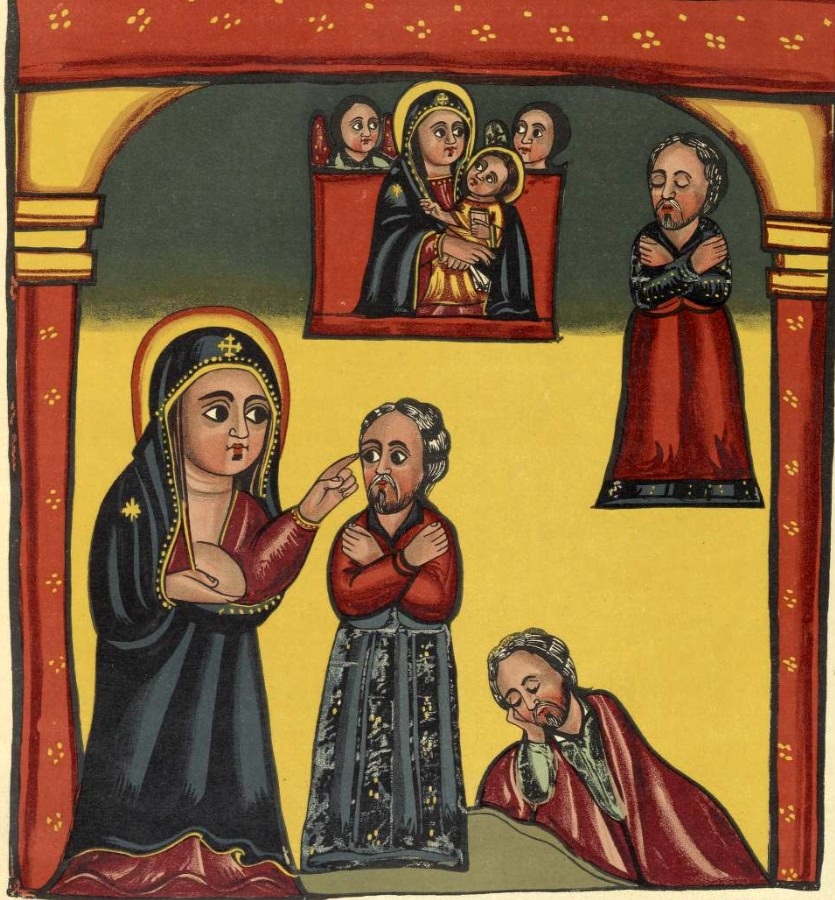
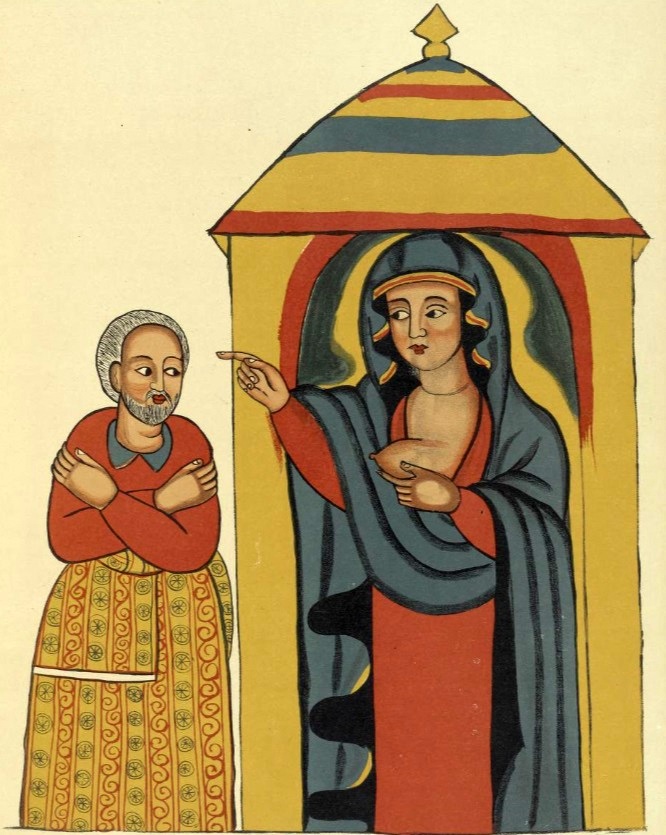
Here is an interesting tidbit regarding John the Baptist speaking of wanting a wife (and obtaining one, then having children) and on his own death; from the Mandaean tradition. This comes from the G.R.S. Meade book “Gnostic John the Baptizer”, which takes from the Mandaean Book of John, and I have included it in full since the translation is in public domain. I have updated some of the text to make it flow a little easier for the modern reader and added notes where needed.
YAHYA (John) proclaims in the nights and speaks: “The heavenly wheels and chariots quaked. Sun and Moon weep and the eyes of Ruha shed tears.” He says: “Yahya, thou art like to a scorched mountain, which brings forth no grapes in this world. Thou art like to a dried-up stream, on whose banks no plants are raised. Thou has become a land without a lord, a house without worth. A false prophet has thou become, who has left no one to remember thy name. Who will provide thee with provision, who with victuals, and who will follow to the grave after thee?” When Yahya heard this, a tear gathered in his eye; a tear in his eye gathered, and he spoke: “It would be pleasant to take a wife, and delightful for me to have children. But only if I take no woman,—and then comes sleep, desire for her seizes me and I neglect my night-prayer. If only desire does not wake in me, and I forget my Lord out of my mind. If only desire does not wake in me, and I neglect my prayer every time.” When Yahya said this, there came a Letter from the House of Abathur: “Yahya, take a wife and found a family, and see that thou does not let this world come to an end. On the night of Monday and on the night of Tuesday go to thy first bedding. On the night of Wednesday and on the night of Thursday devote thyself to thy hallowed praying. On the night of Friday and on the night of Saturday go to, thy first bedding. On the night of Sunday and (? yea) on the night of the Day devote thyself to thy hallowed praying. On Sunday, take three and leave three, take three and leave three. See that thou does not let the world come to an end.” Thereon they fashioned for Yahya a wife out of thee, thou Region of the Faithful. From the first conception were Handan and Sharrath born. From the middle conception were Birham and R’himath-Haiye born. From the last conception were Nsab, Sam, Anhar-Ziwa born. These three conceptions took place in thee, thou Ruins, Jerusalem. Yahya opened his mouth and spoke to Anhar in Jerusalem: “Instruct thy daughter, that she may not perish; and I will enlighten my sons and teach them, that they may not be hindered.” Thereon Anhar opened her mouth and spoke to Yahya in Jerusalem. “I have borne sons in this world,” said she to him, “yet have I not given birth to their heart in the world. If they let themselves be instructed, then will they ascend to Light’s region; if they let not themselves be instructed, then will the blazing fire consume them.”
Yahya (John) opened his mouth and spoke to Anhar (John’s wife) in Jerusalem: “If I leave the world, tell me, what will thou do after me?”—”I will not eat and will not drink,” she answered him, “until I see thee again.”—”A lie has thou spoken, Anhar, and thy word has come forth in deception. If a day comes and goes, thou eatest and drinkest and forgettest me out of thy mind. I asked thee rather, by Great Life and by the eve of the Day whose name is dear: If I leave the world, tell me, what wilt thou do after me?”—” I will not wash and I will not comb me,” says she to him, “until I see thee again.”—”Again has thou spoken a lie and thy word has come forth in deception. If a month comes and a month goes, thou washest and combest thee and forgettest me out of thy mind. Again did I ask thee, Anhar, by the first bed in which we both lie: If I leave my body, tell me, what wilt thou do after me?”— “I will put on no new garments,” she answers him, “until I see thee again.”—”Again has thou spoken a lie, Anhar, and thy word has come forth in deception. If a year comes and a year goes, thou puttest new garments on thee and forgettest me out of thy mind.” “Why dost thou not tell me all, Yahya,” says she to him; “and how sorely thou bruisest the whole of my body! If thou dost depart, when wilt thou return, that my eyes may fall upon thine?”—”If a woman in labour descends into Sheol and a bell is hung up for her in the graveyard. If they paint a picture in Sheol, and she then goes forth and they give a feast in the graveyard. If a bride parades round in Sheol, and they celebrate marriage in the graveyard. If the wedding-companions borrow in Sheol, and the paying-back takes place in the graveyard.” Then answered she him: “My lord, how shall it be that a woman in labour . . . “[and so on, repeating the above]. “If thou knowest,” he makes answer unto her, “that this does never happen, why does thou press me with asking: When does thou return? I go hence and return not. Happy the day when thou dost still see me. If there were a going-away and returning, then would no widow be found in this world. If there were a going-away and returning, then would no fatherless be found in the world. If there were a going-away and returning, then no Nazoræans would be found in the world.” Thereon Anhar opened her mouth and spoke to Yahya in Jerusalem: “I will buy thee for dear gold a brick grave and have a boxing of wood joinered together for thee in the graveyard.” But Yahya opened his mouth and spoke to Anhar in Jerusalem: “Why wilt thou buy a brick grave for dear gold and have a boxing of wood joinered for me in the graveyard? Art sure that I am returning, that thou does say: No dust shall fall on him? Instead of buying a brick grave for dear gold, go rather and share out for me bread. Instead of getting a boxing joinered together, go rather and read for me masses for the departed.” Thereon Anhar opened her mouth and spake to Yahya in Jerusalem: “Thou does go hence and forget me, and I shall be cut off in the Sinners’ Dwelling.” [But Yahya answered her:] “If I forget thee, may the Light Dwelling forget me. If I forget thee, may my eyes not fall on Abathur. If I ascend to Life’s House, thy wailing will arise in the graveyard.” Praisèd be Life, and Life is victorious.
On February 24 and 25 in the Orthodox tradition there are two feast days about discovering the head of John the Baptist (commemorating two different dates, and there is a third feast day for another finding later in the year; the head kept getting lost!). The head of John the Baptist is quite the fascinating relic and there are four places that claim to house the head, one place is Roman Catholic, another Eastern Orthodox, then a museum in Germany and an Islamic mosque! The head of John the Baptist has many legends associated it, particularly the Knights Templar. I may have to go down this rabbit hole at some point as they all are very fascinating! Today’s post is in regards to an apocrypha text titled “The Life of John the Baptist by Serapion“. The dating of the text is not known, it could be as early as the latter half of fourth century. The tradition is not known, perhaps Syriac or Coptic. I am not going to cover the entire text in this post, but rather just a section towards the end. This section relates to what happened after John was beheaded, and what the head actually did! It is quite the crazy tale. Just another piece of lore to add to the mysticism of John the Baptist’s head. I am using the English translation by Slavomir Ceplo in the New Testament Apocrypha: More Noncanonical Scriptures Volume 1. Since it is a newer translation, I will not provide the section in full but rather paraphrasing it. I highly recommend that volume (as well as 2 and 3) as those series of books contain very rarely read literature that are extremely fascinating.
The above piece of artwork is from 1876 titled L’Apparition and was painted by Gustave Moreau. I think it will fit quite well with this story!
After John was beheaded, it was handed to Herodias. The eyes of the head were still open and apparently the ears could still hear. Herodias starts cursing the head that lays in front of her, telling it she will pluck out it’s eyes, rip out it’s tongue and pull out all it’s hair. As she reaches towards the head to accomplish this, the head of the John spreads out all it’s hair and flies to the center of the room!! As it was floating in front of the king and his officials, the roof of the building opened up and the head flew out. The story then speaks of the three associated with John’s death and how they were disposed. As the head was flying off, Herodias’ eyes were pulled out from her head and the room (which had opened up for the head to fly away) fell upon the body of Herodias, at which time the floor of the building opened up. This swallowed Herodias to the depths of hell. Seeing all this, her daughter went mad. It states she went to a frozen lake to dance upon it, at which time the Lord broke the ice and caused her to fall in. Attempts to rescue her were futile, so they cut off her head with a sword, the same which had decapitated John. After this, a whale (?!) appeared and and spit out her body back onto the shore?!!? Just take a minute to process that. During all this commotion, Herod had suffered a stroke in front of the audience. All this took place immediately after the death of John. If you recall my post on the apocrypha tale “The Martyrdom of Zechariah“, those three meet a different ending, though not quite as graphic as this tale.
One of Herod’s men went down to the prison and quickly handed over the body of John to John’s followers, hoping nothing else would happen.
What happened with John’s head? It went and flew over Jerusalem for three years saying, over and over, “Herod, you may not marry the wife of your brother while he is still alive“. After three years, the head flew elsewhere throughout the world stating this same phrase, over and over. After making a fifteen year world tour, the head flew to the city of Homs (in Syria), where followers took the head and buried it, afterwards building a church over it.
I have featured Salome on my blog in the past, but wanted to share this Manichaean psalm. There are numerous psalms from the Manichaean faith, but in a particular group titled “Psalms of Thom(as)”, number 16 is titled “Salome built a tower.” I did not see this posted online elsewhere, so I want to share it here. I am pulling this translation from the 1938 book “A Manichaean Psalm Book: Part II” by Charles Robert Cecil Allberry. As far as I know, there is no other English translation available, at least in modern times. Some of the psalm is lost, so it will be represented with …… and there are some parts that may not have been translated properly. I have included as is:
Psalms of Thomas: 16
Salome built a tower upon the rock of truth and mercy.
The builders that built it are the righteous, the masons that hew stones for it are the angels.
The floor of the house is Truth, the beams of the roof are alms, faith is the …… the Mind is the …… of its door.
They that go into it rejoice, they that come out of it, ---- their heart seeks after gladness.
She built it and gave it a roof.
Salome gave a parapet to the tower, she took an anesh of storax to purify it, she took the ……. of incense into the palm of her hand…….. forth, she set it upon her head, she went into it, she called my Lord Jesus, saying ……. mayset thou answer me, Jesus, mayest thou hear me, for I am not double-minded, one is my heart and one my intention, there is no thought in my heart that is split or divided.
Garland me with the Brightnesses and take me up to the house of peace.
The governors and rulers, --- their eyes looked upon me, they wondered and marvelled that the Righteous belonged to a single Lord.
Love the symbolism in this psalm! Definitely gives one something ponder upon!
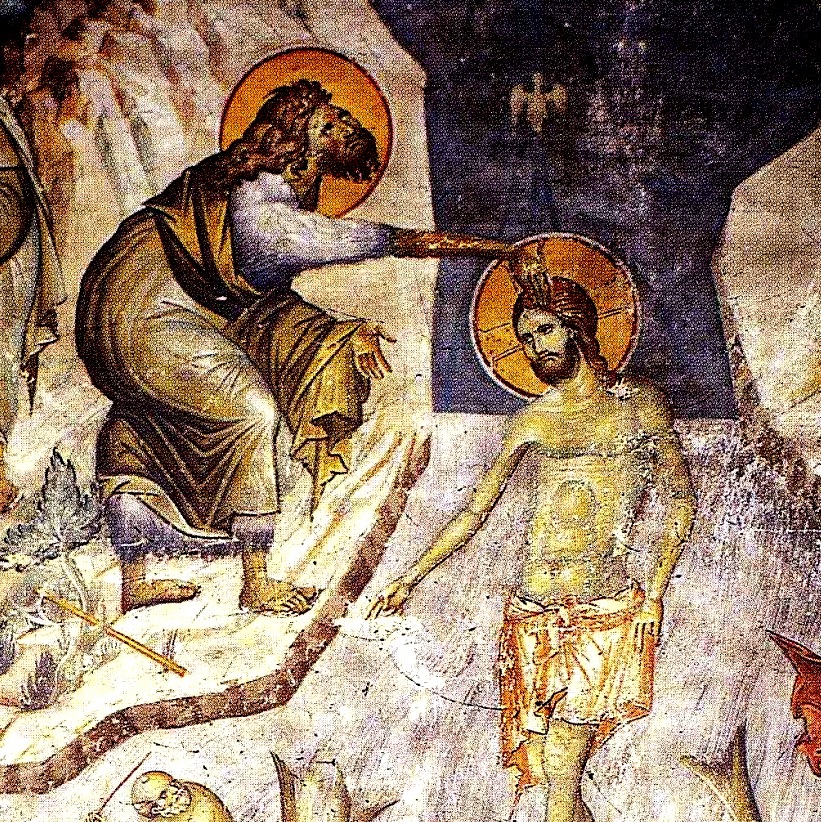
Today is the feast day of Theophany, which commemorates the baptism of Jesus by John. I present you with a different take on this event. This post, as well as more coming up, will feature Mandaean writings relating to John the Baptist. Mandaeism is the only “gnostic” religion to survive since antiquity without any downtime periods. If you are unaware of their practices, a quick google search will bring up what they are all about. What is interesting about the religion is their view of John the Baptist (as Messiah), but also that of Jesus. I am presenting you piece of Mandaean that relate between John and Jesus. Some choice words are to be had. This translation comes from G.R.S. Mead’s “The Gnostic John the Baptizer” book and I have left the translation as is without any “modernizing” it.
JOHN AND THE BAPTISM OF JESUS
Yahyā proclaims in the nights, Yōhānā on the Night's evenings.
YAHYĀ proclaims in the nights.—Glory rises over the worlds.
Who told Yeshu (Eshu)? Who told Yeshu Messiah, son of Miryam, who told Yeshu, so that he went to the shore of the Jordan and said unto Yahyā: "Yahyā, baptize me with thy baptizing and utter o'er me also the Name thy wont is to utter. If I show myself as thy pupil, I will remember thee then in my writing; I attest not myself as thy pupil, then wipe out my name from thy page," Thereon Yahyā answered Yeshu Messiah in Jerusalem: "Thou hast lied to the Jews and deceived the priests. Thou hast cut off their seed from the men and from the women bearing and being pregnant. The sabbath, which Moses made binding, hast thou relaxedin Jerusalem. Thou hast lied unto them with horns and spread abroad disgrace with the shofar."
Thereon Yeshu Messiah answered Yahyā in Jerusalem: "If I have lied to the Jews, may the blazing fire consume me. If I have deceived the priests, a double death will I die. If I have cut off their seed from the men, may I not cross o'er the End-Sea. If I have cut off from the women birth and being pregnant, then is in sooth a judge raised up before me. If I have relaxed the sabbath, may the blazing fire consume me. If I have lied to the Jews, I will tread on thorns and thistles. If I have spread disgrace abroad with horn-blowing, may my eyes then not light on Abathur. So baptize me then with thy baptizing, and utter o'er me the Name thy wont is to utter. If I show myself as thy pupil, I will remember thee then in my writing; if I attest not myself as thy pupil, then wipe out my name from thy page."
Then spake Yahyā to Yeshu Messiah in Jerusalem: "A stammerer becomes not a scholar, a blind man writes no letter. A desolate house mounts not to the height, and a widow becomes not a virgin. Foul water becomes not tasty, and a stone does not with oil soften." Thereon Yeshu Messiah made answer to Yahyā in Jerusalem: "A stammerer a scholar becomes, a blind man writes a letter. A desolate house mounts unto the height, and a widow becomes a virgin. Foul water becomes tasty, and a stone with oil softens." Thereon spake Yahyā unto Yeshu Messiah in Jerusalem: "If thou givest me illustration for this, thou art really a wise Messiah."
Thereon Yeshu Messiah made answer to Yahyā in Jerusaem: "A stammerer a scholar becomes: a child who comes from the bearer, blooms and grows big. Through wages and alms he comes on high; he comes on high through wages and alms, and ascends and beholds the Light's region.
"A blind man who writes a letter: a villain who has become virtuous. He abandoned wantonness and abandoned theft and reached unto faith in almighty Life.
"A desolate house who ascends again to the height: one of position who has become humble. He quitted his palaces and quitted his pride and built a house on the sea-shore. A house he built on the sea-shore, and into it opened two doors, so that he might bring in unto him whoever lay down there in misery,—to him he opened the door and took him within to himself. If he would eat, he laid for him a table with Truth, If he would drink, he mixed for him wine cups with Truth, If he would lie down, he spread a bed for him in Truth. If he would depart, he led him forth on the way of Truth. He led him forth on the way of Truth and of faith, and then he ascends and beholds the Light's region.
"A widow who a virgin becomes: a woman who already in youth has been widowed. She kept her shame closed, and sat there till her children were grown. If she passes over, her face does not pale in her husband's presence.
"Foul water that is made tasty: a girl wanton who has got back her honour: she went up a hamlet and she went down a hamlet without taking her veil from her face.
"A stone with oil softens: a heretic who has come down from the mountain.
He abandoned magic and sorcery and made confession to almighty Life. He found a fatherless and filled him full and filled full the widow's pockets.
"Therefor baptize me, O Yahyā, with thy baptizing and utter o'er me the Name thy wont is to utter. If I show myself as thy pupil, I will remember thee in my writing; if I attest not myself as thy pupil, then wipe out my name from thy page. Thou wilt for thy sins be haled to account, and I for my sins will be haled to account."
When Yeshu Messiah said this, there came a Letter out of the House of Abathur: "Yahyā, baptize the deceiver in Jordan. Lead him down into the Jordan and baptize him, and lead him up again to the shore, find there set him." Then Rūhā made herself like to a dove and threw a cross over the Jordan. A cross she threw over the Jordan and made its water to change into various colours.
"O Jordan," she says, "thou sanctifiest me and thou sanctifiest my seven sons."
Then follows what, from its animadversion on Christian institutions and especially on the use of the crucifix, is plainly a later addition. Rūhā is apparently still speaking; she is the Mother of all heresies.
"The Jordan in which Messiah Paulis was baptized, have I made into a 'trough.' The bread which Messiah Paulis receives, have I made into a 'sacrament.' The drink which Messiah Paulis receives, have I made into a 'supper.' The head-band which Messiah Paulis receives, have I made into a 'priest-hood.' The staff which Messiah Paulis receives, have I made into a 'dung-stick.'"
Gnosis of Life speaks:
"Let me warn you, my brothers, let me warn you, my beloved! Let me warn you, my brothers, against the . . . who are like unto the cross. They lay it on the walls; then stand there and bow down to the block. Let me warn you, my brothers, of the god which the carpenter has joinered together. If the carpenter has joinered together the god, who then has joinered together the carpenter?"
Praisèd be Life, and Life is victorious.
(For those who are not familiar with the atmosphere of bitter inner and outer theological strife of the times, it is as well to note that the last two pieces are in the form of haggadic controversy between the followers of John and Jesus respectively.)
Featured artwork is a 13th century iconography of the Theophany.
Those who study Christian history have heard of the Jewish historian, Flavius Jospheus and his mentions of John the Baptist, Jesus and James (brother of Jesus). I have read the Jesus and James mentions before, but I must admit, I never really read the John quotation. While reading through G. R. S. Mead’s Gnostic John the Baptizer: Selections from the Mandaean John Book, there was a section he presented of FJ’s mention of John. I am on a John the Baptist kick here lately (expect some posts in the future), so let’s start off with the selections that Mead provides in his book. There may be better translations out there now, as this writing is from the early 1900s, so keep that in mind.
I. JOHN'S PROCLAMATION AND HIS REBUKE OF THE AUTHORITIES. (Follows on B. J. II. vii. 2.)
Now at that time a man went about among the Jews in strange garments; for he had put pelts on his body everywhere where it was not covered with his own hair; indeed to look at he was like a wild man.
He came to the Jews and summoned them to freedom, saying: "God hath sent me, that I may show you the way of the Law, wherein ye may free yourselves from many holders of power. And there will be no mortal ruling over you, only the Highest who hath sent me." And when the people had heard this, they were joyful. And there went after him all Judæa, that lies in the region round Jerusalem.
And he did nothing else to them save that he plunged them into the stream of the Jordan and dismissed them, instructing them that they should cease from evil works, and promising that there would then be given them a ruler who would set them free and subject to them all that is not in submission; but no one of whom we speak (?), would himself be subjected. Some reviled, but others got faith.
And when he had been brought to Archelaus and the doctors of the Law had assembled, they asked him who he is and where he has been until then. And to this he made answer and spake: "I am pure; for the Spirit of God hath led me on, and I live on cane and roots and tree-food.”
But when they threatened to put him to torture if he would not cease from those words and deeds, he nevertheless said: "It is meet for you rather to cease from your heinous works and cleave unto the Lord your God."
And there rose up in anger Simon, an Essæan by extraction, a scribe, and he spake: "We read every day the divine books. But thou, only now come from the forest like a wild animal,—thou darest in sooth to teach us and to mislead the people with thy reprobate words."
And he rushed forward to do him bodily violence. But he, rebuking them, spake: "I will not disclose to you the mystery which dwelleth in you, for ye have not desired it. Thereby an untold calamity is come upon you, and because of yourselves."
And when he had thus spoken, he went forth to the other side of the Jordan; and while no one durst rebuke him, that one did what he had done also heretofore.
II. HIS INTERPRETATION OF PHILIP'S DREAM. (Follows on B. J. II. ix. 1.)
While Philip was still in possession of his dominion, he saw a dream,—how an eagle tore out both his eyes. And he summoned all his wise men. But when each interpreted the dream differently, there came to him suddenly, without being summoned, that man of whom we have previously written, that he went about in skins of animals and cleansed the people in the waters of the Jordan. And he spake: "Give ear to the word of the Lord,—the dream which thou hast seen. The eagle—that is thy venality; because that bird is violent and rapacious. And that sin will take away thy eyes which are thy dominion and thy wife." And when he had thus spoken, Philip died before evening and his dominion was given to Agrippa.
III. HIS PERSISTENT REBUKING OF AGRIPPA AND HIS EXECUTION. (Follows immediately on the preceding.)
And Herod, his brother, took his wife Herodias. And because of her all the doctors of the Law abhorred him, but durst not accuse him before his face. But only that one whom they called a wild man, came to him in anger and spake: "Why hast thou taken the wife of thy brother? As thy brother hath died a death void of pity, thou too wilt be reaped off by the heavenly sickle. God's decree will not be silenced, but will destroy thee through evil affliction in foreign lands. For thou dost not raise up seed for thy brother, but gratifiest thy fleshly lust and committest adultery, seeing that four children of him are alive." Now when Herod heard this, he was filled with wrath and commanded that they should beat him and drive him away. But he accused Herod incessantly wherever he found him, and right up to the time when he (Herod) put him under arrest and gave orders to slay him. Now his disposition (or character) was extraordinary and his mode of life not that of a man; indeed just like a bodiless spirit, thus did this one too continue. His lips knew no bread; not even at Passover did be taste unleavened bread, saying that, in remembrance of God who had freed the people from slavery, it was given for eating in the flight, for the way was in haste. To wine and intoxicating drink he let himself no even draw near. And every animal he abhorred as food, and every wrong he rebuked, and tree-produce served him for use.
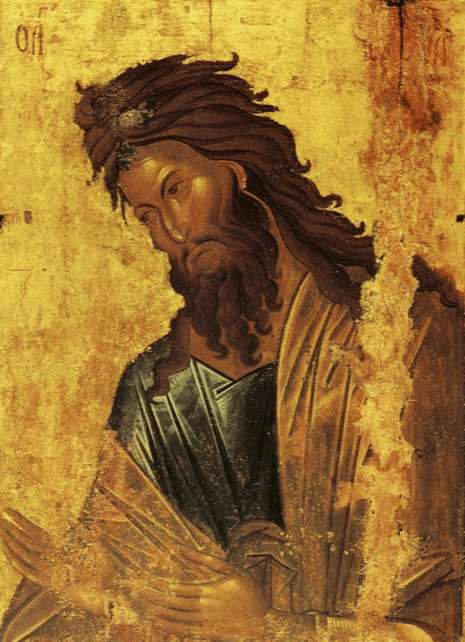
Featured artwork is iconography of John the Baptist, from the Hagia Sophia.
This is going to be my last “John” entry for awhile but this is a really interesting story. Some years back, an English translation of the “Evangelikon”, which accompanied a text titled the “Levitikon”, was published. What is this you ask? It is an alternate version of the Gospel of John. The manuscript was reportedly found by Bernard-Raymond Fabré-Palaprat in 1804 France. As far as I know, the other texts in the codex have not been published in English, but the version of John has, and that is what I will be going through. I am not going to talk about the history of the manuscript. I HIGHLY recommend just picking up this book. It is titled The Levitikon: The Gospels According to the Primitive Church, translated by Rev. Donald Donato of the Apostolic Johannite Church. Let it be known the person who discovered this text had started a Templar revival / Gnostic church in the early 1800s, and this text, along with others from that codex, was the basis of that movement.
So what is different between this version and the regular Gospel of John? Besides minor translation differences, there are quite a few. I may not catch everything with this comparison, but I’ll do my best.
The first major difference I spotted is in the second chapter. The Passover of the Jews verses are different. In the ESV translation, it states:
13 The Passover of the Jews was at hand, and Jesus went up to Jerusalem. 14 In the temple he found those who were selling oxen and sheep and pigeons, and the money-changers sitting there. 15 And making a whip of cords, he drove them all out of the temple, with the sheep and oxen. And he poured out the coins of the money-changers and overturned their tables. 16 And he told those who sold the pigeons, “Take these things away; do not make my Father's house a house of trade.” 17 His disciples remembered that it was written, “Zeal for your house will consume me.”
18 So the Jews said to him, “What sign do you show us for doing these things?” 19 Jesus answered them, “Destroy this temple, and in three days I will raise it up.” 20 The Jews then said, “It has taken forty-six years to build this temple, and will you raise it up in three days?” 21 But he was speaking about the temple of his body. 22 When therefore he was raised from the dead, his disciples remembered that he had said this, and they believed the Scripture and the word that Jesus had spoken.
23 Now when he was in Jerusalem at the Passover Feast, many believed in his name when they saw the signs that he was doing.
What I have in BOLD above, this is omitted in the Levitikon version. After finding the money changers, Jesus scorns them and they leave. The story jumps immediately to verse 23. In this aspect, it did not show a violent outburst towards the money changers. In fact, they co-operated and left. The Gospel of John has been criticized over the years for it’s anti-Semitic tone but the omission of this section changes that narrative, at least in this chapter.
In John 6, we have these two verses in the ESV translation:
42 They said, “Is not this Jesus, the son of Joseph, whose father and mother we know? How does he now say, ‘I have come down from heaven’?” 43 Jesus answered them, “Do not grumble among yourselves.
In the Levitikon version (LV), we have some extra verses in between 42 and 43. It is asked that since he (Jesus) has come from the Greeks, is this why he is allowed to converse with us. It is also asked if what Jesus learned among the Egyptians, and what their fathers had taught them, is he allowed to converse among them. After these two questions are posed, it goes back to the normal narrative. This implies that Jesus had travelled to foreign lands and learned from various Greek and Egyptian teachers. The canonical gospels leaves out what Jesus did after a short mention of his teenage years all the way through the start of his ministry (roughly 15 years). Did he travel to Greece and Egypt? This version would like you to believe that.
Another John 6 difference is the omission of Judas. In the ESV translation, it states:
66 After this many of his disciples turned back and no longer walked with him. 67 So Jesus said to the twelve, “Do you want to go away as well?” 68 Simon Peter answered him, “Lord, to whom shall we go? You have the words of eternal life, 69 and we have believed, and have come to know, that you are the Holy One of God.” 70 Jesus answered them, “Did I not choose you, the twelve? And yet one of you is a devil.” 71 He spoke of Judas the son of Simon Iscariot, for he, one of the twelve, was going to betray him.
In the LV, after Jesus mentions about choosing you twelve (J6:70), last part is omitted about one of them being the devil. Instead it mentions he (Jesus) receiving strength from above in order that he may teach in the Father and Holy Spirit, and that he gives them the power he has received from the Father and Holy Spirit, in the temple where the bread of eternal life is kept. Now this quite the departure. It’s a more spiritual ending to this chapter. It makes the Judas mentions feel like a tacked on ending.
John 7:15 is the following verse:
15 The Jews therefore marveled, saying, “How is it that this man has learning, when he has never studied?”
In the LV we have a small addition. After this phrase, before the question mark, there is mention of ‘except Greek letters’. This addition harkens back to the earlier addition where it mentions that Jesus had studied with Greeks and implies he can read / write in the Greek language.
While comparing the two versions, I noticed a foot note that in early manuscripts, John 7:53 & 8:1-11 are not mentioned in the earliest manuscripts of the text. Let it be know that the LV does include that section, so by historical placement of it’s authorship, that would seem to indicate it was produced later and not an earlier version.
John 13:36 – 38 is omitted in the LV. These verses foretell Peter’s denial of Christ three times before the crow of the rooster.
John 17:26 ends with:
26 I made known to them your name, and I will continue to make it known, that the love with which you have loved me may be in them, and I in them.”
However, the LV adds quite a bit after this. Jesus speaks on length about the Holy Spirit. He tells his disciples to teach what they have been taught by him, and that they will receive the Holy Spirit to continue this work. An interesting note is that it mentions that “John will be your father until he comes to be with me in Paradise”. Now which John is this? Traditionally the church has attributed the Gospel of John to John the Evangelist/Theologian. But the introduction to the LV, it presents that the Gospel of John is actually in reference to John the Baptist. Not as in the author of the book, but rather John being the one who is a main character of the story. John the Baptist is not executed in the Gospel of John like he is in other gospels, so is this the John that Jesus is referring to in this version?
J19:42 states:
42 So because of the Jewish day of Preparation, since the tomb was close at hand, they laid Jesus there.
That is the ending of the chapter in the canonical version, but in the LV, there is an extra line that states John the Disciple whom Jesus loved gives testimony to this scripture and encourages the reader to teach it, and thus ENDS the LV! Just like the original ending to Mark, there is no resurrection. There is no appearance to the apostles.
I highly recommend everyone purchase the book. To read it all in full with these alterations does present a slightly different feel to it. Now whether this is a legit alternate version or a medieval forgery, we will never know. But it is a fascinating curiosity!
Be sure to check out these links for a bit more information on the Levitikon:
Martha, sister of Mary (of Bethany) and Lazarus, is a well known secondary character in the Gospels of Luke and John. But has she appeared elsewhere in non-canonical sources? There are some Latin medieval tales (particular of the “Golden Legend” lore) but there are much earlier stories, those being from the Gnostic tradition! I have collected references to this famous myrrh-bearer and provided them below. There are some passages from various Church fathers that refer to Martha as a leader of various groups, but unfortunately no writings exist from those traditions. Hopefully one day something will come out that supports these claims.
While there is mention of Martha in The Gospel of Bartholomew and First Apocalypse of James, it’s the massive Pistis Sophia that supplies the material I have presented. I used the G.S.R. Mead translation for these quotes, but did slightly clean up the wording to make it an easier read for the modern reader.
Chapter 37:
She (Sophia) continued again and uttered the third repentance, saying:
“O Light of powers, give heed and save me. May they who would take away my light, lack and be in the darkness. May they who would take away my power, turn into chaos and be put to shame. May they turn quickly to darkness, who press me sore and say: We have become lords over her. May rather all those who seek the Light, rejoice and exult, and they who desire thy mystery, say ever: May the mystery be exalted. Save me then now, O Light, for I lacked my light, which they have taken away, and I needed my power, which they have taken from me. Thou then, O Light, thou art my savior, and thou art my deliverer, O Light. Save me quickly out of this chaos.”
Chapter 38:
And it came to pass, when Jesus had finished speaking these words unto his disciples, saying: “This is the third repentance of Pistis Sophia,” that he said unto them: “Let him in whom a sensitive spirit has arisen, come forward and speak the thought of the repentance which Pistis Sophia had uttered.”
Martha asked and received permission to speak. It came to pass then, before Jesus had finished speaking, that Martha came forward, fell down at his feet, kissed them, cried aloud and wept with lamentation and in humbleness, saying: “My Lord, have mercy upon me and have compassion with me, and let me speak the solution of the repentance which Pistis Sophia had uttered.”
And Jesus gave his hand unto Martha and said unto her: “Blessed is every one who humbled himself, for on him they shall have mercy. Now, therefore, Martha, are thou blessed. But proclaim then the solution of the thought of the repentance of Pistis Sophia.”
And Martha answered and said unto Jesus in the midst of the disciples: “Concerning the repentance which Pistis Sophia had uttered, O my Lord Jesus, of it thy light-power in David prophesied aforetime in the sixty-ninth Psalm, saying:
‘O Lord God, give heed to my help. Let them be put to shame and con-founded who seek after my soul. May they turn straightway and be put to shame, who say unto me: Ha, ha. May all who seek thee, be joyful and exult because of thee, and they who love thy salvation, say ever: May God be exalted. But I am wretched, I am poor; O Lord, help me. Thou are my helper and defense; O Lord, delay not.’
This then is the solution of the third repentance which Pistis Sophia hath uttered, singing praises to the height.”
Chapter 39:
It came to pass then, when Jesus had heard Martha speak these words, that he said unto her: “Well said, Martha, and finely.”
Chapter 57:
And Jesus continued again in the discourse and said unto his disciples: “It came to pass again thereafter that Pistis Sophia cried unto me, saying:
‘O Light of lights, I have transgressed in the twelve aeons, and have descended from them; wherefore have I uttered the twelve repentances, one for each aeon. Now, therefore, O Light of lights, forgive me my transgression, for it is exceedingly great, because I have abandoned the regions of the height and have come to dwell in the regions of the chaos.’
When then Pistis Sophia had said this, she continued again in the thirteenth repentance, saying:
“Hearken unto me singing praises unto thee, O Light of lights. Hearken unto me uttering the repentance for the thirteenth aeon, the region out of which I have come down, in order that the thirteenth repentance of the thirteenth aeon may be accomplished,–those aeons which I have overstepped and out of which I have come down. Now, therefore, O Light of lights, hearken unto me singing praises unto thee in the thirteenth aeon, my region out of which I have come down. Save me, O Light, in thy great mystery and forgive my transgression in thy forgiveness. And give unto me the baptism and forgive my sins and purify me from my transgression. And my transgression is the lion-faced power, which will never be hidden from thee; for because of it have I gone down. And I alone among the invisibles, in whose regions I was, have transgressed, and have gone down into the chaos. Moreover I have transgressed, that thy commandment may be accomplished.’
This then Pistis Sophia said. Now, therefore, let him whom his spirit urges to understand her words, come forward and proclaim her thought.”
Martha came forward and said: “My Lord, my spirit urges me to proclaim the solution of that which Pistis Sophia hath spoken; thy power hath prophesied aforetime concerning it through David in the fiftieth Psalm, saying thus: ‘Be gracious unto me, O God, according to thy great grace; according to the fulness of thy mercy blot out my sin. Wash me thoroughly from my iniquity. And may my sin be ever present to thee, That thou may be justified in thy words and prevail when thou judges me.’
This is then the solution of the words which Pistis Sophia hath uttered.”
Jesus said unto her: “Well said, finely, Martha, blessed one.”
Chapter 73
And when Mary had said this, the First Mystery said unto her, “Well said, finely, Mary, blessed one.”
And he continued again in the discourse and said unto the disciples: “Sophia again continued in this song and said: ‘The Light had become my savior. And it had changed my darkness into light, and it has rent the chaos which surrounded me and girded me with light.’
It came to pass then, when the First Mystery had finished saying these words, that Martha came forward and said: “My Lord, thy power has prophesied aforetime through David concerning these words: ‘The Lord had become my helper. He had changed my lamentation into joy; he had rent my mourning-robe and girded me with joy.'”
And it came to pass when the First Mystery had heard Martha speak these words, that he said: “Well said, and finely, Martha.”
Chapter 79
“And when Pistis Sophia had said this, she looked at the region of Adamas and saw the dark and chaotic region which he had made, and saw also the two dark exceedingly violent emanations which Adamas had emanated, in order that they might seize Pistis Sophia and cast her down into the chaos which he had made, and constrain and harass her in that region, until they should take her light from her. It came to pass then, when Pistis Sophia had seen those two dark emanations and the dark region which Adamas had made, that she feared and cried unto the Light, saying: ‘O Light, lo! Adamas, the doer of violence, is wrathful; he had made a dark emanation, And he had also emanated another chaos and had made another dark and chaotic one and made it ready. Now, therefore, O Light, the chaos which he had made, in order to cast me down therein and take from me my light-power, take then from him his own. And the plan which he had devised, to take my light,–they are to take his own from him; and the injustice which he had spoken, to take my lights from me,–take then all of his.’
These are the words which Pistis Sophia had uttered in her song. Now, therefore, who is sober in spirit, let him come forward and set forth the solution of the words which Pistis Sophia had uttered in her song.”
Chapter 80
Martha again came forward and said: “My Lord, I am sober in my spirit and understand the words which thou has said. Now, therefore, give me commandment to set forth their solution in openness.”
And the First Mystery answered and said unto Martha: “I give thee commandment, Martha, to set forth the solution of the words which Pistis Sophia had uttered in her song.”
And Martha answered and said: “My Lord, these are the words which thy light-power hath prophesied aforetime through David in the seventh Psalm, saying: ‘God is a righteous vindicator and strong and long-suffering, who brings not on his wrath every day. If ye turn not, he will whet his sword; he had bent his bow and made it ready. And he had made ready for him instruments of death; he had made his arrows for those who will be burnt up. Behold, injustice had been in labor, had conceived wrong and brought forth iniquity. It had dug a pit and hollowed it out. It will fall into the hole which it had made. Its wrong will return on its own head, and its injustice will come down on its pate.'”
When Martha had said this, the First Mystery which looked without, said unto her: “Well said, finely, Martha, blessed one.”
Those are the various quotes of Martha in the Pistis Sophia. As you can see, she is just applying various Psalms to the Repentance of Sophia stoy line. If I find more Martha quotes elsewhere, I will be sure to update this page. I may put up some of those medieval tales as well. One of which sounds pretty interesting, so we shall see….
This particular Coptic tale is quite interesting. It is an ascension text, but then dives into a question and answer narrative. John the Theologian/Evangelist is taken up into the heavens by Jesus. There, John is handed over to a Cherubim, whom he questions rigorously. There are some interesting dialogue that is presented here. I find the Eucharist dialogue to be really fascinating. The manuscript from which this story originates is dated to about 1000AD, though like texts of this nature, an earlier date is most probable. This is a decently length read, and like always, I “modernized” some of the wording to make it a bit easier to read for the modern viewer. The original translation was done by E. A. Wallis Budge in 1913.
ALPHA OMEGA JESUS CHRIST
THESE ARE THE MYSTERIES OF JOHN THE APOSTLE, THE HOLY VIRGIN, WHICH HE LEARNED IN HEAVEN. IN THE PEACE OF GOD. AMEN.
And it came to pass that when the Savior had risen from the dead, He came on to the Mount of Olives, and sat down. And He made a cloud to envelop all the countries wherein were the Apostles, and it gathered them together into the presence of the Savior upon the Mount of Olives. And John answered and said unto the Savior, “My Lord, behold Thou did say unto me: ‘Thou are My beloved one, and thou has found grace before Me.’ Now therefore, my Lord, I wish Thee to take me into heaven, and show me all the mysteries so that I may know them.” And the Savior made answer and said unto him, “John, enquire thou of Me fully, and I on My part will hide nothing from you. Rise up, and let us pray to My Father, Who is blessed, and He shall hear us.”
Then the Savior and the Apostle John rose up, and He prayed a long, blessed prayer. And when He had said ‘Amen’, the heavens moved away upon this side and on that, and they opened out one beyond the other even to the seventh heaven. And behold, a great Cherubim came out from heaven, and the whole place shone with bright light, and the whole of his body was full of eyes, and flashes of lightning shot out from him.
Then the Apostles became like unto dead men, and they fell down upon the earth through fear; but the Savior took hold of their hands, and raised them up, and removed the fear from them, and established their hearts for them. And John answered, “My Lord, explain to me the order of the Cherubim, which is exceedingly terrible.” The Savior made answer and said unto John, “Hearken unto Me, and I will show you everything. Thou sees the Cherubim. The words of the Father are hidden within him, from their beginning until their fulfillment. Behold, I will make him to come to you so that he may explain everything, O My beloved John.”
And the Savior turned Himself towards the Cherubim, and He said unto him, “I tell you to take My beloved John into heaven. And you shall explain onto him every question which he shall ask you.” Then straightway the Cherubim lifted up John upon his wing of light, and he bore him up unto heaven. And when he arrived at the first gate, the gatekeepers opened the door to him with readiness and fear. Now I, John, saw great mysteries in the First Heaven. I saw twelve men seated upon twelve thrones, within the great gate, in great glory and dignity. And I said unto the Cherubim, “Master, who are these who are seated in such majestic dignity?” The Cherubim said unto me, “See these twelve men? These are the twelve Rulers of the worlds of light, and each one of them rules for one year at a time; but Michael is he who orders their operations, so that the earth brings forth its fruit all the same.” And I said, “There does come a year sometimes when there is a famine in one place or another.” The Cherubim answered and said unto me, “Behold, I have shown you that which you did ask me.” And I answered and said unto the Cherubim, “My Lord, there comes a year when water is scarce, and yet there is plenty, and there comes a year when water is exceedingly plentiful, yet there is a famine; how is this?” The Cherubim answered and said unto me, “See thou that the water is under the feet of the Father? If the Father lifts up His feet, the water rises upwards; but if at the time when God is about to bring the water up, man sins against Him, He is wont to make the fruit of the earth to be little because of the sins of men. Now if at the time when He is about to bestow a little fullness, and men keep guard over themselves so as not to commit sin, the Father is wont to bless the earth so that it may bring forth fruit, and abundance comes through the supplication of Michael. It only men were to know of the supplications of Michael at the time when the water should come upon the earth, they would never commit sin at all. However, Michael takes with him twelve times ten thousand angels, and they go into the presence of the Father, and they cast themselves down before Him, and they do not rise up again until God sends the waters down upon the world.”
Then I answered and said unto the Cherubim, “I have heard one say that ‘God created the heavens and the earth’, and again, that ‘God created the waters from the beginning.'” And the Cherubim said unto me, “Hearken, and I will inform you concerning everything. Before ever God created the heavens and the earth, water was in existence, and there is no one whatsoever who knows anything about the creation of water except God Himself. For this reason whosoever shall take an oath which is false, in the name of water, shall never receive forgiveness. And whosoever shall take an oath which is false by the wheat-plant, shall also never receive forgiveness, for the same ordinance applies to both the water and the wheat-plant.”
And I said to the Cherubim, “My Lord, I wish that you would inform me concerning the matter of the wheat-plant, and tell me where, in the beginning, before the earth had been cultivated, it was found that man might live upon it.”
The Cherubim said unto me, “Hearken, and I will inform you concerning everything. Now it came to pass that God having created Adam placed him in the Paradise of joy, and He gave him a command saying thus: ‘Of every tree which is in Paradise thou shall eat, with the exception of the tree of knowledge of that which is good and of that which is evil; of that thou shall not eat. And on that day wherein thou shall eat thereof, thou shall certainly die.’ Now the Devil was jealous of Adam when he saw with what great glory he was surrounded. The Sun and the Moon, the two great luminaries, used to come daily and worship Adam before they rose above the earth. And the Devil went and led astray Adam and his wife, until at length they were cast forth out from Paradise; and they were banished to the land of Eueilat, where Adam lived a life of care and anxiety. Now after all these things, Adam was hungered, and he could not find food to eat similar to that which they were wont to eat daily in Paradise. And he cried out to the Lord in grief and in tribulation of heart. And the Son of graciousness, Who acted as sponsor for him, had compassion upon him, and He spoke unto His Good Father, the Lord of the Angels and of the Spirits, saying, ‘Behold, the man whom We have created in Our image and likeness is hungered, and I am sorrowful on his account, O My Father. Now, if it be Thy will, do not let him die before Thy face.’
And in this wise did His Father of Compassion answer and say unto His beloved Son, ‘If it be that Thou are moved with compassion for the man whom We have created, and who has cast My commandment behind him, go Thou and give him Thy flesh and let him eat thereof, for it is Thou who has undertaken to act as his advocate.’
And the Son of Goodness made answer and said unto His Father, ‘Blessed by Thy word. That which Thou has said I will do.’ Then the beloved Son came forth from the presence of His Good Father, and He took a little piece of His right side, of His divine flesh, and He rubbed it down into small pieces, and brought it to His Holy Father. His Father said unto Him, ‘What is this?’ And He said, ‘This is My flesh, according to what Thou did say unto Me.’ His Father answered and said unto him, ‘Yea, certainly, My Son. Wait, and I will give unto Thee some of My own flesh, which is invisible.’
Then His Father took out a portion of His own body, and He made it into a grain of wheat, and He brought forth the seal of light wherewith He set a seal upon the worlds of light, and He sealed the grain of wheat in the middle thereof. And He said unto His beloved Son, ‘Take this, and give Thou it unto Michael, the Archangel, and let him give it unto Adam, and let him tell Adam that he and his sons shall live thereon. And Michael shall teach him to sow it, and to gather it in at harvest.’ Then Jesus called Michael, and said unto him, ‘Take this grain, and give it unto Adam so that he and all his sons may live thereon.’ And Michael came to Adam, and he was on the Jordan, and it was the eighth day since he had eaten anything, and he was crying out to the Lord for food. And Michael said unto him, ‘Peace be to thee! The Lord has heard your prayer, and He has sent unto you a seed of grain.’ And when Adam heard these words from Michael, his body recovered its strength, and he came from the water, and cast himself down at the feet of Michael. And Michael gave unto him the grain which had been sealed with the seal of light, and he taught him how to sow it and to reap it, and he went up into heaven with great glory. Therefore the water, and the wheat-plant, and grain, and the throne of the Father stand in one category, and they are the equals of the Son of God.” Now I John saw these things, and I rejoiced when I had heard them.
And it came to pass after these things that the Cherubim raised me up upon his wing of light, and carried me into the Seventh Heaven, and I saw mighty miracles take place therein. I saw there all the ranks of the angels. The first rank contained the Seraphim, who were dressed in grain-plant, and they had golden censers in their hands, and they said, ‘Hallelujah!’ The angels in the second rank had golden phials in their hands, and they were filled with dew, and they were emptying them out on to the fields. Now Michael was the governor who was over them, and he appointed unto each one of them his work.
And I saw another great and wonderful thing. While I John was looking at the angels as they were all divided into ranks, I found that the name of Michael was written upon all their garments, and that the angels were crying out his name always. And I answered and said unto the Cherubim, “How does it come to pass that the name of Michael is written upon their garments? And wherefore do they cry it out?” And the Cherubim answered and said unto me, “No angel is allowed to come upon the earth unless the name of Michael is written upon his garments, for otherwise the Devil would lead them astray.”
After this I saw a great fountain of water, whereof the waters were as white as snow, or as I might say, its waters were like unto milk, and there was an angel standing above it, and his wings were dipped in the water. And the place round about the fountain was planted with trees which were laden with fruit, and the fruits thereof were of a very great many different kinds. And this fountain was like unto a sea, and every tree which grew by the side of it consisted entirely of one branch.
And I, John, saw another great and wonderful thing there. I saw the root of a tree which emitted water into the fountain. And I said unto the cherubim, “My Lord, explain to me the matter of this fountain, the water whereof is white, and the matter of this angel, which stands above it.” The Cherubim said unto me, “This is the fountain which pours out the dew upon the earth.” I said unto him, “How is it that this angel is standing above it, with his wings always dipped in the waters of the fountain?” The Cherubim said unto me, “See thou this angel? His work is this. Every time the trumpet sounds he rises up, and he shakes his wings which are full of dew, and he smites the heavens therewith, and the heavens open, one beyond the other, so that the dew may distil through them upon the earth.” And I said unto the Cherubim, “In what way do these Seven Heavens open, one beyond the other, so that the daylight may penetrate them and fall upon the world?” And the Cherubim answered and said unto me, “Hearken, and I will explain everything to you. There are seven trumpets appointed over the dew, and all these are wont to sound before the dew comes upon the earth. When the first trumpet sounds, and the second, and so on until the seventh, the dew follows the sound of the trumpets from one heave to the other. The seventh trumpet belongs to Michael, and when Michael blows his trumpet, the dew runs swiftly, and all the governors withdraw, until it comes upon the earth in order to make all the fruits to swell.”
Now, while I was marveling at these things, I saw another angel coming from a distance in wrath, and he stood up by the fountain which was filled with dew; he wept, and his eyes dropped blood into the fountain which was full of dew. For he was filled with wrath against all mankind, and the whole of the place trembled and shook when he stood up there. Then the heavens opened on this side and on that and everywhere, and I saw a great and mighty angel come forth from the heavens, and they called his name Michael, and he was girt about the lions with a girdle of gold. There was a sponge in his hand, wherewith he wiped away all the tears of the angel of wrath, and he drove the Angel of Wrath afar off, saying, “Get thee gone from this fountain, you Angel of Wrath, for you wish to bring a famine upon the earth.”
And I said unto the Cherubim, “My Lord, show me the matter of the Angel of Wrath whose eyes drop blood into the fountain.” He said unto me, “See thou Angel of Wrath? He is the Angel of Famine. If Michael were to cease from the wiping away of his tears of blood which he lets drop, and were to allow them to enter the fountain, the water thereof would come to an end and the dew which falls down upon the earth, and diseases and dissensions would break out, and the land would be smitten with famine.” And moreover, he said unto me, “There are forty legions of angels, each legion containing ten thousand angels, who sing hymns over the dew until it comes upon the earth, without any blemish at all in it.”
After these things he brought me to the Land of Eden. He placed me upon his wing of light, and he brought me to the place where the sun rises, by the side of the fountain which supplies water to the four rivers, Phison, Tigris, the Nile and the Euphrates. I saw the Paradise of joy, which was filled with all kinds of trees which bore fruits of all kinds. And I said to the Cherubim, “My Lord, I would like for thou to show me the tree whereof Adam ate, and became naked, and God was afterwards wroth with him.” The Cherubim answered and said unto me, “Thou asks a question which concerns great mysteries, but I will hide nothing whatsoever from you. Now therefore, rise up, set thyself behind me, and I will explain to you everything, and I will show you the tree of the fruit which Adam ate.”
Then I rose up and I followed him. I walked through the Paradise, and I looked round about, and I saw the tree in the middle of Paradise; now it had no fruit upon it, and thorns grew all over it, and the trunk went down into the ground a very long way. And I answered and said to the Cherubim, “Make me to understand the matter of this tree which has no fruit on it, and which is grown over with thorns.” And the Cherubim said unto me, “This is the tree of which Adam ate and became naked.” And I said unto him, “There is no fruit on it; where did he find the fruit which he ate?” And the Cherubim said unto me, “A kind of fruit did grow on it, and it was not without fruit at the that time.” And I said unto him, “Of what kind was its fruit?” He said unto me, “It was a kind of apple.” And I said unto the Cherubim, “Shall it remain wholly without fruit, or not?” And he said unto me, “This is the order which God laid upon it from the beginning.”
Now while I was marveling at these things, I saw Adam. He was coming along at a distance, and he was like unto a man who was weeping. He was spreading out his garment, and he was carrying away in his garment the leaves which were under the tree, and pouring them out on the ground, and burying them. And I said unto the Cherubim, “Why is Adam spreading out his garment, and putting in it the dried leaves which have been blown off the tree, and digging a hole in the ground and burying them therein?” And the Cherubim said unto me, “From the moment when the Devil entered into Paradise, and seduced Adam, and Eve his wife, the trees, which up to that time had possessed a sweet smell, ceased to have any smell at all, and their leaves began to fall off. And Adam used to dress himself in the leaves, and to make them be witnesses for him in the judgment because of what he had done.” Then I said unto the Cherubim, “My Lord, by what means did the Devil enter into Paradise, and seduce Adam and Eve? Unless this matter had been permitted by God he could not have entered in, for nothing can take place without the consent of God.”
Then the Cherubim said unto me, “Four and twenty angels are appointed to Paradise daily, and twelve go in there daily to worship God. Now at the moment when the Devil went into Paradise, and seduced Adam, there was no angel at all in Paradise, but an agreement took place that they should remain outside it until Adam had eaten of the tree.” And I said to the Cherubim, “If they agreed to this, with the consent of God, then no sin rests upon Adam.” And the Cherubim said unto me, “By no means. If Adam had been patient for a short time, God would have said to him, ‘Eat of the tree.’ God removed the righteousness wherewith he was arrayed, and He cast him forth from Paradise, in order that the things which He spoke might be fulfilled when He should send His Son into the world.”
And I said unto the Cherubim, “My Lord, of what kind was this righteousness wherein Adam was arrayed, and which he received from His hand?” And the Cherubim said unto me, “On the day wherein God created Adam, Adam was twelve cubits in height, and six cubits in width, and his neck was three cubits long. And he was like unto an alabaster stone wherein there is no blemish whatsoever. But when he had eaten of the fruit of the tree, his body diminished in size, and he became small, and the righteousness wherein he was arrayed departed and left him naked, even to the tips of his fingers, that is to say, to his very nails. If he was not cold in the winter, he was not hot in the summer.”
And I answered and said unto the Cherubim, “My Lord, at the time when God created Adam, He also created Eve with him from the heavens. But, on the other hand, I have heard that God created Adam and Even from the beginning, and, again, I have heard that God brought a deep sleep upon Adam, and that when he was unconscious, He took one of the ribs from his side, and made it into a woman, and that He filled up the place where the rib was in his side with flesh. The Almighty did not then create two bodies, there being only one body.” And the Cherubim answered and said unto me, “Hearken, and I will explain unto you everything. At the time when God created Adam, He created Eve also with him, in one body, for at the time when the Master was working on Adam, the thought concerning Eve was with Him. For this reason two bodies came from one body, but He did not separate them from each other immediately. At the time when He brought slumber upon Adam, and Adam fell asleep, and slept heavily, He brought Eve forth from him, and she became his wife. She was, of a surety, hidden in the rib of the left side of Adam from the day wherein God created him. Consider, then, with great attention the sign which is in the sons of Adam.”
And I said unto the Cherubim, “O my Lord, what is the sign which is in the sons of Adam?” And the Cherubim said unto me, “At the moment when the ice was about to come upon the earth, the first things which went cold in the body of the man were his finger nails. Because at the time when God deprived Adam of the righteousness wherein he was arrayed, the first things which grew cold were his finger nails. And he wept, and cried out to the Lord, saying, ‘Woe is me, O my Lord. At the time when I kept the commandments of God, and before I did eat of the fruit of the tree, my whole body was white like my nails.’ For this reason every time Adam looked upon his nails, he used to cry out and weep, even as Hezekiah, when he was sick, used to turn towards the wall, and weep.”
And I answered and said unto the Cherubim, “When Hezekiah was weeping, why did he not look at the man instead of a wall?” And the Cherubim said unto me, “Hearken, and I will make everything manifest to you, O faithful virgin. Now it came to pass in the time of Solomon that the king compelled all the demons to describe to him all the various kinds of sicknesses, and the remedies which were to be employed in healing them all, and the various kinds of herbs which must be used in relieving the pains of sicknesses, and Solomon wrote them all down upon the wall in the House of God. And any man who was attacked by a sickness, no matter of what kind, used to go into the temple, and look upon the wall, until he found there written the remedy which was suitable for his sickness; then he would take that remedy, and would go into his house, ascribing glory to God. And it came to pass that, after Solomon the king was dead, Hezekiah plastered over the walls of the temple with lime, and the prescriptions for the relief of sickness could no longer be found. Now when Hezekiah the king had fallen sick, and was sick unto death, he could not find the prescription whereby to heal his sickness, because it was he himself who had plastered over the walls of the temple with lime. And when the prescriptions which had been written upon them could not be found again, he went into the house of the Lord, and lay down there, and he looked upon the wall, and he wept, saying, ‘My Lord, let not that which I have done in the matter of plastering over with lime the walls, whereon were inscribed the prescriptions for healing, be held to be a sin by Thee, for I said, Let men make supplication to God with hope, and they shall find healing. Never shall I find a prescription for healing whereby I may be made whole.’ And the Lord heard him, and had compassion upon him, and sent unto him Isaiah the Prophet, and he spoke to him, saying ‘Take the fruit of the wild fig tree, and plaster it over your body, and you shall find relief.’ Now therefore, O John, God will never forsake the man who performs his commandments.”
And again I said unto the Cherubim, “My Lord, I would that you did make me understand the matter of the Cherubim, whose voices cry so loudly in heaven that mankind tremble upon earth at the sounds from them.”
And the Cherubim said unto me, “Do you see these great winds which are shut up inside their storehouses, over which the angels are set? When the trumpet sounds inside the veil, the gentle winds come forth, and they breathe upon the wings of the angel who is over the fountain of the dew; then the angel moves his wings, and the dew comes upon the earth, and the seed grows in the earth, and the trees, and the crops, and the fruit. If the trumpet does not sound, a harsh, strong noise comes forth from heaven, and thereupon the waters of rain come upon the earth in great quantities, which make the fruits grow, and rain storms, and thunders of which men are afraid. For it is the sound of the rustling of the wings of the Seraphim which governs the waters of rain, until they come down into the firmament; and they fall on the earth gently, for if they were to descend upon the earth in their full violence they would lay waste the earth just as did the waters of Noah and the lightnings which came with them. This would happen if the Seraphim did not come down to govern the waters of the rain, for all the waters are in the sky and the heavens. Behold, I have made clear to you all the mysteries.”
And I answered and said unto the Cherubim, “My Lord, I would that you did make me to know what it is which supports the sky and makes it to be suspended thus.” And the Cherubim said unto me, “It is suspended by faith, and by the ordinance of God.” And I said unto the Cherubim, “What is it that supports the earth?” And the Cherubim said unto me, “It is four pillars which support the earth, and they are sealed with seven seals.”
And I said unto him, “My Lord, be not wroth with me when I ask you this matter also, show me, what is it that bears up the four pillars?” And the Cherubim said unto me, “He Who created them knows what appertains to them.” And I said unto the Cherubim, “My Lord, what is the ordinance concerning the hours of the night and day?” He said unto me, “Hearken, I will show you. God appointed twelve Cherubim to stand outside the inner veil, and they were not to toil in any way, but were to sing twelve hymns daily. When the first Cherubim had finishing singing his hymn, the first hour came to an end. When the second Cherubim had finished singing his hymn, the second hour came to an end, and so on until the twelfth Cherubim. When the twelfth Cherubim had finished singing his hymn, the twelve hours were ended.”
Then I said to the Cherubim, “As concerning the twelve hours of the night: are there Seraphim appointed over them, or not?” And the Cherubim said unto me, “Assuredly not, but when the beasts, and the birds, and the reptiles pray, the first hour is ended. When the second hour is ended, the beasts pray again, and so on until the twelfth hour of the night; it is the animals of God which set limits to them.” And I said unto the Cherubim, “Does the sun know when the twelve hours have come to an end, so that he may depart to the place where he sets or rises?” And the Cherubim said unto me, “When the angels who blow the trumpets have finished, Michael knows that the twelfth hymn is finished, and he speaks to the Angel of the Sun, who goes and brings to an end his course.”
And I answered and said unto the Cherubim, “My Lord, is it God Who ordains the life of a man from the time when he was in his mother’s womb, or not?” And the Cherubim said unto me, “Know thou that one man is wont to perform very many superfluous works, and another very many acts of goodness, from the time when he is born to the end of his life. God, however, sets a sign on the righteous man before He fashions him, for it is impossible to cause anything to happen without God. But sin is an alien thing to God, for He Who created man was without sin. It is man who himself commits sin, according to his wish, and according to the desire of the Devil.”
And I said unto the Cherubim, “Man has been born to suffering, according to what Job said, ‘My mother brought me forth for suffering.’ ” And the Cherubim said unto me, “God is a compassionate Being, and He does not forsake man utterly, but He shows mercy upon him, for he is His own form, and His own image, and is the work of His own hands. And now, O John, He will not forsake him that does the will of God, and he who does good things shall receive them doubled many times over in the House of God.”
And I said unto the Cherubim, “My Lord, at the moment when God is about to create man, does He give him the name ‘righteous’ or ‘sinner’, or not?” And the Cherubim said unto me, “Hearken, and I will show you. At the moment when God is about to create a man, before He places him in the womb of his mother, He calls all the angels, and they come and stand round about. If the Father blesses the soul, the angels make answer ‘Amen’. If there come from His mouth the words, ‘This soul shall give Me rest,’ the angels make answer ‘Amen’. If the Father says, ‘This soul shall commit iniquity,’ the angels make answer ‘Amen’. Whatsoever comes forth from the mouth of the Father, that comes to pass.” And I said unto the Cherubim, “Is the matter of which man is fashioned more excellent than that of the beasts?” The Cherubim said unto me, “Yes. Now when men die, each one of them is taken to the place of which he is worthy, but so far as beasts are concerned, whether they die, or whether they live, their place is the earth.”
And I said unto the Cherubim, “Are there souls in them?” He said unto me, “Every created thing has a soul in it. Now therefore, the soul of every created thing is its blood.” And I said unto the Cherubim, “Will they then be punished, or will rest be given unto them?” He said unto me, “Let it not be that rest be not given unto them, and let them suffer not; but man is a being who can suffer, and can enjoy rest.”
And it came to pass that when I had heard all these things, I marveled at the works which God performs in connection with man. And I said unto the Cherubim, “My Lord, be not wroth with me if I ask this matter also. I would that thou did inform me concerning the stars which we see in the firmament, and tell me why it is that we cease to see them when the sun has risen. I would that thou did inform me where it is they go until it is time for them to perform their service again.” And the Cherubim said unto me, “The stars are of different orders. There are some stars which remain in the heavens until noon, but they cannot be seen because of the light of the sun. There are seven stars which come in the north of the world, and they remain there in the heavens always. And there are seven stars in the heavens which are called:
those which are there are not permitted to emerge from their place of storehouse, except when death comes upon the earth.”
And I said unto the Cherubim, “Why is it that one star differs from another? And why is it that a star is wont to transfer itself from the place which it had originally to another?” And the Cherubim said unto me, “Hearken, and I will make known unto you everything. There are very many orders of stars which move from the place wherein they were placed originally, but the decree of God which directs them abides forever. Behold now, I have made manifest unto thee all things, O beloved one of God. Arise, get thee down into the world, and tell therein everything which you have seen.”
Then straightway the Cherubim brought me down on the Mount of Olives, where I found the Apostles gathered together. And I told them of the things which I had seen, and when we had saluted each other, each departed to his country, ascribing glory to God. And they preached in the Name of the Christ, through Whom be glory to Him, and His Good Father, and the Holy Spirit forever. Amen.
Featured artwork: Orthodox iconography of a Cherubim
Jesus and John on a cloud, made with Midjourney A.I.
I guess I have Saint John on my mind as I have yet another post on him (and a few more in queue!). My last post was an Ethiopic version of the death of John, this time I have a Coptic tale of this event to share. The manuscript of this story dates to about 990AD. I am not sure of when the story was originally written, so like the previous one, you’ll just have to go with it. And as usual, I use E.A. Wallis Budge’s translation (from 1913) as my basis in this transcription, but have updated some of the words to make it a bit easier to read for the modern viewer.
THE REPOSE OF SAINT JOHN THE EVANGELIST AND APOSTLE OF THE CHRIST. IN THE PEACE OF GOD. AMEN.
The blessed John was in Ephesus with the brethren, rejoicing in the Lord. Now on the first day of the week all the brethren were gathered together, and John began to speak to them, saying “My brethren, my fellow heirs, and my partners in the Christ Jesus, our Lord, know that unto you hath the Lord given from His hand power, and that he had wrought for you very many mighty works, and miracles, and acts of grace. And you know of what kind are the teachings, and the guiding directions, and the refreshing, and the service, and the gracious acts, and the gifts, and all the other things which you see with your eyes, which are given unto you from the hand of our Master. He had never made Himself manifest unto you through the eyes of the body, neither have you hearkened unto Him through the ears of the body, but He had made Himself visible unto you through the integrity of your heart, and by visions, and by works which are holy. Strengthen yourselves, then, in Him, and you shall remember Him at all times; moreover, you shall also remember the mystery and the association which had come unto you, and which our Lord had fulfilled.
And now, O brethren, He made supplication to you through Himself, and He appealed unto you, wishing to make you to cease to grieve Him over much, or to despise Him, or to conspire against Him, for He knows the despising which takes place through you. He knows also the reviling, and He has knowledge of the treachery, and the punishment wherewith you punish Him. When you shall hearken unto His holy commandment to obey it, He will show compassion upon you. Do not make to grieve through you the Good God, the Merciful, the Long-suffering, Him Who is without spot, Him Who is without blemish, the Ineffable, the God Who is One alone, the Unchanging One, Him Who is without guile, Him Who is without wrath, the Name which is above every name which men can comprehend. Let Him but rejoice with you, and you enjoy free and happy citizenship with Him. Let Him but have gladness with you, and you live in happiness and innocence. Let Him but repose in your hearts, and you are turned into beings who rejoice in holiness of life. Let Him but show Himself unmindful of you, and you must live in painful restraint. Let Him but have pleasure in you, and you become participators in good things and in the things which are offered to Him. Let Him but live delicately, and you love Him. Let Him but laugh, and you become ready to follow Him.
I say these things, then unto you, O my brethren, because I hasten to embark on a certain matter which has been laid upon me, and of which the completion shall be unto me by the help of God. For of what kind is the other matter which I shall say unto you, there being for you the pledge of your God? There is for you the pledge of His kingdom, there is for you His presence, which cannot be entreated. If you cease from the habit of sinning from this time onwards, then the deeds which you have committed through want of understanding He will remit to you; but if even after you have had knowledge of Him you continue and persist in the doing of these same works, they shall first of all try you in the judgment, and then they shall deliver you over to the fire.”
Having said these things, Saint John prayed, saying, “Jesus, who did weave the crown which was in Thine own garland. O Thou Who did make the crown of all the saints, and these plants which are of many kinds, and has changed men into Thy flowers which do not wither and fade! O Thou Who has spoken Thy words in our hearts! O Thou Who alone does have a care for Thy servants! O Thou Physician of our bodies, Who does heal them all for nothing! O Thou Who alone does do good unto us! O Thou in Whom there is no pride whatsoever! O Thou Who alone are the Compassionate, and are the Lover of all mankind! O Thou Who alone are the Savior, and the Righteous One, Who exists in every place, Who has existed from everlasting, God, the Christ Jesus! Thou are He Who shelters everyone who puts his hope in Thee, with Thy gift, and with Thy compassion. Thou knows every wile and every craft deed of the Enemy who does wage war against us at all times.”
And when Saint John the Evangelist had made an end of saying these words, he took bread, and he gave thanks unto God in this manner, saying, “What other blessing is there? Or what other word can be spoken? Or what other giving of thanks is there which we can pronounce over this bread which we break, except Thou alone, the Lord Jesus, the Christ?
We ascribe glory unto Thee, O Lord Jesus the Christ, Whose Name has been made manifest by the Father. We ascribe glory unto Thee because of Thy coming in through the door. We ascribe glory unto Thee for Thy holy resurrection from the dead, which has been made know unto us through Thee. We ascribe glory unto Thee, the Way. We ascribe glory unto Thee, the Seed, the Word, the Salt, the True Gem, the Holy Storehouse, the Plough, the Net, the Majesty, Who was sent for the sake of us, the children of men, that He might deliver the race of man. We ascribe glory unto Thee, the Truth, the Rest, the Glory, the Might Power, the Commandment, the Boldness of speech, the Freedom, and our place of refuge.
For Thou are the Lord, the Root of immortality. Thou are the Fountain which cannot be destroyed. Thou are the Strength which endues throughout the Ages. Thy Name has been set upon all these things here, so that we also may make our cry unto Thee through them. For we know Thy Majesty which is invisible, and which does not make itself manifest unto us at this time. When Thou shall have purified us, then we shall see Thee alone in the body which Thou has changed from oldness into newness.”
And as John was breaking the bread, he prayed over each one of his brethren, so that they might be worthy of the Grace of the Lord. Similarly Saint John himself, when he tasted the bread, prayed for himself. John the Theologian spoke after this manner saying, “Let me, even me, have a portion with you, O my beloved.”
Then he said to Pyrrhus, “Take with you two brethren, and let them have baskets in their hands, and digging tools, and follow me.” Now Pyrrhus was not by any means neglectful, and he did according to what he had been commanded by Saint John the Theologian, and the servant of God. And when the blessed John had come forth from his house, he went outside the gate of the city, and he gave orders that the exceedingly great multitude, which were following him and pressing upon him, should be made to withdraw, and to depart from him. And when he had arrived at a place in the region wherein were the tombs, he said to the brethren, “My sons, dig a grave in this place,” and those who were there dug down into the ground. Then John the Theologian was commanding them saying, “Dig the grave very deep.” And he was saying, “Dig down much deeper”; and those who were there dug down deeper still. And he spoke with them, and addressed words to them, and encouraged them, and counselled them unto edification, and he instructed them, and he persuaded them to enter into the Kingdom of God. And he prayed over each one of them.
Now when the young men had finished making the grave in the place wherein they had dug it, they arranged everything connected therewith in a seemly manner, according to what Saint John wished. Now we had no knowledge whatsoever of what he was about to do. Then he took off the clothes which were upon him, and having stripped them off himself, he threw them down into the place which they had dug deep in the ground, and which was in the form of a chamber which spread out. Then John stood on his feet – now the only garment which he had on him was a tunic which came down on both sides – and having spread out his hands he prayed thus saying, “O Thou God, Who has chosen me for Thyself to be an Apostle to the heathen, and has sent me forth into the world, Who has made manifest the Prophets and His Apostles, Who has never ceased from doing that which is good since the foundation of the world, Who delivers everyone who has no strength, Who has made Thyself to be apprehended by every man of reason, unto Whom every living thing ministers through His foreknowledge, Who did make our soul to have longings, and does make it to be tranquil, or solitary and savage, Who does Thyself make it to laugh to scorn its enemy, Who did fashion it like unto Thyself when it was dead, Who did make for it a law which it could distinguish in the abyss of lawlessness, Who did make it to vanquish its enemy by causing it to flee from him; Who did give it Thy hand and did deliver it from Amente; Who did not leave it to become a citizen of this world, who did teach it to escape from its enemy; who did make Thy knowledge to illumine every place; Thou Son of God, Thou Savior, Thou Lord, Thou Orderer of the things which are in the celestial heights, Thou Guardian of the things which are on the earth; Thou Grace and Gladness of those who belong to Thee; receive Thou the soul of John, which belongs to Thee, for it is Thou Who has kept me up to this hour, and I have never at any time polluted myself with women.
Thou did appear unto me at the time when I was wishing to marry a wife in the period of my youth, and Thou did say unto me, ‘John, I have need of you.’ Thou did in the beginning act as the steward of my body, when the desires caused by the sicknesses of the body arose, and it was Thou Who did prevent me from gratifying them on many occasions when I was wishing to marry a wife. Afterwards Thou did speak to me at the third hour of the day on the sea, saying, ‘John, if it be that thou does not in truth belong to Me, I will withdraw Myself from thee. Take thou a wife, and you shall make yourself to become blind in both my eyes; thou shall suffer grief, then thou will pray unto Me.’ Thou it was Who did open my heart three times in the same year, and Thou did graciously bestow upon me other eyes, which did not make themselves visible. Thou it was Who did make the joyful expectation of the contemplation of women to become to me an abomination. Thou it was Who did deliver me from a fleeting fantasy, and did keep me for the life which endures forever. Thou it was Who did make me to become a strange to the madness of evil which arises in the flesh, and did make me to be remote from the death which is bitter. Thou it was Who did deliver me from the second death, that is to say, the Gehenna of fire, and di make me to stand up, being a pure man. Thou it was Who did stop the mouth of the disease which appertained to my soul, and did prevent the committal of the act which appertained thereto, or rather the outward and manifest works which are wont to be performed by the body. Thou it was Who did deliver me, and did cast out from my heart that which disturbed me sorely. Thou it was Who did prepare me to come unto Thee in a state of holiness. Thou it was Who did make my thoughts concerning Thee to be unpolluted. Thou it was who did graciously grant unto me the faith in Thee which was undivided. Thou it was Who did make my thoughts and my counsels to incline ever more and more towards Thee. Thou does give unto each man according to his works. It was Thou who did deposit in my soul the intention not to permit anything whatsoever except Thyself to enter into me. For what can I find which is more choice ore more pure than Thee? And now I have found Thee. And I have fulfilled the stewardship which Thou did commit to me; make me therefore worthy to enjoy rest in Thy holy repose. Do thou bestow upon me graciously the perfection which is in Thee, that is to say, the sinlessness and the salvation, which cannot be described, and which cannot be pried into, and which are beyond the comprehension of man. I come unto Thee, my Lord Jesus, the Christ. Let the fire die down, and let the darkness withdraw itself, and let Chaos become helpless, and let the furnace of blazing fire be without power, and let Gehenna be extinguished, and let the holy angels accompany me, and let the demons shake with fear. Let the holy angels would the Principalities, and let the Powers of darkness withdraw themselves and fall down headlong. Let the Places which are on the right hand stand on their feet. May Diabolos be put to shame, and Satan made an object of ridicule. May his wrath be quenched, and may his raving madness be suppressed. May his honor be disgraced, and his pride wounded; may his sons be dragged downwards, and may all their roots be pulled out. Grant Thou unto me the power to walk, and strengthen me so that I may complete my course without suffering and without trouble. I come unto Thee, my Lord, that I may receive the good things of those who live in holiness.”
And when John the Theologian had said these things, he looked towards the east, and he ascribed glory to God, and stretching out his hands again he prayed, saying, “Be Thou with me, O my Lord Jesus, the Christ.” Then straightway he cast himself down into the pit which they had dug, the place wherein his apparel was spread out, and when he had said to them, “Peace and grace,” he dismissed the brethren, and they departed. And they came out of the city on the morrow, and they could not find him, but they found his sandal, and the newly dug ground in the place where he had gone down into the earth. Finally they remembered the word which the Lord had spoken to Peter, saying, “If I will to make him remain until I come, what is that to thee? Follow thou Me.” And they ascribed glory to the Lord Jesus, the Christ, because of His miracle which took place in the blessed Apostle, and Evangelist, and Theologian, and holy virgin, Saint John, the beloved of the Christ, Jesus our Lord, and our God, and our Savior, to Whom, with the Father and the Holy, and universally vivifying and consubstantial Spirit, all glory is seemly, now, and always, and forever and forever. Amen.
Featured artwork is a Byzantine era icon of John’s repose.