The Virgin Mary and the Cannibal of Qemer

Now here is something a bit different! Cannibals have made their way into the apocrypha throughout the years (believe it or not!). This particular tale I am sharing with you comes from the Ethiopic tradition and features Our Lady interacting with a cannibal. This story is a well known tale in the Ethiopic apocrypha but not so much outside that tradition. As always, my goal is to bring to light stories that modern English readers have never heard of. I have provided an English translation of the tale by E.A. Wallis Budge. I have slightly updated some of the language to make it more modern. This tale comes from the “Miracles of Our Lady the Virgin Mary” tradition that is quite well known in Ethiopia. This tradition features numerous tales of Mary helping others in various situations. I do plan on highlighting more of these tales in the future. Also, most of these tales have beautiful iconography artwork that correspond with the stories. So when possible, I will be including such artwork.

THE VIRGIN AND THE CANNIBAL OF THE CITY OF QEMER

A miracle of Our Holy Lady, the Two-Fold Virgin Mary, who gave birth to God. May her prayer and her blessing, and the mercy of her beloved Son be with our king David forever and ever! Amen.

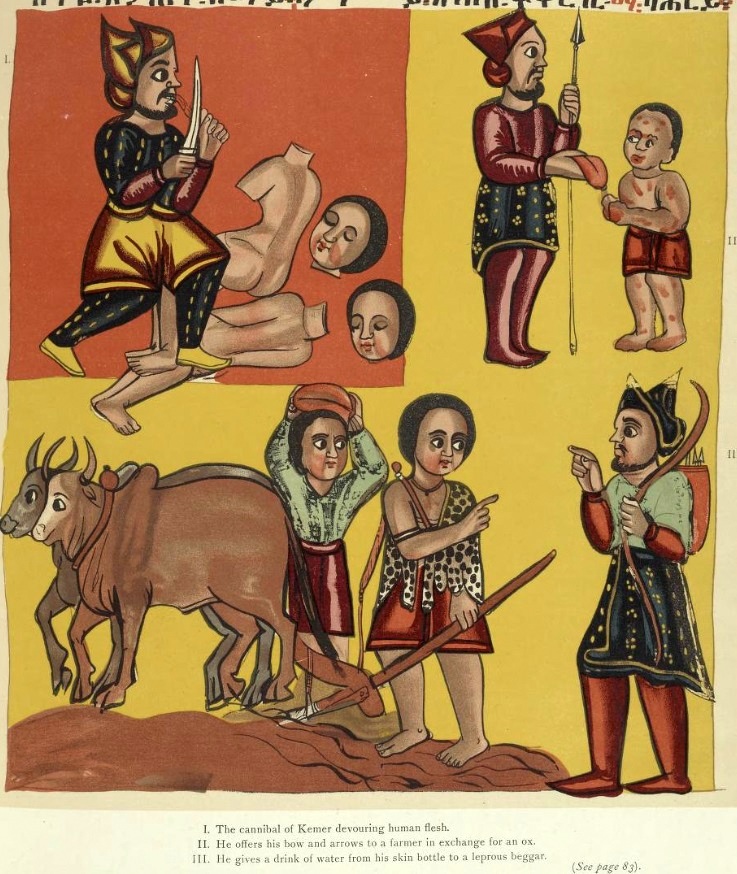
Now there was a certain main in the city of Qemer, and he was of a noble race and was, in name, a Christian. And his sin was very great, and indeed, it exceeded that of all other men, for he did not eat ordinary food and the flesh of oxen, but he lived upon human flesh. Now when this cannibal had devoured seventy-eight people, whom were his friends, acquaintances, and kinsfolk. As the people who were in his service began to come to an end, the remaining men fled from him so that he might not be able to devour them. He was left alone with his wife and two children, and them also he ate. It came to pass one day as he was walking along that he found a certain husbandman on the road, and he lay in wait for him and followed him. When he knew that he would be too strong for him, he left him and departed. As he was going away, he said unto him, “Sell me an ox, and behold, I will give thee my bow which is ornamented with gold; take it.” And the husbandman said unto him, “I refuse it wholly, for money and food are more useful to me; I will not give thee the ox.” Then the cannibal spoke unto him a second time and said, “I will give thee in addition arrows”; but the husbandman refused to accept them. And again, the cannibal said unto him, “Show me, I pray, thy cave wherein thou dwellest.” The husbandman said unto him, “Behold, it is close by thee. Dost not thou thyself dwell in the habitations of men?” And he refused to show him his dwelling, and departed. Then again the husbandman said unto him; “Thou art of noble family, but thy heart is depraved, and full of guile, and thou appearest to be like unto a rich man who hath his abode in the city of Qemer.” And the cannibal said unto him, “Why dost thou compare me with such an one, O my brother?”

Then the cannibal took some water in a vessel, and as he was going along the road, he found a certain poor beggar whose whole body was covered with the sores and scabs of leprosy; and he wished he could eat the poor man, but he did not like him because of his sores which were putrefying, and which stank exceedingly. Now the beggar was thirsty, and he begged some water from the cannibal, and said unto him, “Give me some water to drink, for God’s sake”; but the cannibal became greatly enraged, and heaped abuse upon him. Then the beggar begged again for water from him for the sake of heaven and earth, and the for the sake of the martyrs and the righteous men; and the cannibal refused to give him any. And the beggar begged from him a third time, and said unto him, “In the name of Mary, give me water to drink before my soul depart.” Then the cannibal said unto him, “Verily, from my youth up, I have heard that she saveth men by her prayers, therefore I myself will take refuge in her.” And he said to the beggar, “Take and drink for Mary’s sake”; but when only a little water had gone down his throat, that is to say about a handful, the cannibal seized him and stopped him from drinking before he was able to satisfy his thirst. Then the cannibal died, and the angels of darkness took his soul, and cast it into Sheol. And our holy Lady, the Virgin Mary, who gave birth to God, came unto the Son of God and said, “Have compassion upon me, O my Son.” And he said unto her, “What good thing hath he done for thee?” And she said unto him, “He gave a thirsty man water to drink in my name.” Then the Lord said, “Bring forth the scales and weigh the souls which he hath devoured against the water which he gave the thirsty man to drink”; and they weighed them, and the little drop of water outweighed the seventy-eight souls. And the angels of light who were looking on marveled, and they gave shouts of joy because the cannibal had been saved and was made to live through the entreaty of our holy Lady, the two-fold Virgin Mary, who gave birth to God, through whom all things come to pass. May her prayer, and her blessing, and the mercy of her beloved Son be with our king David forever and ever! Amen.

Thy love did save the evil-doing cannibal, because the handful of water give to the beggar stood on his side. Vain and useless beneath the heavens are all things; What can benefit the children of men without thy love, O Mary thou Pearl?

That particular hymn ends the story of the Cannibal of Qemer. Quite the interesting tale. The traditional interpretation of the story would be to showcase the mercy of Christ upon someone so evil, even though a single good will gesture at the end was enough to save the sinner’s soul. Whether you agree with the morale of the story is up to you. The iconography I shared with this story comes from the 1900 edition of the E.A. Wallis Budge publication The miracles of the Blessed Virgin Mary, and the life of Hannâ (Saint Anne), and the magical prayers of A̕hĕta Mîkâêl. More to come from this fascinating, exceedingly massive size book!

bP

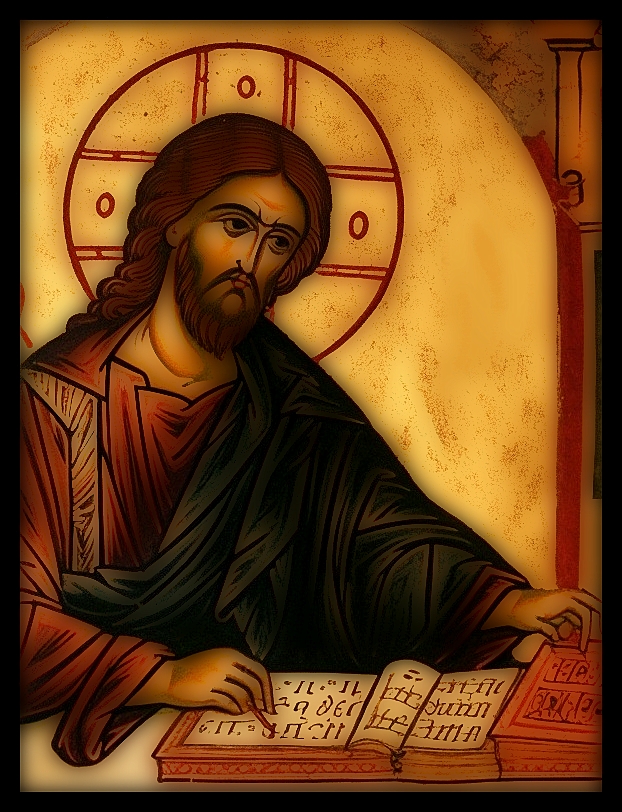
Jesus writes a letter to King Abgarus

One of the shortest but very interesting pieces of apocrypha is the correspondence between King Abgarus and Jesus Christ. I find it fascinating that the only claimed writing from Jesus is between him and a King from Osroene. Now upon reading these two letters (one from the King, and the response from JC), you can tell it originates in legend rather than historical fact. That being said it did become quite popular in the early Christian world. So what did this say? Let’s look at the letter from King Abgarus first. I am using the M.R. James translation for this:

Abgarus Uchama the toparch to Jesus the good Saviour that hath appeared in the parts of Jerusalem, greeting. I have heard concerning thee and thy cures, that they are done of thee without drugs or herbs: for, as the report goes, thou makest blind men to see again, lame to walk, and cleansest lepers, and castest out unclean spirits and devils, and those that are afflicted with long sickness thou healest, and raisest the dead. And having heard all this of thee, I had determined one of two things, either that thou art God come down from heaven, and so doest these things or art a Son of God that doest these things. Therefore now have I written and entreated thee to trouble thyself to come to me and heal the affliction which I have. or indeed I have heard that the Jews even murmur against thee and wish to do thee hurt. And I have a very little city but (and) comely (reverend), which is sufficient for us both.

So the King is requesting a visit from Jesus to help his illness. Obviously there are plenty of compliments in the letter to flatter Jesus. So does this work? Let’s see what the response was:

Blessed art thou that hast believed in me, not having seen me. For it is written concerning me that they that have seen me shall not believe in me, and that they that have not seen me shall believe and live. But concerning that which thou hast written to me, to come unto thee; it must needs be that I fulfil all things for the which I was sent here, and after fulfilling them should then be taken up unto him that sent me. And when I am taken up, I will send thee one of my disciples, to heal thine affliction and give life to thee and them that are with thee.

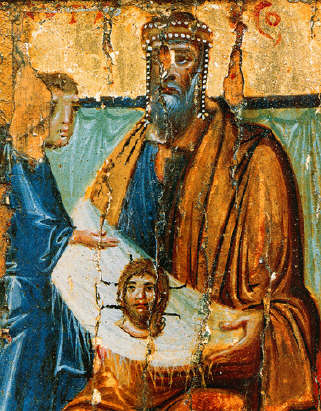
Jesus is quite the busy man but will send a disciple in his place. This is all that survives from the original text but over time, like all good legends, more details get added. At some point, a cloth makes its way into the story line which is very similar to the ‘veil of Veronica’ but it is a cloth of Jesus’ face pre-Passion. I will not dive into the full history (I will provide a link to a far more researched article at the end), but did want to make mention of the cloth as it is used as a relic. I find relics to be quiet fascinating even if I doubt their historical status (the early relics that is).

10th century iconography of the cloth

Another interesting point I want to make of this letter to Abgarus is that the letter has been copied throughout the years and used as an amulet. Now this is the aspect I really like about the story. So if you want to make yourself an amulet that has been used in antiquity, you can’t go wrong with this one! I would recommend using the iconography I posted above to go along with it.

For further reading of the legend, check out this excellent article:

M.R. James translation: http://www.pseudepigrapha.com/LostBooks/lettersJesusAbgarus.htm

https://www.orthodox.cn/patristics/apostolicfathers/abgarus.htm

wiki link: https://en.wikipedia.org/wiki/Abgar_V

Main page artwork is Midjourney generated with some photo editing.

bP

Discourse on the Arch-Angel Gabriel

In the past month I brought you Coptic tales of Michael and Raphael, now here is one on Gabriel! This particular text is LONG! This text comes to us from via Miscellaneous Coptic texts in the dialect of Upper Egypt by E. A. Wallis Budge. This text is complete except it’s ending. Like the other texts, I have “modernized” some words to make it a bit easier to read. Without further ado….

DISCOURSE ON THE ARCHANGEL GABRIEL BY CELESTINUS, ARCHBISHOP OF ROME

The discourse which the glorious Patriarch, who became a habitation for the Holy Spirit, Apa Celestinus, the Archbishop of the great city of Rome, pronounced on the great honor of the messenger of good tidings of the words of light, the Archangel Gabriel, on the day of his holy festival, which is the twentieth day of the month Khoiak. And he spoke also concerning the deeds of power and the marvelous things that took place in his holy shrine which had been built in his honor in the city of Rome. And he spoke also about the words which are written in the law, ‘Whatsoever thing thou wouldst not wish to be done unto thee, that do not unto anyone.’ And he spoke also concerning the words, the greatest sin of all is lying testimony, especially the confirmation of the lie by means of false swearing. And he spoke also concerning the words, prayer help a man, and deliver him from the snares of Satan. In the peace of God! Bless us. Amen. Amen.

Thanks be unto God! Now His grace has acted as a protector to us, and He has prepared us by His invisible hand, and has brought us into the circle of this year of our lives, and has brought us together in the shrine of the announcer of glad tidings of the worlds of light, the holy Archangel Gabriel. For this reason I will take (i. e. borrow) the voice of the holy hymn-writer David, the collector of the words that are sweet, and the righteous king, and I will say with my poor tongue, ‘This is the day which the Lord has made; let us gather ourselves together and rejoice and be glad in it.” And to Judah he said, ‘Celebrate thy feast, and give the things which thou hast vowed.’ Therefore blessed be God, for He has made us worthy, and gathered us together in the shrine of His holy steward and messenger of glad tidings of the worlds of light, the holy Archangel Gabriel. Let us assemble then in purity of heart and purity of body, and let us celebrate the festival of him whose festival both God and His angels keep. Let us cast out from us every blemish and all hypocrisy, and let us celebrate the festival of the Archangel Michael, and let us cry out and say with the sacred Psalmist David, ‘Bless the Lord, O all ye His angels, ye mighty ones of power, who perform their words.’ Verily, O holy Archangel Gabriel, great is the glory which God has given unto thee over all the spiritual and angel hosts that are in the heights of heaven, O thou archangel who was called by this name of ‘Gabriel’ by God from the beginning, and who does continue to serve the offspring of God that is to say, the Word. Now the interpretation of the name of Gabriel is ‘God and man’ according to the type of our Lord, Who came in humility, and Who put on the flesh for our sakes. He was God and man, and His Godhood was not separated from His manhood, not even for the twinkling of an eye, God forbid! But He was God and man, completely and at the same time, in the womb of His mother. She brought Him forth: He was God and man. They crucified Him: He was God and man. He became the very same flesh as man, in Godhood in the same nature, indivisible, immutable, inseparable each from the other.

Come now, O Nestorius, thou truly godless man, thou mouthless person, who deserves to be buried, fill thyself full of shame, and hold thyself to be covered with disgrace! Come now, and look at the King Christ. He is One. He is God and man. Kings and their armies come and bow down to Him in worship, and the whole world partake of His Body and of His Blood. They cry out in the voice of that blessed man, saying, ‘Remember Thou me, O Lord, when Thou shalt come into Thy kingdom.’ And thou, O profane man, did languish in thy misery, and did die in exile because of thy blasphemy, and because of thy tongue which was full of poison.

Now we had well nigh gone and forgotten thy honor and thy glory, O thou great Archangel Gabriel. But show unto us consideration, for I am exceedingly helpless in my actions, and my feeble tongue is unable to describe the glory which God hath given unto thee, O Gabriel, thou archangel of joy. What tongue of flesh and what human mouth is there that can describe thy honor, O thou holy priest of the Great King? Let my withered face rejoice, O Gabriel, thou messenger of glad tidings of the angel hosts, O thou true ministrant, who does minister to the offspring of his Lord, O thou orator of the truth, thou herald of the kingdom which is in the heavens! I wish to see thee, O holy Archangel Gabriel, who didst hold converse with the Virgin; O thou traveler for the journey from heaven of God, the Almighty One of mankind, I desire to see thee. O thou who did hold converse with the Queen of Women, I wish to see thy face resplendent with joy. Thou did hold converse with the choicest woman in heaven and in earth, thou didst say unto her, ‘Hail, O thou who hast found favor! The Lord is with thee.’ O thou Commander-in-Chief of the King of kings, my feeble tongue is incapable of describing thy glory! I will, however, say, ‘Blessed be God, the Merciful, who did say with His mouth of God (i. e. divine mouth), “In the place where two or three are in My Name, there am I in their midst.’ If God is with two or three, then who shall be able to estimate this day His joy, and that of His Good Father, and that of the Holy Spirit, when they see this great multitude of listeners who are gathered together to glorify His great and holy Archangel Gabriel, the archangel of joy? Let us then drive away from us all violence, and all backbiting, and all blasphemy, and all hatred, and all lying, and every evil deed, for those who do them fall under a curse. For every man who uttered a lie is like unto the Devil, who never stood in the truth. Has thou never heard what is written, ‘The Lord shall destroy every one who uttered a lie?’ and also, ‘Every one who uttered a lie is not of the truth, but is of Satan.’ Therefore, he who uttered a lie, or taken a false oath about the possessions of this world, which he must depart and leave, is like unto Judas the Iscariot, who betrayed his Lord for the sake of money. Has thou not heard what is written, ‘Cursed is the man who shall utter the Name of the Lord over a matter which is vain?’

Now I wish to speak to you for the benefit of your souls, but it is our God of the Archangel Gabriel, whose feast we are celebrating this day, Who urged me on. For all the angels whom God sent under the Old Covenant ministered unto men who died; but it was thou thyself, O holy archangel, whom the Father sent under the New Covenant unto Mary, the holy Virgin, to announce to her the birth, according to the flesh, of His Only-begotten Son. O thou Archangel Gabriel, to whom honor is meet, O thou wise herald, O thou a holy innocent, whose wings are laden with sweet odor, O thou master of the house who art ready, and who prepared a house for Him that laid the foundation of all the world! God looked through all creation, and He found among the whole race of women none who could be compared with Mary, and He was pleased to dwell in her under a dispensation, until He had redeemed our race. God looked through all the hosts of angels in heaven, and He found no one who could be compared with thee in the dispensation of thy holy name O Gabriel. For this reason He sent thee to His Mother, the Virgin, to give her glad tidings, and a being incorporeal was sent unto the holy and believing woman. He sent the messenger of the glad tidings of life to the Queen of the race of women. And Gabriel was sent, and upon him rested the cloud of life, wherein was the life of every man, and it was his duty to make it to dwell for nine months in the womb of her who was the choicest woman of heaven and earth. And when the arch angel appeared unto her, he said unto her, ‘Hail, O thou who hast found favor! The Lord is with thee. Behold, thou shalt conceive, and thou shalt bring forth a Son, and thou shalt call His Name Jesus.’ And immediately he had said these words to her, she conceived through the hearing of her ears, and through the salutation of the Archangel Gabriel, and the Son of God went down into her womb, she being unconscious of it.

I beseech thee, O holy Archangel Gabriel, thou messenger of the good tidings of life, when thou come into our midst this day, wherein this great festival is celebrated everywhere, bless thou this great multitude which is gathered together in thy Holy Name. For, behold, thy Lord, and the Lord of us all, is with us this day, together with all His holy angels, and His Mother, the Virgin, and they celebrate the festival in thine honor. And all the incorporeal angel hosts rejoice with thee on the day of the revelation of thy holy name. O Gabriel, thou consolation of the angel hosts, thou object of boasting of the ranks of angels who are in the heavens, great is the honor which God hath given unto thee in heaven and on earth. In heaven thou art called ‘messenger of glad tidings of the worlds of light’, and on earth thou art called ‘angel of joy’, because of the great and marvelous services which have been entrusted unto thee, O Gabriel, thou truly faithful ministrant. For when persecution rose up against Daniel the Prophet, and they cast him down into a pit of lions, and he was in sore affliction through hunger and thirst, the holy Archangel Gabriel had pity upon him, by the command of his Lord. And he seized Habakkuk by the hair of the head — now he had the dinner in his hand — and by the fervor of the Spirit he transported him from Judea to Babylon, a distance of forty caravan stages, and took him straightway into the den of the lions, and gave the dinner to Daniel. And Daniel ate, and blessed God, saying, ‘Thou hast I remembered me, O Lord, O Thou Who forsake not & those who love Thee.’

And it was also Gabriel who shut the mouths of the lions, so that during the seven days in which he (Daniel) was at the bottom of the pit of the lions they attacked him not. And it was the Archangel Gabriel who appeared unto Daniel, and taught him the meaning of the vision, even as it is written, ‘Gabriel, make me to understand the vision’; and, ‘Behold, the man Gabriel came to me, and gave me strength according to the former measure’. It was the Archangel Gabriel who appeared unto Zacharias in the Temple, and announced to him the birth of John, and when he made himself unbelieving he caused dumbness to make its appearance in him. And it was Gabriel who appeared unto the shepherds, and proclaimed unto them the glad tidings, that is to say, the news of the birth of God the Word, of the truly spotless lamb, the God-bearer Mary.’ It was the Archangel Gabriel who brought out the Hebrews from captivity, and delivered the people in the land of their servitude. And he saved them in the desert, and wrought all these signs by the hand of Moses, the greatest of the Prophets. And Gabriel is the faithful messenger who is equipped for service in the midst of the angel host, and it is he who brought glad tidings among the angels. And Gabriel is the body-guard of God Almighty, and the steward of the kingdom which is in the heavens. O Gabriel, thou faithful messenger of glad tidings, who is there that can declare thy glory? What tongue of flesh belonging to the men who are on the earth can declare thy great glory, O thou Archangel Gabriel? Thou stands before God at all times, according to what thou thyself didst testify to Zacharias in the Temple, saying, ‘I am Gabriel who stand before God.’ And what human heart, even though it be that of the wisest man on earth, can make manifest unto us thy honor, O thou Archangel Gabriel, unto whom belong the face that radiated gladness and joy?

Moreover, there is no honor which is like unto thine, for thou stands before God at all times, and thou does make supplication unto Him on behalf of the whole race of Adam. And at the moment when all the orders of angels, and these Cherubim and Seraphim cast themselves down before God, and confess the glory, and honor, and power of God, the King of heaven and earth, and they cry out always, saying, ‘Holy art Thou, Holy art Thou, Holy art Thou, Lord of Hosts, the heavens and the earth are full of Thy glory,’ at that moment I say the great Commander-in-Chief, the messenger of the good tidings of life, Gabriel, and the great Commander-in-Chief Michael, the governor of the heavens, cast themselves down before God, Who is seated on His throne, saying, ‘O Lord God Almighty, have mercy on thy people. Show compassion on Thy likeness and image. Redeem the work of Thy hands. Accept not the accusation of the Enemy against them, for he hates Thy servants. Give strength unto the men whom Thou has created according to Thine image and likeness. Bless the work of their hands. Increase the fruits of their ground. Send unto them the dew and rain at all times. Make thou the waters of the river Nile to rise for them, according to Thy will. Forgive them their foolish wickedness. Make not a reckoning with them of their iniquities, for Thou well know that it is their ignorance of the wiles of the Devil which had led astray their hearts from Thee.’ And they neither cease from their prostration on their faces, nor from their invocations of Him by day and by night until He had forgiven His image and His likeness, and this His loving-kindness and compassion come upon them (i.e. men) through their supplication.

But, I beseech thee, O holy archangel, forgive me, for I have made bold to undertake a work of which I am unworthy, and which is beyond the measure of my ability, that is to say, to declare thy honor; nevertheless the excuse of my halting tongue shall not prevent me from singing a little song in thine honor. And He Who is in truth the Great King shall be able to pay unto thee honor according to thy merit. I will now turn back, and will declare unto you certain of the works of power and of the marvelous deeds of the great Archangel Gabriel, which took place in the holy martyrium wherein we are gathered together to the glory of God and of His great and holy Archangel Gabriel, whose festival we are celebrating this day.

There was a certain rich man in this city whose name was Philip, and this man was exceedingly rich in gold and silver, and in flocks and herds. And according to what was commonly reported about him, he possessed more than fifty denarii of gold, for he was a very great merchant, and he carried on business in many countries. And a very large number of men in his employ used to work in foreign countries, and they brought to him great quantities of merchandise from all lands. And the people used to shower upon him blessings innumerable because of the good works that he did. And this good man was naturally charitable, and he was very generous to the poor whom he loved, and he used frequently to give large gifts and alms to the poor and to the orphans, and besides these he gave large offerings to the shrine of the holy Archangel Gabriel. Now he lived hard by the shrine of the holy Archangel Gabriel, and there was a certain poor man who lived near him, whose name was Stephen, and he begged his bread day by day. And Philip, the rich man, in his goodness used to provide the poor man with everything which he needed, for the love of God, and as I have already said he lived near him. Now the poor man Stephen knew how to read and write well, and the rich man Philip was uneducated, and did not know how to read or write. And Philip often made the poor man conduct his correspondence for him with his customers, and with the men who did business under his directions, and he trusted him with all his confidential matters; and Stephen wrote letters about every matter which concerned Philip’s business. And very often the men who bought from the rich man and sold to him gave much money to the poor man secretly, to make him to keep the rich man ignorant of his various transactions in business, and to prevent him from knowing what moneys he should be receiving from them day by day. In this wise the poor man gradually became a rich man, but the riches which he had gathered together wrongfully were scattered abroad suddenly, even as I shall now make clear unto you, according to the words of the honey-sweet writer David, who said, ‘Trust not in wrongdoing, neither set thy heart to snatch at riches; if riches come unto thee, set not thy heart upon them.’

And when the poor man had, little by little, gained wealth, he found bread, and ate thereof. And on a certain day he went to the rich man, and said unto him, ‘I wish thee to do me a favor. Give unto me a little gold, for I want to become a merchant and, together with my sons, to traffic therewith, and when the time comes wherein thou shall ask for thy gold to be returned I will give it unto thee, together with thy share of the profit which I shall make, and I shall be under an obligation to thee.’ And the rich man said unto him, ‘Go, and prepare thy bond for me, setting out therein of what thou need, and I will give it unto thee.’ And the poor man sat down, and prepared the bond asking the rich man for seven hundred oboli, and he swore by God Almighty that, when the business was done, he would give unto the rich man one half of the profit which he should make on them. And the rich man took the bond, and gave the seven hundred oboli to the poor man, who went and traded with them for three years. And although he gained a very large sum of money thereby he made no attempt to give any of it to the rich man, either as capital or as interest. And when many days had passed, the rich man brought the poor man into his house to set his accounts in order for him. And when he had opened the chest wherein the bonds (or, contracts) and the ledgers were kept, he set Stephen to search for the documents of which he was in need. And when Stephen, the man of whom we are speaking, found his own bond he slipped it inside his undergarment (or, shirt), without the rich man, on account of his innocence and want of suspicion, knowing anything about it; and he came out of the house without the rich man knowing that he had it.

Thus day by day the poor man waxed rich little by little, but the riches which are gathered together by means of wrongdoing perish quickly and become scattered, even as I have already said. And when Stephen went into his own house he rent his bond and tore it up into little pieces, and he said in his heart, through his evil thoughts which Satan thrust into his mind, ‘Verily I shall never now pay this man any part of the seven hundred oboli which I owe him. And if he shall say unto me, “Give me the oboli,” I will say unto him, ‘I owe thee nothing. Produce my bond (or, contract) which thou must hold if I really owe thee money, and if thou can not do so I owe thee nothing. I have no need of gold for myself.” Then I will take them for myself and become rich thereby, and they will suffice me for a very long time. I will eat with them, and I will drink, and I will heal my soul.’ And he did not remember that which is written, saying, ‘Thou fool, thy soul shall be taken from thee. The things which thou hast prepared, whose shall they be?’

We are, however, delaying our narrative. Now when four years had passed, and the rich man saw that the poor man had paid him nothing either as regards principal or interest, he made haste and sent a message unto Stephen by his servants, summoning him to him. And when the poor man had come to him, he said unto him, ‘Give me the seven hundred oboli which thou owes me, for I am in need of them.’ And that godless man began to make a denial to the pious rich man, saying, ‘I have no money whatsoever of thine, and thou didst never give me any.’ And the rich man said unto him angrily, ‘O thou wicked man, behold, have I not in my hands the bond (or, contract) which thou didst make with me, for seven hundred oboli? Behold, it is five years since I gave them to thee. Not only hast thou not paid me any interest on them, but lo, thou now wishes to take possession altogether of that which belongs to another.’ And the poor man answered and said, ‘If the bond is in thy possession, produce it here so that I may see it, and then I will go and deliver unto thee my house and my children, and thou will be master of seven hundred oboli.’ And the rich man examined all the bonds and all the other documents in the chest, and when he could not find the bond he knew forthwith that it had been stolen and carried away. And he said unto the poor man, ‘I know of a certainty that it is thou who hast carried it away by theft. But if thou are bold enough in thy heart to say that I did not give thee seven hundred oboli, come and let us go to the shrine of the holy Archangel Gabriel which is in our quarter of the city, and if thou wilt swear unto me there, and will convince me, I will make no further claim upon thee.’

Then that fool thrust aside all fear of the Lord from him, and the remembrance of the very many benefits which he had received from the rich and pious man, and he forgot altogether that which is written, saying, ‘The Lord shall destroy every one who utters a lie.’ And he said unto the rich man ‘Let us go, and I will swear to thee’; and straightway they walked to the shrine of the Archangel Gabriel. And when they arrived there they found a great multitude of people gathered together and they wondered what had happened. And the rich man said unto the poor man, ‘Give me the seven hundred oboli which I gave unto thee. Swear not to a lie lest evil come upon thee.’ And that fool said, ‘I owe thee nothing,’ And the rich man said unto him, ‘If thou owes me nothing, swear it to me so that I may depart.’ And that godless man held in contempt the powers of the holy Archangel Gabriel in respect of moneys which were lost (i.e. bad debts). And in his foolish stupidity he laid his hand upon the door of the altar-chamber, and he swore an oath, saying, ‘I swear by the mighty power of the Archangel Gabriel that I owe thee nothing, and that thou didst never give unto me the seven hundred oboli for which thou are harassing me.’ And straightway, while yet the words were in his mouth, a power smote him, and he fell headlong on his face, and both his eyes became blind, and his face was turned round behind him, and his tongue filled his mouth. And he fell down on the pavement of the sanctuary, and he bit his own tongue and lips in great agony, and he foamed at the mouth like a man who is possessed of a devil. And when the multitude saw what had happened they marveled and were greatly amazed, and they cried out with a loud voice, saying, ‘One is the God of the Archangel Gabriel.’ And after a considerable space of time, during which he was suffering torture, the poor man Stephen cried out with a loud voice, saying, ‘Forgive me, O my Lord Archangel Gabriel, that I dared to swear a false oath in thy name. This rich man did lend me seven hundred oboli five years ago, and I worked (i.e. traded) with them, and I have not given him anything at all for them. And having found a favorable opportunity I stole and carried away the bond, and I deceived him, wishing to keep possession of the oboli and to become rich thereby. Woe is me! What shall I do? For I have sworn a false oath.’ And straightway he sent a messenger to his house in haste and his wife brought seven hundred oboli, and gave them to the rich man. And the man Stephen remained in a state of torture the whole day, and it seemed to him as if a spear was being driven into his body, and he yielded up his spirit in the most miserable way that it is possible for a man to do. He swore a false oath, and he gained nothing at all thereby except the destruction of both his soul and his body. Thus ye see, O my beloved, the manner in which the power of the Archangel Gabriel prevailed, in whose honor we are celebrating the festival this day, and that he who swore a false oath in his name shall surely die in misery. Let us put ourselves far away from lying, that evil vice, and especially from those who confirm the lie by a false oath. Do you not hear the Lord crying out to every one, ‘Let your words be Yea, Yea, and Nay, Nay, so that judgement may not be passed on you?’ And let us take care to guard our life against the terrible oaths which we are in the habit of swearing, especially concerning subjects of the most trivial character, lest we receive great condemnation and punishment everlasting in the place wherein a man will not be deemed worthy of visitation.

And this makes me remember that I promised to relate unto you a few of the works of power and of the miracles of the great Archangel Gabriel, whose festival we are celebrating this day, to the glory of God and of His great Archangel Gabriel, the messenger of glad tidings. Now there was another man in this city who had been blind in both eyes from his childhood. And when he heard about the works of power and the miracles of the Archangel Gabriel, he asked the servants of his household to take him into the shrine of the Archangel Gabriel, saying, ‘Assuredly his mercy will come to me, and he will graciously give me the light of mine eyes.’ And they took him into the shrine of the Arch Angel Gabriel, and he was saying, ‘Assuredly his mercy shall come to me.’ And when he had gone inside he cast himself on his face before the holy altar, and he wept, saying, ‘O my lord, thou holy Archangel Gabriel, show compassion upon my misery, and graciously grant unto me the light of my eyes, for I suffer exceedingly.’ And while he was weeping, and saying these words, he felt the hand of a man touch his eyes. And when all the people who were gathered together in the shrine of the Archangel Gabriel saw that the man who was blind could see, and that he was uttering loud cries for joy, saying, ‘One is the God of the holy Archangel Gabriel, for His mercy hath come to me, and He has bestowed upon me the light of my eyes,’ the whole multitude rushed to him, and the people asked him, saying, ‘ Tell us what has happened unto thee, and how it is that thou can see.’ And he told them the good news and about everything which had happened unto him, saying, ‘It happened to me after I had come unto this holy shrine. I cast myself down before the holy altar, and I made entreaty to the holy Archangel Gabriel. And straightway I felt the hand of a man come down over my face, and it made the Sign of the Cross over my eyes, and straightway I was able to see. And I heard a voice saying unto me, “Behold, I grant unto thee the light of thine eyes, according to the supplication which thou didst make to me.” And I said unto him, ” Who art thou, my lord? ” And he said unto me, ”I am Gabriel, the archangel.” These are the words which I heard, but I saw no man talking to me.’ And when the people heard these things they lifted up their voices and cried out loudly, saying, ‘One is the God of the Archangel Gabriel.’ And the man who had recovered his sight remained in the shrine of the Archangel Gabriel, and ministered therein until the day of his death.

And there was another man, who was rich in gold and in silver and he was dumb, and he after a time fell sick of the disease which is called ‘gout’, and he suffered excruciating pains in his feet by day and by night. And he had spent ample means on the physicians, and was in no way benefited thereby; on the contrary, his disease became more severe. And when he heard of the works of power and the miracles which took place in the shrine of the holy Archangel Gabriel, he made his slaves take him up and carry him into his holy shrine. And he lay down in the shrine, and he was in great pain, and he cried out, saying, ‘My lord, thou holy Archangel Gabriel, have compassion upon me, and graciously heal me, for I am suffering exceedingly great pain.’ And there was likewise another man there who was paralyzed in his legs, and he had always to drag himself along the ground like a child. And he was in the shrine lying down, and he was entreating the archangel to grant him healing, and he was lying down by the side of the blind man in the shrine, and he was suffering agony in his feet, and the two men were seeking for healing at the hands of the holy Archangel Gabriel. And at that moment the archangel had compassion upon them, and he was pleased in his benevolence to bestow healing upon both of them at the same moment. Thereupon he appeared unto the paralyzed man in a dream, and he was in the form of a man of light, whose face was emitting rays of light. And he said unto the man who was paralyzed, ‘If thou wishes earnestly to be healed and to recover thy health stay where thou art until all the people who are in the shrine have lain down. And when thou art sure that they are all asleep rise up, uncover thy hands and thy feet, and go to the bed of the rich man who is suffering pain in his feet, and begin to lift up (or, carry off) the bed whereon he is, and thou shalt find healing. Thou shalt walk on thy feet, and thou shalt recover straightway, and thou shalt depart to thy house like one who hath never suffered from illness.’

And when the man awoke from his dream he marveled, and he said within himself, ‘Verily I have been deceived by this dream. If I were to do this, and to go and carry away the rich man’s clothes, he would certainly wake np, and his slave would seize me. And, moreover, I am helpless, being paralyzed, and they would deliver me over into the hands of the Eparch of the city, and he would kill me. I should be going in quest of healing for my body, and should ruin my soul through the tortures which they would inflict upon me. No, I will never do this thing.’ And on the coming night the Archangel Gabriel came to him, wearing royal apparel of great magnificence, and he was shining more brightly than the sun. And he spoke unto the paralytic — now a very strong sweet odor issued from his mouth — and said unto him, ‘For what reason has thou been careless, and has not done that which I commanded thee? Be certain of this thing: if thou will not obey me never till thy dying day shall thou be relieved of thy disease. If, however, thou will do what I command thee thou shalt recover thy health forthwith.’ And when the archangel had said these things unto him he departed from him immediately; and the paralytic woke up trembling and afraid. And he strengthened his heart boldly, saying, ‘Verily it was the Archangel Gabriel who spoke unto me. Now, therefore, even though it happen that the slaves of the rich man seize me and put me to death, I will not be disobedient on this occasion. Let the will of the Lord be done.’ Thus the paralytic hid the matter in his heart, and he informed no man of what had taken place.

And when the evening was come the paralytic waited until all the people who slept in the shrine were asleep, and then he rose up, and stripped his hands and his feet, and he went to the deaf man, who was suffering from gout in his feet, and he seized the clothing which was on him and began to pull it off him. And the man who was diseased in his feet and who was dumb awoke from his sleep in a state of fright, and God and the Archangel Gabriel had compassion upon him, and the fetter of his tongue was broken straightway, and he spoke, although he had never uttered a word before, and he cried out with a loud voice to his slaves, saying, ‘Get up quickly and seize this thief who had come and carried off my clothes which were on me.’ And the paralytic trembled lest the slaves of the rich man should seize him, and straightway the power of control came to his hands and his feet, and he leaped up from the ground, and took to flight on his feet like unto a trained runner until he reached the place wherein he slept. So likewise also was it with the man who had gout in his feet, for the power of control came to him, and he jumped down from his bed like a man who had never ailed at all, and pursued the paralytic and his servants, and he wished to seize him. And after a little time, when they had realized the act of grace which had been vouchsafed to the two of them, that is to say, to the rich man who had been relieved of his gout and also of his dumbness, and to the paralytic, and that they had gotten control of their limbs, the two men came forward, and they acknowledged the healing which had come to them both, and they cried out both together, ‘One is the God of the holy Archangel Gabriel.’

And when the whole multitude of people who were gathered together in the shrine of the holy Archangel Gabriel had seen this great miracle they were filled with very great fear, and stupefaction came upon them. Then they asked the paralytic, ‘What happened to thee to make thee act thus?’ And he declared unto them everything that had happened to him, saying, ‘Behold, this is what happened to me. It was the Archangel Gabriel, who appeared unto me twice, dressed in a garb of light, who did this.’ And all the people who were gathered together in the shrine of the holy Archangel Gabriel lifted up their voices and cried out, saying, ‘One is the God of the valiant archangel! Great are the works of power of the messenger of the glad tidings of life, Gabriel, whose name is most honorable.’ And the men who had obtained healing remained in the shrine of the Archangel Gabriel, and they prayed and fasted therein until the day of their death. What shall I say about the miracles which thou hast wrought, O thou mighty orator of God the Word, thou holy Archangel Gabriel? Verily, if I were to carry out my intention to its full extent, I would do my utmost to describe each and every one of thy miracles, and I would not narrate a part of them only. However, I must only describe a few, and I therefore make a selection from the great and important works which thou has performed, to the glory of the Christ our Saviour and of His great and holy Archangel Gabriel, whose festival we are celebrating this day.

There was a certain man who lived in a village which was about six or eight miles distant from the city, and this man had an only son who had arrived at the age of manhood . After a time he fell sick of the disease of the gout, and he suffered excruciating pains in his hands and his feet, both by day and by night, and he was wholly unable to lift up his head. And he passed six years lying upon a bed, and never once rose up from it during that period. And his parents and his kinsfolk often fell into despair about him, and said, ‘Verily death would be far better on him than this suffering which attacks him.’ And his parents spent very large sums of money on physicians, from whom he received no benefit whatsoever; on the contrary, he became worse. And when his father heard of the works of power and the miracles that were taking place in the shrine of the holy Archangel Gabriel, which was in the city of Rome, he made a vow, saying, ‘If the God of the Archangel Gabriel will hearken unto my supplication, and will graciously bestow healing upon my son, I will give six oboli to thy shrine yearly until the day of my death. For I know well, O my lord Archangel, that thou are able to do everything. Now I cannot bring my son to thy shrine, for he is neither able to walk nor to ride a beast because of the pain that is upon him but I believe that thy holy power fills every place. Let thy mercy come to me, and grant unto me the healing of my little son and if thou wilt I will acknowledge thy power until the day of my death. And straightway the Archangel Gabriel hearkened unto the entreaty of the man, and he wished to bestow healing upon his son, for he is compassionate. And he brought a little drowsiness upon the young man, and he slept more than he usually did, for he slept neither by day nor by night, and he was always crying out because of the excruciating pain which consumed him. And when the young man had fallen asleep the holy Archangel Gabriel came unto him in a dream. He was arrayed in great and indescribable glory, and he was enveloped in a mantle which emitted rays of light, and he said unto the young man, ‘Behold, I am going to remove the pain from thee, and no suffering shall attack thee from this hour.’ And the young man said, ‘My lord, who art thou that art surrounded with such great glory as this?’ And he said unto him, ‘I am Gabriel the Archangel’; and straightway he disappeared from him. And when the young man awoke in the morning he found that all his body was bathed in sweat. And when he perceived that healing had come to him, and that there was no pain whatsoever in his body, he leaped off his bed and stood upright, and he ran along and skipped, and he blessed God; now he had become like unto one who had never been ill at all. And straightway he cried out, saying, ‘I glorify thee, O great and holy Archangel Gabriel, because thou has remembered me, and has granted healing unto me.’ And when his father and his mother saw the healing which had come to their son unexpectedly they wept many tears, and then they asked their son, saying, ‘What was it that happened unto thee, O our beloved son?’ And he described unto them the dream which he had seen, and straightway they cried out, saying, ‘One is the God of the holy Archangel Gabriel. Great is the benefit which thou has performed for us, O good messenger of glad tidings.’ And there was great rejoicing in all their house because of the healing of the young man which had taken place, more especially because he was the only son. And everyone who heard marveled exceedingly, and they glorified God and the holy Archangel Gabriel, and the report of the healing reached every one.

And on the morrow, which was Sunday, the man called his son and gave unto him the six oboli and certain other gifts of value, and he sent him to the city of Rome to present them to the shrine of the holy Archangel Gabriel, according to the vow which he had made. And the young man took them with gladness, and he put them in his wallet to go to the shrine of the holy Archangel Gabriel. And having journeyed on by himself until he drew nigh unto the city, which was about three miles off, he came to a wood (or, forest) of large trees and thick undergrowth through which it was very difficult to travel. And behold, straightway a very fierce lion rushed out of that dense forest, and with a roar sprang upon the young man, and leaped upon him, and digging his teeth into his side dragged him away into the forest, wishing to devour him. And the young man cried out in great distress, saying, ‘O my lord, thou Archangel Gabriel, help me in this great distress, for thou know, O my lord, that my father hath sent me to thy shrine to present these little gifts to thy holy shrine, and then to return to my house, but behold, I shall die through this lion.’ And at that very moment, behold, the holy Archangel Gabriel came forth from heaven, wearing a garb of light, and he took the young man out of the mouth of the lion, and he made the Sign of the Cross over his side, and healed him of the wound which the lion had inflicted upon his…..

[The remainder of the Encomium is wanting]

Thus ends this tale of Gabriel. Quite the long text and surprisingly it was complete except the ending which is more than you can say on most of these types of stories. This will be the last Coptic tale I will share for now as I have other entries I want to post, but I do plan on returning to such texts in the future. I think it is very important that these types of stories are accessible to modern readers. The other apocrypha get all the love but these tales from North East Africa tend to get over looked by the English speaking world. I am making it my mission to change that!!

Featured photo: Coptic image of Gabriel https://www.researchgate.net/figure/P-Heid-Inv-Kopt-684-C-Papyrologisches-Institut-Ruprecht-Karls-Universitaet-Heidelberg_fig1_326401756

bP

Comparing translations of Thomas sayings

I mentioned in previous blog posts on how important it is to check out various translations of texts. Sometimes it is not possible but when there are multiple translations you should definitely do so! Unless you can read the source manuscript (Coptic, Greek, etc…), you are forced to go by modern (or somewhat modern, i.e. within the past hundred or so years) translations. I thought this would be a good experiment to do with the Gospel of Thomas. This gospel has been translated by numerous people. The Coptic version survives mainly intact but there are also Greek fragments. So in this experiment, I will also be comparing the Greek to English translations, along with the Coptic. Greek would be the main source of Thomas thus the English translation of the Coptic is a 2nd generation translation. So let’s start off with Saying 2.

Here is the Greek to English translation by Thomas O. Lambdin:

Jesus said, “Let the one seeking not stop seeking until he finds. And when he finds he will marvel, and marveling he will reign, and reigning he will rest.”

Here is his translation from the Coptic source:

Jesus said, “Let him who seeks continue seeking until he finds. When he finds, he will become troubled. When he becomes troubled, he will be astonished, and he will rule over the All.”

Here is Marvin Meyer’s translation:

Yeshua said, Seek and do not stop seeking until you find. When you find, you will be troubled. When you are troubled, you will marvel and rule over all.

Stevan Davis translation:

Jesus said, “The seeker should not stop until he finds. When he does find he will be disturbed. After having been disturbed, he will be astonished. Then he will reign over everything. Having reigned, he will rest.”

Stephen Patterson and James Robinson translation:

Jesus says: “The one who seeks should not cease seeking until he finds. And when he finds, he will be dismayed. And when he is dismayed, he will be astonished. And he will be king over the All.”

William D. Stroker translation:

Jesus said: Let him who seeks not cease seeking until he finds. And when he finds he will be troubled, and when he is troubled he will be astonished, and he will rule over the All.

Comparing these all, the first sentence is pretty much the same. It starts with “Jesus said/says”, which is typical of Thomas sayings. Then it proceeds with the seeker seeking and not stopping until said seeker finds. For the most part, all the translations are pretty close. Now the middle and last parts of the saying is where the wording changes up a bit. In the Greek to English translation, we see the word “marvel” appear in the saying. In the Coptic to English translations, “marvel” gets replaced with “disturbed”, “dismayed” and “troubled”. The Greek source is obviously the more “poetic” than the Coptic source. Also, “marvel” is more akin to “astonishment” or in “awe” of something. It has a more positive aspect to the experience. The Coptic to English translations tend to give off a more negative impression. That just goes to show how the Coptic translation from a Greek source has changed up the meaning somewhat of that saying.

Let’s take a look at saying 36.

Here is the Greek to English translation by Thomas O. Lambdin:

Jesus said, “Do not worry from early until late nor from evening until morning. Worry neither for your food, what you will eat, nor for your clothes, what you will wear. You are much greater than the lilies which neither card nor spin. When you have no clothing, what do you wear? Who can add to your time of life? He it is who will give you your clothing.”

Here is his translation from the Coptic source:

Jesus said, “Do not be concerned from morning until evening and from evening until morning about what you will wear.”

Here is Marvin Meyer’s translation:

Yeshua said, From morning to evening and from evening to morning, do not worry about what you will wear.

Stevan Davis translation:

Jesus said: Do not worry from morning to evening or evening to morning about what you are going to wear.

Stephen Patterson and James Robinson translation:

Jesus says: “Do not worry from morning to evening and from evening to morning about what you will wear.”

William D. Stroker translation:

Jesus said: Do not be concerned from morning until evening and from evening until morning about what you will put on.

First off, the Greek version is much longer!! This isn’t the case of a missing fragment from the Coptic version either. The Greek source goes into much more depth on the meaning of the saying and it makes the Coptic version inferior in comparison. Now to compare the first part of the Greek version with the Coptic translations, they are pretty much in agreement. Content wise, the Greek manuscript is the superior source, not just in it’s wording, but the extended explanation.

I invite you to go to gnosis.org (link below) to check out the various Gospel of Thomas translations. They do not list the Stroker translation (I pulled that from a book I have of his) but they do list the others including the Greek sayings. There are much more Greek sayings and I highly recommend reading those if you have not done so.

http://www.gnosis.org/naghamm/nhl_thomas.htm

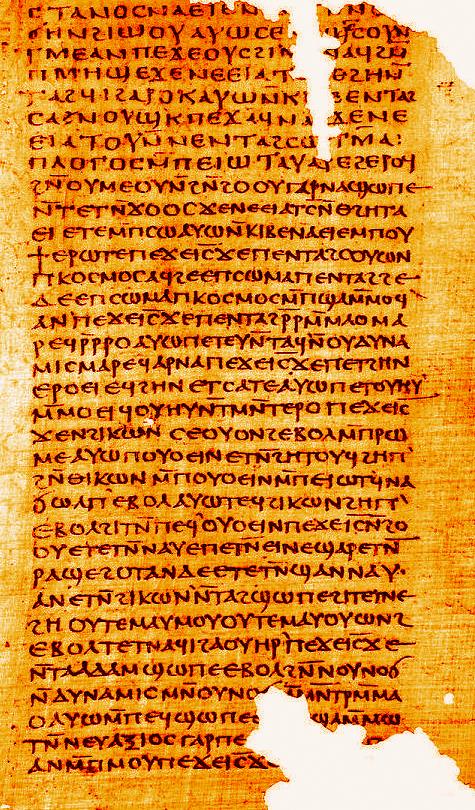
Featured photo is from the Coptic Gospel of Thomas papyri.

bP

Encomium on the Arch-Angel Raphael

I have another tale for you from the Coptic tradition this time of the Arch-Angel Raphael and his interaction with Saint John Chrysostom. This comes from the Miscellaneous Coptic texts in the dialect of Upper Egypt by E. A. Wallis Budge. I am presenting this text in full. I have modernized some words and there are sections that are missing. Without further ado….

The discourse which Saint John Chrysostom, that is to say, he of the tongue of gold, Archbishop of Constantinople, pronounced concerning the Holy Arch-Angel Raphael, on the day of his festival, which is celebrated on the fourth of the Epagomenal days. This discourse was pronounced in the shrine that had been newly built by the God-loving Emperor Arcadius in the name of the Holy Arch-Angel Raphael in the southern part of the city. And after the dedication in the following year, the God-loving Emperor came to pray and to bow down in the new shrine which his brother had built, and he (Chrysostom) consecrated it. And the pious Emperors Honorius and Arcadius were in accord, and they invited the great John Chrysostom to pronounce a few words of laudation on the Holy Arch-Angel Raphael. And the Holy Chrysostom, or rather, the hostel of the Holy Spirit, uttered this discourse. And he related a few of the mighty deeds, and signs, and miracles, which took place through the Holy Arch-Angel Raphael, and explained wherefore he was called the reed of the spirit. In the peace of God, may his holy blessing come upon us, and may we all be saved together. Bless us. Amen.

My beloved, ‘the angel of the Lord encamped round about them that fear Him and delivered them,’ and in very truth the holy Archangel Raphael did encamp round about those who fear Him, that is to say, the family of Tobit, and delivered him. And again, the Scripture said, ‘He will give His angels charge concerning thee, that they keep thee, and bear thee up on their hand, lest thou strike a stone with thy feet.’ For in truth the Lord did give His holy Archangel Raphael charge concerning Tobias, the son of Tobit, to keep him in all his ways, ‘lest thou strike a stone with thy feet.” When the husbands of Sarra (Sara) struck a stone, and fell down, He sent His word and healed them, and delivered them out of all their tribulations. The Psalmist David said, ‘Verily God sent His word,’ that is to say His great Archangel Raphael. He healed Sarra, the daughter of Raguel, of the cruel disease of barrenness, and delivered her from the reviling of the servants of her father, according to the word of the holy Apostle Paul, who said, ‘Are they not all ministers of the Spirit who are sent out to perform service for those who shall inherit salvation?’

My beloved, when I think of the loving-kindness of God towards man, which is very great, and especially towards the righteous, I marvel exceedingly. Now the righteous Lord, even as it is written, ‘putteth away the sins of the sinners,’ even as has been said by the mouth of the Lord, which cannot lie, ‘There is joy in heaven before God and His angels over a sinner when he repents.’ In truth the holy angels merit honor, and it is meet especially for us to rejoice with them. Now it is the righteous who minister unto them, through the command of the Creator God Almighty, with willingness and trembling. The blessed angels rejoice in the conversion of sinners, and they also minister unto the righteous with exceedingly great gladness. Even so is it with a king of this earth. When a tyrant, or an arrogant oppressor, rises up in his province, and committed lawless acts and does deeds of aggression, the king straightway meditates in his heart, saying, ‘By what means can I put down this tyranny?’ Then he summoned to him one of his chief captains in whom he had confidence, and he dispatched him to depose the adversary of the king. And when the captain has done this, he returns to his lord with joy and gladness, the tyrant of yesterday being vanquished and lashed to his horse. Then does the joy of the king rise up, because his enemy had fallen before his general, and he bestowed upon his chief captain honors and gifts which are greater than any which he had ever bestowed on any one before. And in this manner does the man-loving God act in this world.

Now Michael, and Gabriel, and Raphael are they who are the greatest of all the angelic hosts. As concerning this Michael, God sent him in primeval time, and he smote the Old Serpent, that is to say, Satanael, and he vanquished him, and bound him in fetters for one thousand years, and because of this God bestowed upon him this great and exalted position. And as for Gabriel, because of his faculty of knowing things beforehand, the Lord, and His Father, and the Holy Spirit decided that he should go to the Virgin with the good news. Raphael went to the righteous men, and served them, and acted as guide to them, and healed them of their sicknesses, and it belonged to him to bind the wicked demon Asmodeus with fetters. For God had appointed unto each of the angels the work which is associated with the meaning of their names. Michael, He appointed to act as a minister to men before Him because of his faculty of watchfulness (or, keeping awake). If thou would translate the name Michael, its signification is ‘The Compassion of God Almighty’. The name Gabriel means ‘God and man’, and for this reason God made him the minister and the messenger of the good tidings of what God is about to do unto man. The meaning of the name Raphael is ‘God Who guides men’. And God gave unto these angels these names through His foreknowledge of those who were about to be before they came into being.

And now let us return to the subject of the discourse and speak about Tobit, the son of Tobiel. Tobit said, ‘I Tobit was walking on the road at midday. Righteousness was in my hands at all times all the days of my life.’ Verily Tobit was a traveler on the ways of truth, and a doer of charity with a benevolent mind, and the son of Tobiel gave first-fruits and tithes to the house of God. For this reason, the Devil became envious of him and made him blind. God Himself said by the mouth of the holy Prophet David, ‘Behold, I have become old, and I never saw a righteous man whom God had forsaken.’ Subsequently God sent His holy Angel Raphael, and he bestowed upon him the light of his eyes. And also, when he wished to send his son Tobias into a region afar off. He made the good angel to act as his guide. And in the place whereunto he departed he healed Sarra, the daughter of Raguel, and bound the demon Asmodeus with fetters. Thus, he filled the house of the poor man with joy, and the house of the rich man he filled with gladness, and the house of chiding and abuse he filled with singing and music, and he made the grief and sighing of Raguel to flee away. And he wiped away also the tears from the eyes of Sarra, and took up her prayers to the Seventh Heaven, to God Almighty.

For, O my beloved, this Raphael is a good angel, he is a minister, he is a flame of fire, he is a spirit, he is a faithful guide, he is incorporeal, he is also an archangel. He is a good servant, he is a wakeful watcher, he is a workman who is to be trusted. He is a physician who heals and accepts no fee. All these things which I declare unto you this merciful archangel does at the command of his handicraftsman, God. And if you wish to know, O beloved brethren, how it is that all these names are applicable to this compassionate archangel, I will make the matter manifest to you. Now I have already told you that the archangel is a good being. Behold, his loving-kindness manifested itself openly, because the archangel serves man with obedience, even to the preparation of food for him. He is a man, he is a minister who stands before the deathless King, the Christ.

He ministers at His command, according to the word of the sweet-smelling tongue of Paul, ‘Are they not all ministers of the Spirit who are sent out to perform service for those who shall inherit salvation?’ Thou see the faithful testimony! He is a spirit, according to the prophecy of David, saying, ‘Who makes His angels’ spirits; he is a flame of fire, even as it is written, ‘His ministers a flame of fire.’ He is a guide, and therefore he guided Tobias in a foreign land, without any injury whatsoever. He is a chief cook, for he cooked the fish for the young man. He is an angel. He is a master of the bridal ceremonies, for he spoke unto Tobias, and he made a marriage. He is a being without body, for he tasted no food whatsoever all the days wherein he was travelling with him. He is a messenger, for he made supplication to the Treasury of Compassion, the Christ, on behalf of Tobit and Tobias his son, and Sarra. He was a………. when Tobias was in the bride-chamber. He took a camel to Ecbatana and brought back silver. He is a physician, for he healed the eyes of Tobit, who was a charitable man, for he said unto his son, ‘According to what thou hast, and according to thy superabundance, do acts of charity, for charity delivered a man from death.’ He is a Commander-in-Chief, for he bound Asmodeus in fetters. He is an unpaid minister, for he would not take the hire which had been agreed upon with him. He is a good servant, for he performed service for all those who needed it from him. He is a faithful minister, for he stood before him and served like a loyal servant. O how deep is the sea of the compassion of God! O how great is the obedience of this archangel, who stands before the Lord of Hosts, and stands as ever a man to serve!

Now therefore, permit us, O my beloved, to bring forward and to declare unto you a few matters concerning this martyrium wherein we are gathered together in the name of the archangel. It happened to me one day, when I John was celebrating my Eucharist at the sixth hour, that a great light rose up in the house wherein I was, and behold, a young man with an exceedingly beautiful countenance came in to me. He was enveloped in great splendor, and he had a staff of gold, surmounted by a cross, in his right hand, and he called unto me three times, saying, ‘ John, thou reed of the Holy Spirit! John, thou tongue that healed the souls which have been shattered by sin! John, thou tongue of the speaker who is able to persuade God in the Seventh Heaven! ‘ And when I heard these words, I was troubled, and I fell down at his feet that I might worship him. And he took hold of my hand, and raised me up, and said unto me, ‘Fear not. Do not worship me, for I am thy fellow servant, but worship God.’ And I said unto him with fear and trembling, ‘Who art thou, O my lord, who art enveloped in such great splendor? I have never seen anyone like unto thee.’ And he removed fear from me, and he said unto me, ‘I am Raphael, one of the Seven Archangels. I am Raphael whom my Master joined to Philotheus, and I presented him and his father and his mother to the Christ Jesus. I am Raphael the archangel, and the Christ gave thee into my hand from the time when thou were a child. And moreover, from the time when thou were born until this day, I have never left thee for an hour, or for half an hour, or even for the twinkling of an eye. And I will never leave thee until the day comes when I shall take thee to the King, the Christ. He gave thee into my hand when thou were spotless. I was with thee in the house of the learned man who taught thee letters, and also when thou did make thy passage by sea to Athens and Berut, into which cities thou did enter. I walked with thee, and I prepared the path whereon thou were to travel, and I prepared for thee the instruction, which was peculiarly suitable for thy mind and heart, even as the husbandman prepared his seed beforehand, and dug his furrows in the water. And now, be strong and prevail. Fear thou not, O thou marvelous confessor, for I am not one to strike fear into souls; on the contrary, I am one who giveth comfort unto souls, for I am called by my fellow angels, ”The merciful angel.” Be strong, let thy heart be bold, and fear thou not, for I am not associated with disturbance, but with peace. Now therefore, O John, behold the Emperor Arcadius will ask thee about a matter which concerned me, for he would like to build a martyrium in my name. Encourage him with thy softest speech, for it is written, “The tongue of the righteous man is more excellent than gold and silver”; and make him to be happy in the building of my shrine. When thou shalt consecrate my shrine and the gifts of great price and beauty which the God-loving Emperor shall give unto it (?) ……….. Declare these words unto the pious Emperor……. the Christ……..the Holy Spirit, which is like unto a sweet odor that flowed from his mouth. Be of good cheer, and the peace of the Father, and of the Son, and of the Holy Spirit be with thee.’ And when he had said these things unto me, he went up into heaven with great glory.

And I John neither ate nor drank that day because of the joy which was in my heart through the archangel’s talk with me. And it came to pass on the following day that the pious Emperor Arcadius came unto my lowliness in the Patriarch’s house and received a blessing from my hand. And I said unto him, ‘Sit thou down, O lover of the Christ, O thou who art troubled in thy mind about the building of the shrine of the holy Archangel Raphael, whose gracious remembrance of the saint, drive away sleep from thee, whose remembrance of the service of the saints make thee to forget the enjoyment of the Empire. Blessed art thou who……….that which is good, ……………shall be unto thee. In very truth is fulfilled in thee the word of the ineffable Paul, “Minister to the saints”; and again, “God is not unjust to forget your labor, and the love which ye manifest in His Name.” ‘And when I had said these words unto him the blessed Emperor was astonished for a long time. And he answered and said unto me, ‘We are blessed, O Israel, because the things which are pleasing unto God are manifest unto us. And blessed are we also because God hath raised up unto us such a spiritual father as thyself. Verily thou art an angel who dost walk upon earth with men.

Furthermore, in thee is fulfilled the word of David, the holy psalmist, saying, “The generation of the upright shall receive blessing.” Furthermore, O my holy father, behold for many days my heart hath been troubling me concerning the building of the shrine of the holy Archangel Raphael. I swear by thy holy prayers that I have not slept at all during the past night because of this matter. Behold, behold the Spirit ….

[About sixty-four pages wanting]

And that ends the text. As you can see, the ending is missing (apparently a large chunk if the editor’s note is to be believed). Since I tackled two of the three main Arch-Angels, I suppose I should present a Gabriel story next. ;)

Featured artwork: 14th century iconography https://en.wikipedia.org/wiki/Book_of_Tobit#/media/File:Manuscript_Illumination_with_Tobit,_Tobias,_and_the_Archangel_Raphael_in_an_Initial_O,_from_an_Antiphonary_MET_sf31-134-6s1.jpg

bP

Discourse on Saint Michael the Arch-Angel

With this post, I am bringing you the FULL text titled “Discourse on Saint Michael the Arch Angel”, by Timothy, Archbishop of Alexandria. This apocrypha text is included in the book Miscellaneous Coptic texts in the dialect of Upper Egypt by E. A. Wallis Budge. You may recall I did some other posts regarding Budge’s translations, as he was a prominent translator of various regional Egyptian texts in the early 20th century. So, to bring light to these rarely seen Coptic texts in their English form, here is a complete copy from that particular book. Please note, I did some slight altering of the early 20th century English to make it a bit more modern (example “saith” to “said”). There are also sections of the texts that are missing.

The discourse which Saint Timothy, the Archbishop of Rakote, pronounced on the festival of the holy Archangel Michael, that is to say, on the twelfth day of this month of Paône (May 6). And he discoursed also on the caverns of those who are undergoing punishments, and on the souls who are in them. And he discoursed also on repentance, and the rising of the Nile. In the peace of God! Bless us! Amen. Amen. Amen.

This day is a great festival, O my beloved. Let us assemble together, and let us rejoice, and let us be glad therein. I behold this day the mighty archangel, the holy Michael, placing in our hands spiritual food, according to the words of the holy singer David, who said, ‘ Judah, celebrate thy festival, and pay thou the things which thou hast vowed.’  And again he said, ‘ The angel of the Lord camped round about those who fear Him, and delivered them.’ Now this merciful angel who camped round about those who fear Him and delivered them is Michael………. [Two lines illegible]

Michael strived on their behalf, and he made supplication to God until He re-established them in these worlds of light. And this he did, not for the righteous only, but also for the sinners who have turned their hearts to Him, even those who have once only offered up an offering in the Name of God and that of the Archangel Michael. And Michael the compassionate will never forget that man who shall give unto the poor even one loaf of bread or one cup of cold water. If thou wished to hear it, I will relate a story unto thee.

Now it came to pass that I, the least of all men, Timothy your father, went up to Jerusalem to worship the Cross of our Saviour, and His life-giving tomb, and the holy places wherein our Saviour walked about. Afterwards I went into the house with the mother of Proclus, the disciple of John the Evangelist, and I dwelt therein, and I found a parchment book which Proclus, the disciple of John, had written; and the people who were in the house had taken it and were using it as a phylactery. And I read therein, and I found this great consolation, which was like unto that about which the Evangelist testified, and he said: It came to pass that I John with whom the angel walked…. [Two lines illegible]

.. up on a lake which was exceedingly terrible. And that lake was situated amongst lakes, and the depth and the breadth of that lake were greater than the depth and breadth of all the other lakes. And I heard great noises therein, which were like unto the roar of mighty waters. And I asked the angel who walked with me, saying, ‘ My lord, what is the meaning of this pit which I see? Up from the midst thereof there raised such a great smoke of fire that the fiery fumes of its smoke go up for a distance of three hundred stadia. I saw lions of fire which made me ill, and dragons of fire, and serpents, and scorpions, and the bear of fire, and the worm which never slept coiling’ itself in folds, and vipers and asps of frightful aspect. And there was a wheel (?), and thousands of thousands and tens of thousands of tens of thousands of fiery lightnings leaped forth, and shot down into the chaos of Tartarus, that burned with fire.

And this angel said unto me, ‘O beloved of God, John, thou see this punishment, which is the most terrible of all punishments. Woe be unto all those sinners who shall be cast into this punishment, for it is exceedingly severe …… [Two lines illegible]

[Two lines illegible] …. I will tell thee about it. The wheel (?) of fire which thou have seen bared down the sinners who are on it, and it submerged them for three hundred days; only with the greatest difficulty can a man remain fast in the lower part thereof, for afterwards they are cast up again, like a wheel, in the third year. All those who are to be punished are bound thereto, and the path of all of them lead to the bottom of that pit.’ And I wept for a long time over the destruction of the sinners. And the angel said unto me, ‘Weep thou not, O John, beloved of God, for, behold, thou shall this day see a mighty miracle wrought by the Archangel Michael and his great boldness.’

Then, while I was talking with him, behold, Michael the archangel came forth from heaven sitting upon the chariot of the Cherubim. The angels went before him singing, and there followed him all the righteous, and the Patriarchs, and all the Prophets, and they were decked with great splendor and with great glory. And there were ……… in their hands, and branches of sweet-smelling shrubs, and they went before him dancing and singing praises to him. And he came and stood over those who were suffering punishments, and straightway the flames were extinguished, and all the wild beasts which were in them……. [Two lines broken and illegible]

and they disappeared. And straightway Michael the archangel lowered into the lake his right wing, and there came up on it a multitude of souls, whereof the number could not be told, for they reached from the arm of the compassionate archangel to the extreme tip of his wing, and he brought them up out of their tortures, and set them down upon the earth, and he filled twelve meadows therewith. And again Michael, the mighty one, lowered his wing into the lake, and he seized a larger number of souls than on the first occasion, and brought them up. And afterwards the Cherubim, and the Seraphim, and all the righteous who had come forth and followed him, bowed low before him, and they entreated him to lower his wing into the lake for the third time. And Michael, who is full of compassion, did so, and he brought up on it an exceedingly great number of souls, whom he delivered from unending tortures. And straightway the angels, and all the righteous who had come forth with Michael, took them and carried them into the Jerusalem which is in the heavens ……. [Two lines broken and illegible]

Michael brought them before the Father of goodness, and all the souls worshipped Him; and straightway the Archangel Michael took them into the rest which is everlasting.

And I John marvelled exceedingly at the compassion of God and His Archangel Michael, and I ascribed glory to the Father, and to the Son, and to the Holy Spirit, and I gave thanks unto God, and unto the Archangel Michael. And the angel who was accompanying me said, ‘ O John, thou beloved of God, take good heed unto the day which is the day of the festival of the Archangel Michael. Now the first is the twelfth day of the month of Athôr, wherein the Father established him over the kingdom that is in the heavens, because of the victory which he gained, and because he bound in fetters the Enemy who was fighting against his Lord. The second festival is on the twelfth day of the month of Paône, whereon God gave this never-ending gift…… [Four lines broken and illegible]

when they had seen the insolent contempt which the Jews showed to Him, which was so great that even the heaven of heavens was not able to bear His sorrow of heart. And when He had risen from the dead …….. It was Michael who suffered with Him from the door of the tomb to Amente. And again, it was Michael who bound Beliar (i.e. Satan) in fetters, by the order of his Lord, and it was Michael who brought to the Saviour all the captive souls over whom the Devil had tyrannized, and our Saviour went up to the Father with the captive souls. And after the Resurrection the Father rejoiced over His beloved Son, and kissed Him, and granted to Him the power to judge the living and the dead. Unto Him belonged the power of the Godhead henceforth and forever. Then the Son of Goodness, Jesus the Christ, arrayed Michael in great and indescribable splendor, which was greater than the glory that He had bestowed upon him on the first occasion, when He established Him as Governor over the kingdom which is in the heavens [Four lines broken and illegible]

over all the tortures, and each of the angels is arrayed splendidly in his place. And when the Archangel Michael cometh forth from the veil of the Father all ranks of angels, from Adam His created being, are gathered together unto him, and they sing hymns of praise before him, even as thou have seen them, O John the Theologian, until he cometh to the place of all the tortured. And forthwith the way of all the tortured is open, and the great torture which is excruciating and is most terrible is relaxed. And all the souls that are undergoing torture assemble together in this lake year by year, according to the compassion of God the Father. And the Archangel Michael came to these beings who are tortured and lowered his right wing into the lake three times, and brought up a multitude of souls, and sat them down upon the earth. Now, when his wing is filled (i.e. covered) with souls in this manner, their number amounted to two hundred times ten thousand, and nine times ten thousand, and a half of ten thousand, and eight hundred and seventy (i.e. 2,095,870 souls).

[Two lines wanting] and the poor, and those who have kept the day of the Resurrection of our Saviour, that is to say, the Lord’s Day, and those who have given a crust of bread and a cup of cold water to the poor on the holy day of the Lord’s Day. The second class he brought up in the name of the Archangel Michael, and it included those who have been merciful to the poor in respect of the crust of bread which they gave to the needy in the Name of God, and that of the Archangel Michael. And our Lord Jesus the Christ cried to the class of tortured souls so that they may obtain rest whether they be Christian, or Gentile, or Jew. Those who have partaken of the Body and the Blood of our Lord Jesus, the Christ, does God leave alone. And straightway all the righteous, and all the hosts which are in the heavens, invoke the Archangel Michael, even as thou have now seen them do, in order that he may show compassion upon all the souls that have remembered his name upon the earth. After these things he does in this manner a second time …….

[Two lines wanting] . . . the supplications of the saints, and the compassion of God. And the Archangel Michael have acted in this wise from the time of the Resurrection of our Saviour until this day, and moreover, he will not cease to do so on every twelfth day of the month Paône until the end of this world. And he took them (i. e. the souls) each into the place which it have merited; furthermore, Michael went inside the veil on the same day, and casted himself down at the feet of the Father, and worshipped Him, and did not rise up again until the Father had accepted his supplications and until He provided the means of subsistence for men and beasts, and water in the river Nile. For all the angels who are over the Powers of the earth are gathered together every twelfth day of the month Paône, outside the veil of the Father, and wait there until the Archangel Michael cometh forth from inside the veil. Immediately the angels see his face and the kind of apparel which the Father of Good hath put upon him, straightway the angels who are over the operations of the earth know what manner of crops shall be upon the earth; this they know through the kind of apparel wherein Michael is arrayed. And the angels rejoice with an exceedingly great joy on behalf of all mankind because God the Father hath had compassion upon them, through the supplication of the merciful Michael, and had provided for their sustenance, and for the river to rise for men and beasts.

Now therefore, O John, blessed are those who shall remember the poor in the name of the Archangel Michael. I declare unto thee, O John, that if a man shall provide for making a copy of this book, or shall have copied a similar work of instruction, and shall give it to a church in the name of the Archangel Michael, or shall give an offering to the house of God, or shall light a lamp in the church in the name of the Archangel Michael, or shall offer up incense for his name’s sake, or even if he give a loaf of bread in remembrance of him, whether he be the greatest of all sinners, or whether he be a man who is utterly careless, when he comes forth from the body, and he is borne to the places of punishment, he shall not feel the torture of the place of punishment wherein he shall be, because of the deeds of charity which he did in the name of the Archangel Michael. But he shall be in the places of punishment as one who is in a house which is comfortably warm until God shall visit him and shall show mercy unto him and bring’ him out of the places of punishment and take him to a place of rest through the supplication of Michael.

Now therefore, O John, the beloved of God, if a man shall provide a copy of the glorious Covenant (i. e. the New Testament), and shall have one written, and shall give it to a church in the name of the Archangel Michael, or if he have one written, and keeps it in his own possession, neither sickness, nor pestilence, nor ill luck shall enter the house wherein it is forever. And upon his beasts and cattle, and upon his fields, and upon his fruit trees and vineyards no harm shall fall through any wild animal or rat, and there shall be no wastage in his fields, and there shall be no privation in his house, and his children and his children’s children shall lack nothing, even to the fourth generation. The name of Michael shall be over them like a strong coat of armor. If a man shall write down the following legends, or shall paint them upon the wall of his house, that is to say:

no harmful thing of the adversary shall fall upon that house, and no device whatsoever of evil men shall prevail against it. Now, let every man who shall have written a copy of the Covenant (i.e. the New Testament) keep it carefully as a phylactery, and not lay it in a place wherein there is any unclean thing, for mighty is the power of these wonderful Names. And when the angel of the Lord had said these things unto me, he brought me down upon the earth, and I John stood upon the Mount of Olives, and he went up into the heavens. And I marveled exceedingly at the things which had been revealed unto me, and I ascribed glory to God and to His great Archangel Michael.

These are the things which I found in Jerusalem in the house of the mother of Proclus, the disciple of John the Evangelist; and I, your father Timothy, returned to my city Rakote in great joy. Now therefore, O my beloved, inasmuch as we have heard these great and imperishable words from the mouth of the angel, according to the testimony which the Evangelist had borne to us, be not apathetic in showing mercy to the poor and to those who are needy, each one of you according to his ability, in the name of the Archangel Michael. Through the supplication of Michael, we obtain this great freedom of speech before our Saviour. We, miserable sinners that we are, obtain through the supplication of Michael the waters of the river Nile, and the dew, and the rain. We obtain through the supplication of Michael a fine climate, and the growth of the fruits of the earth. We obtain through the supplication of Michael sweet spiritual foods. We obtain through the supplication of Michael the wine which we drink, and the other kinds of sweet spiritual foods, and all the rest of the drinks which we drink to the love of God. If thou wish to make the name of Michael protect thee in every temptation, write thou the name of Michael upon the four corners of thy house, inside and outside. And also write it upon the edge of thy garment so that it may protect thee from every evil which shall rise up against thee, both that which is hidden and that which is manifest. Write thou the name of Michael upon the table at which thou eats ….. thy bread, and it will make it …. Write it also upon the platter wherefrom thou eats, so that it may give sweetness to thy mouth and satisfaction. Write it also upon the cup wherefrom thou drinks, in order that it may bring thee joy and gladness without drunkenness and arrogance; there must be no drunkenness. When we drink wine, we should sing psalms and make a merry noise according to the words of Paul: ‘ He who would rejoice, let him sing psalms.’ Who is mighty in his strength and in his wisdom except Him concerning Whom the Psalmist saith, ‘ The Lord hath risen up like a man from sleep, and like a mighty man drunk with wine ? ‘ The righteous man Noah was drunk with wine, even as the Scripture said, ‘ He planted a vineyard, he ate of the fruit thereof, he became drunk.’ When a man drinks wine, and becomes drunk, he uttered obscene and foul words, nay, more than this, he committs fornication, or does disgraceful and bold and impudent deeds, and he staggers about from one side of the road to the other in the marketplace and streets of the city. Such is the man who is drunk indeed, and who is full of disgrace, and our holy fathers knew of the danger of wine before they gave us admonitions about it; do not, under any circumstances, O my beloved sons of the Holy Church, get drunk. For this matter or, habit clings …… [One line wanting]

Let us keep watch over our feet at all times, and pray with our faces cast down to the earth, and let us make entreaty, saying, ‘ O Archangel Michael, abase thyself before the Good Father that He may forgive us our sins and our transgressions. We beseech thee, O Michael, to make supplication to the Master, the Christ, on our behalf, so that He may bless our days, and give us peaceful years. O our helper, Michael, entreat Him Whose mercy is according to His desire, the God of the universe, so that He may make the storm which is blowing over us to sink to rest. O compassionate Archangel Michael, make entreaty to the Lord for us that He may bring up the water in the river Nile, and that God, the Compassionate, may open unto us His right hand, which is full of good things of all kinds and which giveth food unto all flesh, even as it is written, ‘ When Thou opens Thy hand they shall become filled with Thy goodness.’ O Archangel Michael, Commander-in-Chief of the armies of the Lord, entreat God the Merciful One to keep guard over and to bring up our little sons until they arrive at a full and perfect state of manhood. We beseech thee, O Archangel Michael, of thy compassion to make supplication on our behalf to the Father, who forgives, that we may be guarded from every temptation of the Adversary, and that He may permit us to repent, and that we may be saved before we bring to an end our life in lying vanities.

I beseech you, O beloved brethren, O Christ-loving congregation, to withdraw yourselves from injustice of every kind, and from slander, and impurity, and envy, and hatred, and strife, and theft, and enmity, and slaughter, and fornication, and pollution, and uncleanness, and guile. And you must make haste to lift up your hands and your souls, and to go with boldness, and with purity, and with honest intent to the Commander-in-Chief of the armies that are in the heavens, that is to say, Michael. And may it happen unto us, 0 brethren, that as we gather ourselves together in this holy place on this great festival this day, even so He may gather us together in His kingdom, and that having made us all worthy we may hear that blessed voice, saying, ‘ Come, ye blessed of My Father, and inherit the kingdom which has been prepared for you from the foundation of the world through the grace and love of man of our Lord Jesus the Christy to Whom be all glory and honor, which befit Him, and His Good Father, and the Holy Spirit, life-giving’ and consubstantial, for ever and ever. Amen.

COLOPHON

This book Was copied through the zeal and care of the most God-fearing deacon whose name God knows. He provided the money for the copying of the volume of this book by his own labor, and he had it written, and he gave it to the shrine of Apa Aaron in the mountain of Tebô (Edfû), so that the God of this blessed and righteous man Apa Aaron, and of the Patriarch and Apostolic Archbishop Athanasius, and of the Archangel Michael, might bless our God-loving and charitable deacon with every perfect and spiritual blessing, even as He blessed our Fathers, the Patriarchs Abraham, Isaac, and Jacob, from whom all the nations have received light, and that He might deliver and save him from all the wiles of the Devil, and from all the evil designs of wicked men, and gird him about with patient endurance. And after the establishing of this festival of the saints which he has commemorated may he receive favor from their King, the Christ, and may they cause him to be worthy to hear the voice which is full of joy and gladness of every kind, saying, ‘ Come, ye blessed of My Father, inherit the kingdom which hath been prepared for you from the foundation of the world.’ ^ Amen. Amen. So be it! Amen. Amen.

It was written on the twenty ……. day of the month Epêp, in the seven hundred and eighth year of the Era of Diocletian (i. e. a. d. 992), by …… Zôkratôr …… the least of all men, the son of the blessed Archdeacon Joseph. Pray for me a sinner.

I, Zôkratôr, the least of all men, the son of the blessed Joseph, the archdeacon of the city of Snê (Asnâ), may God give him rest!, beg you to remember me, of your love, O my fathers and brethren. Behold my repentance. Entreat ye God on my behalf that He may forgive me a few of my sins, which are exceedingly many, and that He may lead me henceforward in the right way, according to His holy and blessed wish. And do ye yourselves forgive me all my blunders, because I am not very learned, and I only received my instruction from the schoolteachers. Behold my repentance. Do an act of grace and forgive me.

In this year wherein we have written this volume, which is the seven hundred and eighth year of the Era of Diocletian (i.e. A. D. 992) and the three hundred and seventy-second year of the Saracens (i.e. of the Era of the Hijrah = A. D. 982), a great miracle took place in connection with the rise of the river Nile. On the fifteenth day of the month of Mesore, we were taxed (?) on a cubit of water, but afterwards it (i.e. the flood) ….. until it ….. two cubits. Thus through the prayers which Saint Mary, the Lady of us all, made on our behalf, God visited us through His compassion towards us …… Mesore ………

There you have it! I do plan on doing more posts in the future that bring forth English translations of these rarely seen texts.

Cover photo: Coptic art of Michael the ArchAngel: https://digi.ub.uni-heidelberg.de/diglit/p_kopt_686/0012/image,info

bP

Jesus sayings in the “Sentences of Sextus”…?

A previous entry on my blog was a sample from the “Sentences of Sextus”, a fragmented wisdom collection that was in the Nag Hammadi library, but also survives complete in other manuscripts. If you only read the NHL version, I highly suggest obtaining a copy of the complete work. Not too long ago I picked up a copy by Richard A. Edwards & Robert A. Wild that includes the full version in a handy booklet paperback format. The SoS is presumed to be from an early Christian writer, but some of the sayings definitely predate Christianity. Like all things in the early days of Christianity, there was a lot of fluidity between various spiritual practices. 

What does this have to do with Jesus? I recently picked up a book titled Extracanonical Sayings of Jesus by William D. Stroker that collects most of the non-canonical sayings of Jesus except those in larger Gnostic writings such as the Pistis Sophia, Bruce Codex writings, etc… If one were to combine all that, the book would probably be 1000 pages! This Stroker book is amazing. The author does not offer commentary, just the sayings along with parallel quotes. An amazing reference guide takes up the back third of the book and is going to be a great tool for me in the future. I noticed the guide had SoS listed, so with this blog post, I want to go over these four instances:

Sentence 20: Give precisely the things of the world to the world and the things of God to God.

Now this is pretty obvious. The “render to Caesar what is Caesar’s and to God what is God’s” quote appears in various canonical texts as well as the Gospel of Thomas and the Pistis Sophia.

Sentence 179: What you do not want to happen to you, do not do it yourself either.

This phrase here pops up in various canonical texts as well as Gospel of Thomas (6). It is a bit more universal and could just be a generic wisdom saying.

Sentence 316: Where your thought is, there is your goodness.

Sentence 326(a): As your heart is, (so) will be your life.

These last two sayings are parallels with other phrases that pop up in the writings of the church fathers as well as Matthew 6:21 (ESV For where your treasure is, there your heart will be also) and Luke 12:34 (ESV For where your treasure is, there will your heart be also). 

Now the question arises, did the author of the SoS use Jesus for these quotes? I am not totally convinced. They do feel a bit too universal and may have been spoken of in wisdom traditions during that time. Sentence 20 does feel like a Jesus saying, though the author of the SoS seems to be recalling it not in full. Then again, is the full SoS even from a single author? That too I highly doubt. It does feel like a pre-Christian text that was “Christianized” later on. Does this even matter though? As we journey along the wisdom tradition, does the source, be it Jesus, the Buddha, whoever, even matter, if one learns from it? Knowledge is the key to salvation! 

I will be referencing the Extracanonical Sayings book in the future. I HIGHLY recommend picking this up!!!

bP

Gospel of Bartholomew (2 of 2)

This is the second post of the Gospel of Bartholomew. What is fascinating about these remaining parts of the gospel is the inclusion of the “fallen angel / Satan” origin story. This is always alluded to in the canon but never fully laid out. 

Continuing on with the Gospel of Bartholomew, section 3 begins with Jesus taking his disciples up to Mount Maurei. There he tells them that in seven days he will ascend to his Father and that he will not be seen in this likeness thereafter. So now is the time to get the questions out there! They ask him to show them the abyss. At first Jesus does not recommend this, but proceeds to go along and show them. He led them to Chairoudek, which is the place of truth. He called upon the angels of the west and the world was rolled up like a scroll. The abyss was then presented to the disciples, whom all fell to the ground on their faces in fear. Jesus raised them up and basically said ‘I told you so’ as he called upon the angels to cover up the abyss. Be careful of what you ask!

Section 4 moves to the Mount of Olives. Peter asks Mary (mother) to ask Jesus of what lies in the heavens. Mary tells Peter to ask himself, since he is the “rock” in which the church is to be built upon. I sense a little hostility there, lol. Peter tells Mary that she is the tabernacle that formed the lord, so she should ask. Mary then goes into a pretty long rant regarding Adam and Eve, and their symbolic relationship with the sun and moon. To make a long story short, she does this just to turn around and tell Peter since he is in the image of Adam, he should be the one to ask. When it was said and done, neither of them asks. It is Bartholomew who goes up to Jesus and he asks not what the heavens have, but rather, about the adversary (Beliar/Satan). Jesus was surprised by this and warned against this. Not learning from the past request, Bartholomew insists and begins to praise Jesus to get on his good side. Jesus eventually gives in and the others in the group ask to see the adversary as well. So Jesus takes them down from the Mount of Olives and to the gates of Hell. He calls upon Michael to open the gates. Once opened, the ground begins to shake and hundreds of angels bring up Beliar, whom is bound with fiery chains. This text gives an interesting description of Beliar. Depending on which manuscript you read, there are different specs. Some say his length is 1,600 cubits while other say 1,900 or 17. His breadth is either 40, 300 or 700. All are quite ridiculous in their descriptions, but let’s just say he was a monstrous size being! His face was like lightning of fire, eyes full of darkness, nostrils had smoke coming from them, and wings of various lengths (depending on the manuscript). Noticed there is no mention of horns. That attribute had not yet made itself to the mythology of the devil when this was originally written.

Jesus tells Bartholomew to put his foot upon Beliar’s neck and then ask him whatever he wishes to know. Now if Beliar is a large being, I am not sure how stepping on his neck will do anything. Perhaps it is something like the lasso of truth from the Wonder Woman comics, LOL!  Bartholomew proceeds to step upon the neck of Beliar but soon becomes afraid and runs off. He goes to Jesus and requests one of his garments to help him overcome his fear. Jesus tells him that his garments are not of this world and he can not have them. With a little bit more motivation, Jesus urges Bartholomew to go back. He musters up the courage and resumes with his foot onto the neck of Beliar and pushes his face into the ground. He asks who is he and what is his name. Beliar tells him to ease up on the neck so he could speak. Bartholomew relents. Beliar states that he was originally called Satanael, which meant “Angel of God“. But when he rejected the reflection of God, he was called Satanas, which meant “Angel of the Underworld“. Bartholomew demands he tell him everything and keep nothing hidden. Beliar is getting pissed, but goes along with the request and goes into a lengthy detail of events. Here is what he had to say:

For I was formed as the first angel. For when God made the heavens, he took a handful of fire. First, he made me; second, he made Michael; third, he made Gabriel; fourth, he made Raphael; fifth, he made Uriel; sixth, he made Xathanael. He also made six thousand other angels whose names I am not able to speak, for they are God's staff-bearers. They beat me with their staffs seven times a day and seven times a night. They never leave me alone, and they dissipate my power.

He goes on to say that each of the seven heavens have a million angels. Outside the heavens, there are angels who oversee various aspects of the material world. Khairoum oversees the north wind, Ertha oversees the east wind, Kerkoutha the south wind and Naoutha the west wind. Beliar tells Bartholomew he can not say the other angel names as he is not permitted to do so. Bartholomew asks how he punishes the souls of men. A breaking wheel came from the abyss with a jagged-edged sword that flashed fire. Beliar tells him that each of the jags of the sword are for various different sins. Beliar admits that he or his underlings are not permitted to go into the world (if he was able, he’d rampage through it in three days) but have lesser minions go out and tempt men with various sins that will trap them for damnation. Beliar starts naming off other angels before Bartholomew tells him to be quiet. He asks Jesus to have mercy on the sins of men. However, Beliar was not done speaking. He still had quite a bit to say including how he ended up where he is at. This next part is pretty interesting in the mythology of the “fallen angel”. We always hear of this story, but are never really told the full story. Well, this gospel presents a version of that origin.

Beliar said that God told Michael to bring him a clod of earth from each of the four corners of the earth and watch from each of the four rivers of Paradise. Once these elements were brought together, God formed Adam. Michael bowed to Adam, since he was an image of God. When Beliar came to where Adam was, Michael informed him to worship this image of God’s likeness. Beliar said he was fire, made of fire, and would not worship a material clod of earth. Michael told him that God would be angry with him. Beliar said that would not happen, but rather God will make him a throne, opposite of his, and he would be like him. Well, that didn’t go as planned, as God banished him from the heavens. God asked the other 600 angels below Beliar if they would worship Adam, and they refused and thus were banished as well.After being cast down to the earth, they all fell into a deep sleep for forty years.When the sun shone seven times more brightly than fire, this woke Beliar up.He saw the other six hundred angels asleep and began to wake them up.He woke his son, Salpsan, and plot to deceive the ‘man’ (Adam) who caused this mess.Beliar took a jar and poured sweat from his chest and arm hair.He then dipped it in the water sources from which the four rivers flowed.When Eve drank from the water, she discovered desire.If she would not have drank from this water, she would have been impossible to deceive.

So the water aspect is new to the Eve story, an event that lead her to the infamous apple scene. I do think it’s a bit odd that sweat from Beliar’s chest and arm hair is the catalyst for this poisonous water. After this story, Bartholomew ordered Beliar back to Hell and thus ends their conversation. Bartholomew begins a lengthy prayer to Jesus. Once he finished, Jesus offers him an explanation of his name. He tells Bartholomew that the Father gave him the name “Christ” so that he may come down to earth and anoint all men who come to the olive tree of life. He was given the name “Jesus” so that through the power of God, he may heal every sin of the ignorant and enable men to bear divine things. Bartholomew offers another lengthy prayer to Jesus and when he is done, Jesus proclaims various attributes of himself. Once done, all the apostles and Jesus embraced.

The final section is rather short. Bartholomew asks Jesus what is the most serious sin and Jesus responds with that of hypocritical slander. He also states that all sins would be forgiven, except the sin against the Holy Spirit. This harkens to Mark 3:28-29. Bartholomew asks him to explain this sin and Jesus states “Whoever declares a word against anyone who is a servant of my holy Father also blasphemes against the Holy Spirit.But anyone who serves God reverently is worthy of the Holy Spirit, while the person who speaks anything evil against him will not be forgiven.Woe to whoever swears “by God’s Head”!He is not even really forswearing him.For God Most High has twelve peaks, because he is truth and in him there is no deceit or false oath.” Jesus tells Bartholomew to go out and preach to everyone this word. However, Bartholomew has one more question. He asks if someone commits a sin in the body, what is their punishment. Jesus replies that it is better that a baptized person keeps their baptism blameless and warns against the pleasure of the flesh. He states that monogamy is a solemn matter and after a third wife, the sinner is unworthy of God. The text ends with glorification of God by the apostles.

There you have it! This is a rather short Gospel but does have some interesting mythology building aspects. Section 1 has a retelling of the Harrowing of Hell story, section 2 has an origin of Mary’s conception of Jesus and section 4 has an origin story for the adversary. These stories feel like they originated elsewhere and this “gospel” brings them together as a collection of stories that are delivered in a dialogue structure. As I mentioned in the last post, I used Simon Gathercole’s translation for my overview. I will link a public domain translation below but be aware, like all translations, there are differences. I do highly recommend Simon’s book The Apocryphal Gospels. 

Public Domain translation: http://gnosis.org/library/gosbart.htm

Artwork made via Midjourney.

bP

Gospel of Bartholomew (1 of 2)

Today I present a dialogue style gospel. This is a post resurrection text that mainly involves Jesus speaking to Bartholomew. The gospel goes through various situations including another retelling of the harrowing of hell (see my previous post HERE in regards to that story). This text also goes by the name “The Questions of St. Bartholomew” and is not to be confused with “The Book of the Resurrection of Christ by Bartholomew the Apostle”. The gospel is split into 5 sections. With post one, I will cover sections 1 and 2, and the second post will cover sections 3 – 5.

The gospel starts with the resurrection of Jesus. Bartholomew approached Jesus and asks him to reveal the mysteries of the heavens (that’s a mighty tall request!!). Bartholomew tells Jesus that during the crucifixion, he was viewing the event from a distance and saw angels coming down from heaven to worship Jesus, and then without warning, Jesus had disappeared from the cross. A voice from the subterranean depths was heard by him after this disappearance. He asked Jesus where did he go and Jesus responds that he had went to Hell in order to bring up Adam and all those with him. The voice that Bartholomew had heard came from Hell (Hades). Hades said to Beliar, “It looks like God has come here!“ If you recall from my blog post on the Gospel of Nicodemus, it is Hades and Satan that have a quarrel between each other, and a rather humorous one at that! Now based on the translation (GoB), my copy states “Hell” (I am reading from Simon Gathercole’s work) but in other translations, such as the one I have linked at the end of this post, “Hades” is used. Now keep in mind this is a deity and not a location. Hades would be the more appropriate translation in my opinion. Hades and Satan are not the same deity in these apocrypha texts. Hades is more a neutral character who is basically a “warden” of the underworld. Satan is the one who is causing mischief upon humans. In the GoB, Satan is given the name Beliar. Beliar says to Hades that it appears that one of the prophets is descending. Hades is in disbelief and states that 6,000 years has not yet passed and asks why is this happening. Beliar basically tells him not to worry and to secure the gates as God does not come down here. At this moment, a severe pain erupts through Hades’ body and he flees. 

Jesus arrives at the gates, demands to be let in and then bounds Beliar up with unbreakable chains. He releases all the patriarchs and went back to the cross. Noticed the difference in this retelling and the one in the Gospel of Nicodemus. In this one, the harrowing takes place during the crucifixion while the Nicodemus version takes place after the event. Bartholomew asks who was the massive man that the angels carried up to heaven and Jesus identifies him as Adam. He states that he had told Adam “I was hanged on the cross because of you and your children.“ (Ouch! A slight burn on Adam there, lol) Adam lamented and said “Such is your will, O Lord.” Other angels came to Adam and were singing as they went into heaven but one colossal angel with a flaming sword did not. The text does not identify this angel here, but earlier in the text, it is mentioned that Michael was among those with Jesus during the Harrowing, so I am assuming this colossal angel is Michael.

Jesus tells the apostles that a sacrifice is being offered in Paradise and he must be present to receive it, otherwise the souls of the righteous would not be able to enter. Bartholomew asks how many souls depart the world each day and Jesus tells him 30,000. He then asks how many souls enter Paradise each day and Jesus responds with 3(!). Bartholomew asks if Jesus was in Paradise at the same time as he was teaching them, and Jesus tells him that he is at both places always. Another question asked is how many righteous souls are found amongst the departed. Jesus tells him that it is 53. The 50 that do not enter Paradise, they go to a place of resurrection. A final question is asked and that is how many souls are born each day, Jesus responds that it is one more than the number of souls that depart each day. This ends section one of the gospel.

The second section deals with Mary and her conception of Jesus. Bartholomew approaches Peter, Andrew and John, and suggests they ask Mary how she conceived, carried and eventually gave birth to ‘one of such great magnitude’. The others are a bit hesitant about this. Bartholomew asks Peter to do this, but Peter deflects to John. Eventually Bartholomew decides to be the one to approach Mary since the others refuse. After asking her, Mary says “Are you really asking me about this mystery?If I begin to tell you, fire will come forth from my mouth and set all the world ablaze.“ Apparently this did not dissuade them from repeatedly asking her. Eventually she decides to answer but first they must pray. After getting in position, she stands before them and begins a rather lengthy prayer. Once she is done, she sits down and has the four men sit around here, bracing her so her body does not break apart (remember her prior warning). She begins to recall that during her time in the temple as a youth, an angel appeared to her. This was the second time an angel had come to her, but this angel was different than the first one. The temple shook and Mary fell to the ground. The angel lifted her up and a cloud of dew touched her face. The angel sprinkled the dew over her body and said “Greetings, you who are highly favored, chosen vessel.” He struck the right-hand side of his garment and a loaf of bread appeared, which he placed on the altar of the temple. He ate a piece of it and then gave some to Mary. Next, he did the same with his left-hand, but this time a cup full of wine, drinking some and then Mary. Obviously, this is an analogy of the Eucharist. Both the loaf of bread and cup of wine returned to complete fullness. The angel tells Mary that in three years she will receive his word and conceive a son, through whom all creation will be saved. He offers her parting words and disappears. As soon as she was done speaking, fire starts coming from her mouth to engulf the world. Jesus suddenly appears and says “Do not speak this mystery or all creation will come to an end today.” The apostles froze with fear as they were concerned Jesus would be angry with them. They done made him mad!

This is the end of the second section. My next post will cover the remaining parts of the gospel. For my review, I used Simon Gathercole’s translation from his book The Apocryphal Gospels. This book is an excellent collection of modern English translations of numerous texts and fragments. I HIGHLY recommend it!

M.R. James translation at gnosis.org: http://gnosis.org/library/gosbart.htm

Featured artwork made with Midjourney.

bP

(Greek) Gospel of the Egyptians

In the Nag Hammadi library, there is a text identified as the “Gospel of the Egyptians”, but did you know there is another text that goes by the same name? This other text has the name of the “Greek” Gospel of the Egyptians and only survives in fragmented / quotation form, as the Nag Hammadi version is sometimes identified as the “Coptic” Gospel of the Egyptians. I will present all the known fragments below. I did take out the commentary remarks from the various church fathers that these come from (I will provide a link at the bottom to the source of the sayings) and structured them in a way that the quotes flow a bit better.

Salome asked the Lord “Until when shall men continue to die?” The Lord answers “So long as women bear children.”Salome replies “I have done well, then, in not bearing children?”The Lord responds “Every plant eat thou, but that which hath bitterness eat not.”Salome inquired when the things concerning which she asked should be known, the Lord responds with “When ye have trampled on the garment of shame, and when the two become one and the male with the female is neither male nor female.”

This is the longest fragment that survives. It does feel incomplete and without context, but as is, we have Salome asking about if by not giving birth would it mean there is no longer death for people.  So to take this in a Gnostic context, when a child is born, this child would be the “life source” for the demiurge and the archons. If you wish for people not to suffer and to escape this material plane, then don’t have children. With life comes the eventual decay into death. You can also view this in a re-incarnation scenario where one re-incarnates via their offspring (ancestral memory and genetics), but if you stopped having children, then this stops. A short cut out of samsara? lol

To take it another way, by not bearing children, ideally you would be celibate hence abstaining from the desires of the world. So in an Orthodox Christian monastic way of thinking, this would apply. I like all these interpretations but it’s all how you perceive it. 

The fragment then has the Savior speaking about eating all fruits except those that are bitter. This phrase can be a bit puzzling. Does it really provide an answer to Salome or is it out of context / missing phrase(s)? If it really does answer her question, then it would seem that bitter fruit would be an allegory for the things that are not good for us. Pretty standard advice I would say. 

The last part of this segment is quite interesting as this is basically saying 22 from the Gospel of Thomas. Gotta love these Thomas sayings popping up elsewhere! The way it is phrased, it would seem that once a person truly knows who they are, this is the time in which this knowledge will become known, thus the answer the Savior is giving to Salome.

The Savior said “I came to destroy the works of the female.”

Clement of Alexandria interprets this as the female means lust, and that the works are birth and decay. So if we read this with the first segment, by destroying/stopping the works, i.e. birth from the female, this will end the cycle of death/suffering. He could have phrased it a bit differently, lol.

The soul is very hard to find and to perceive; for it does not continue in the same fashion or shape or in one emotion so that one can either describe it or comprehend it’s essence.

Once again, no context, but this reads to me as the ascension of the soul through the heavens.

The Savior showed his disciples that the same person was Father, Son and Holy Spirit.

Here is a pro-Trinity statement that appears, at least how it is presented since we have no context in how it is used.

There you have it, the remains of the “Greek” Gospel of the Egyptians. Definitely some interesting quotes there and the first segment is one I often contemplate on. 

http://www.earlychristianwritings.com/text/gospelegyptians.html

Featured artwork made with Midjourney.

bP