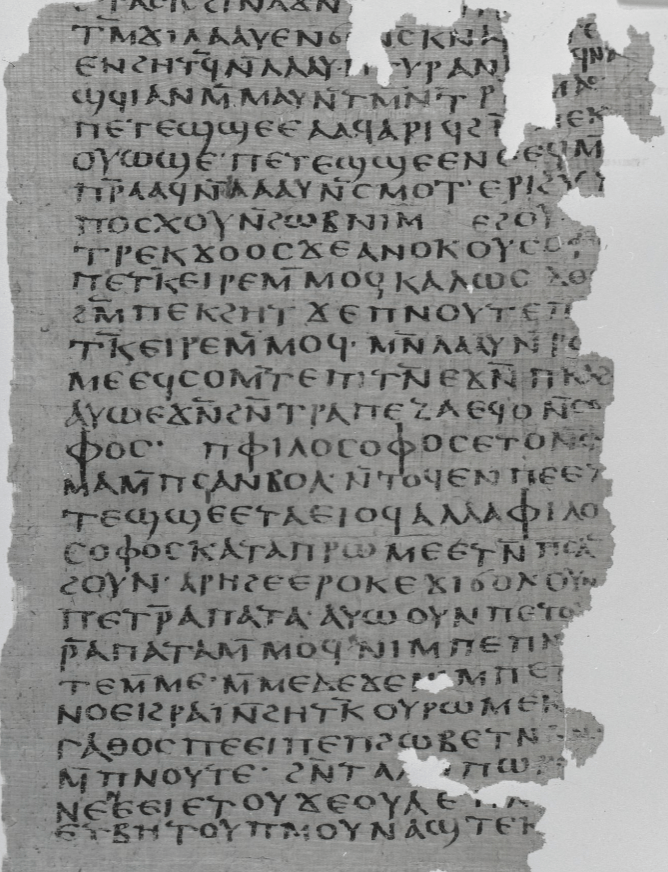
I love how Gospel of Thomas sayings pop up in other writings and today I am showcasing such an example. Saying 22 from Thomas shows up in 2 Clement. What is 2 Clement you ask? Better known as the “Second Epistle of Clement”, this is an early writing attributed to Clement of Rome (not to be confused with Clement of Alexandria), though it’s authorship may not be correctly attributed, i.e. Pseudo-Clement. Interestingly enough, the Orthodox Tewahedo church in Ethiopia has this book (or at least a version of it) listed in their New Testament canon (which is 35 books compared to the 27 in other traditions). As far as I know, no English translation exists of the Tewahedo bible in its entirety, as the OT extra books can be found in English but the NT books not so much.
Gospel of Thomas saying 22 states the following:
Jesus saw some babies nursing. He said to his disciples, "These nursing babies are like those who enter the kingdom."
They said to him, "Then shall we enter the kingdom as babies?"
Jesus said to them, "When you make the two into one, and when you make the inner like the outer and the outer like the inner, and the upper like the lower, and when you make male and female into a single one, so that the male will not be male nor the female be female, when you make eyes in place of an eye, a hand in place of a hand, a foot in place of a foot, an image in place of an image, then you will enter [the kingdom]."
2 Clement addresses this statement in chapter 12 of the epistle, it reads as such:
12:1 Let us, therefore, in love and righteousness expect every hour the kingdom of God, since we know not the day of the appearing of God.
12:2 For the Lord himself, when he was asked by a certain man when his kingdom should come, replied, When two shall be one, and that which is without as that which is within, and the male with the female neither male nor female.
12:3 Now two are one when we speak the truth one to another, and there is, without hypocrisy, one soul in two bodies.
12:4 And by that which is without being as that which is within, he meaneth this: He calleth the soul that which is within, and the body that which is without; in like manner, therefore, as thy body is visible, let thy soul be made manifest by good deeds.
12:5 And by the male with the female neither male nor female, he meaneth this: When a brother seeing a sister doth not in any way regard her as a female, nor doth she regard him as a male;
12:6 when ye do these things, he saith, the kingdom of my Father will come.
Gotta love it! Speaking of Thomas sayings popping up in other works, the recently published oxyrhynchus papyri 5575 has a very interesting Thomas connection. If you do a google search, you’ll see various articles on that. O.P. 5576 and 5577 are gnostic writings, though their translations have not yet appeared online. They are featured in a newly published book though it’s a bit pricey at the moment. When those translations become more easily available, I will most certainly post about them as one of them is a dialogue between Jesus and Mary Magdalene.
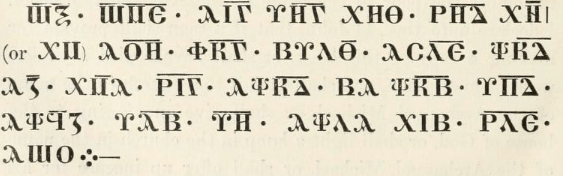
With the feast day of James the Just coming up on October 23, I wanted to post some lesser known stories of James. This post presents two stories from the Ethiopian tradition. Usually I do summaries of texts but in this case I am presenting the two stories in complete form. These come from the 1901 book “The Contendings of the Apostles: Vol 2 – The English Translation” by E.A. Wallis Budge (same person who has done English translations of other Ethiopic & Egyptian texts, be sure to check out his work!). The first story is titled “The Preaching of Saint James the Just” and the second story is titled “The Martyrdom of Saint James the Just”. When I transcribed the text, I pretty much kept it as is. There were a few instances I “modernized” a word/phrase to help it read a bit better. That being said, I kept most of it in the style of the early 20th century biblical English style.
The Preaching of Saint James the Just
In the name of the Father, and of the Son, and of the Holy Spirit, One God.
Here begins the Preaching of James the Just, the Apostle of our Lord Jesus Christ, who was surnamed the brother of our Lord in the flesh. Now the lot which went out to him was that he should preach in Jerusalem, and after he had preached unto the people thereof, he became Bishop in Jerusalem, and he died therein in the name of our Lord Jesus Christ. In the peace of God, Amen. May his prayer and his blessing be with his handmaiden Walatta Madhan!
And it came to pass that, when the Apostles were gathered together that the countries of the world might be divided among them, our Lord Jesus Christ sat in their midst and said unto them, “My peace be upon you, O My holy Apostles! As my Father sent me to the to the world, even so do I send you that ye may preach throughout the whole word the knowledge of my Heavenly Father.” And for this reason they cast lots, and the lot came to James to preach the Holy Gospel in Jerusalem and in all the districts thereof. Therefore did he bow down before God and say, “O God, Thou knowest that the Jews will seek to kill us when we preach thy resurrection and the Holy Gospel. And are not the command the lot which have gone forth to me great? Yet I am only one, and I know that the Jews will not listen unto the words which I shall speak unto them. I beseech thee then, O Lord, send me to the Gentiles, together with my brethren, and I will do everything which thou shall command me to do, and I will bear patiently all the sufferings which shall come upon me for thy name’s sake.” And our Lord answered and said unto James, “Hearken, and I will tell thee; but thou must needs preach the Gospel in the place which hath gone forth to thee by lot. Behold, I have left Peter, my chosen one, to toil for your sake. Thou shalt, however, be Bishop in Jerusalem, and the Jews shall hearken unto thy words, and thou shalt end they contending nobly, and thy grave shall be therein. Rise up and finish that for which I have prepared thee.”
And James said unto him, “O Lord, let but my father Peter help me; and I will bear everything which shall befall me for thy honourable Name’s sake;” and our Lord gave them the salutation of peace, and went up into heaven with great glory. Now the Apostles were filled with the power of the Spirit, and they prayed at the Mount of Olives. And Peter answered and said unto the Apostles, “Let us go with our brother James, so that we may establish him in his bishopric.” Then Peter rose up and all those who were with him, and they stretched out their hands and prayed, saying, “O God, Who dost sustain all creation, hearken unto us. We know that thou wilt not be far from us in whatsoever we require of thee. Grant thou unto our brother James the power to give consolation unto thy people whom thou hast brought back to him, and may he console them, even as thou hast consoled him.” And it came to pass that when they had prayed their prayer, and each of them had given him the salutation of peace, they brought James into Jerusalem, and he preached in the name of our Lord Jesus Christ; and many men believed in his story.
Now, when the Jews saw James preaching in the name of Christ, certain of them wished to slay him, and they were not able to find an opportunity to do this, because of those who had believed in God through him; and when he knew that they were conspiring together against him, he went forth to the regions round about the city, and he preached unto them in the name of our Lord Jesus Christ. And it came to pass that when he had come into those regions he found a certain aged man there, and he said unto him, “I desire that thou wilt let me abide with thee;” and the aged man said unto him, “Take thy rest until tomorrow.” And the Apostle departed to come unto him in his house, and on the way thither he found a man who had a devil in him. Now when Satan saw James the Apostle, he cried out and said, “What hast thou to do with me, O Apostle of Christ? Hast thou come hither to destroy me?” And the Apostle said unto him, “O unclean spirit, make an end of thy speech, and go forth from this man;” therefore Satan went forth from the man in the form of fire. And it came to pass that when the aged man saw this miracle he fell at the feet of the Apostle and said, “I am not worthy that thou shouldst come into my house: but tell me what I shall do that I and all the people of my house may be saved.” Therefore the Apostle glorified the name of Jesus Christ, and said, “Master, I give thanks unto thee that thou hast made fair my way;” and he returned to the man and spake unto him the word which would save him, and he taught him that our Lord Jesus Christ is God. So the aged man brought him into his house; and all the people thereof were gathered together unto him, and he taught them and made them to know the faith, and he baptized them in the name of the Father, and of the Son, and of the Holy Spirit, and he made them to be heirs in the Holy Mysteries, that is to say, the Body of our Lord and His precious Blood.
And it came to pass that, when the people of the country heard of James, they brought unto him all their folk who were sick with sicknesses of every kind, and he healed them; and he appointed priests and deacons for them, and he made the old man bishop, and he gave him the Gospel of our Lord Jesus Christ. Then James went forth into all the districts which were round about Jerusalem, and preached therein; and then he returned to Jerusalem. And the faithful heard of the coming of James (now he was surnamed ‘the Just’) into Jerusalem, and they all came to him, praising God our Lord Jesus Christ, with his Father, and the Holy Spirit, for ever and ever. Amen and Amen.
The Martyrdom of Saint James the Just
In the name of the Father, and of the Son, and of the Holy Spirit, One God.
Here begins the Martyrdom of Saint James the Just, the blessed Apostle, which took place on the eighteenth day of the month of Hamlệ (July). In the peace of our Lord, Amen. May his prayer and his blessing be with his handmaiden Walatta Maghan!
And it came to pass that when James returned to Jerusalem he preached unto the people in that city in the name of our Lord Jesus Christ; and many believed on him by reason of the signs and wonders which God made to go forth by the hand of his holy Apostle, and God our Lord made him worthy of the episcopal throne in Jerusalem. And when he had become Bishop, God made manifest the healing of many folk who were sick of every kind of disease. Now the governor of the city was a lover of money, and hated Saint James because Satan stirred him up against him; and he had no children because God Almighty, whose name is great, was rebuking him for the multitude of his sins. And meanwhile his wife was entreating God to give her children, and she was wont to do deeds of kindness unto all those who were in affliction, and to send gifts and offerings to the sanctuary of the church daily without her husband having knowledge thereof, because of his great greed, and every day of her life she sorrowed exceedingly, and made entreaty to God for children. And it came to pass that although her entreaty waxed great the glorious and holy God did not grant her desire, because he knew that good was about to come upon her. And when the glorious fame of Saint James and of his faith had come to the city, now God was with him in all his work, she rose up with joy and gladness, and came to Saint James in true belief that at the request of the saint God would give her that which she desired. And it came to pass that when the saint knew that Tệryộbastậ {or Piobsata), the wife of ‘Ammậnyộs (Aumanius or Ananus) the governor, wished to come to him to be blessed by him his wonder increased, and he said, “This is a great matter;” now he well knew her husband’s wickedness, and that he had commanded her not to come to him. And when she had come into his presence she bowed her head, and prostrated herself at his feet, and said unto him, “O holy father, I beseech thee to grant the request of thy handmaiden, and to hearken unto her words: I have dwelt with my husband for twenty years and I have not gotten a child, and by reason of this matter I am exceedingly sorrowful.”
And Saint James said unto her, “Dost thou believe in the name of our Lord Jesus Christ, and that he is able to give thee children?” And she answered with her whole heart, and said unto him, “I do believe.” And he said unto her, “If thou believest it shall be unto thee according to thy belief;” and she gave unto him the “blessing” (i.e. alms), which was with her, that he might give it unto those who were in sorrow and affliction; and she came unto her house glorifying God. Now what the holy man had said came to pass, for after this thing God hearkened unto her petition and gave unto her that which she desired, and she conceived and gave birth unto a son whom she called James, according to the name of Saint James; then she took her son and much possessions, and came to the saint, and he blessed her. And she said unto him, “O servant of the Good God, behold, God hath hearkened unto thy petition, and he hath given unto me that I asked for; and this child, this fruit which thou seest in my arms (hath come) through thy prayer; and I beseech thee, O my father, to bless him with all thy heart.” And the saint took him from her hands, and he blessed him with all his heart, and he gave him back to his mother and sent them away to their house in peace.
And it came to pass that when Aumanius (or Ananus) heard of it, he was angry with an exceedingly great anger because his wife had done this thing. And he gathered together unto him all the nobles of the city, and said unto them, “Are ye going to do nothing in this matter? Behold, the Bishop is destroying the city and leading astray all the people, and he wisheth that all those who are in our territories shall be of his opinion, and under his teaching.” And they all rose up and came together, and said, “What then can we do unto him?” And certain men of them said, “Behold, he will come to the feast, and if ye desire to lay hold upon him we will lie in wait for him in the synagogue.” Now many men were called James, but James the Just was not of them. And besides this God Almighty had chosen him and had sanctified him from his mother’s womb, like Jeremiah the prophet, and he neither drank wine all the days of his life nor ate meat where from the blood had gone not forth; and a razor had never gone up upon his head, and he never took a bath, and he put on no clothing except one loose garment all the days of his life. And he continued in the sanctuary always, and he stood up, and watched, and prayed humbly unto God that he would forgive the sins of the people, until at length his foot swelled by reason of his prolonged standing and prostrations; and it was for this reason he was called “James the Just.” Now the Jews knew that he was both just and sincere towards them, and that he was of the type of the Prophets. And this James was the youngest of the sons of Joseph the carpenter, who had four male children and two daughters; and all Joseph’s children married except James, and he became an orphan. And it came to pass that, when our Lady Mary became the bride of Joseph, she found James as a little boy in his house, and she tended him and taught him the fear of God, and for this reason they used to call our Lady Mary the “mother of James.”
And it came to pass that, when James had been appointed Bishop in Jerusalem, multitudes believed on our Lord through him, because they became convinced of his sincerity. Then a great uproar took place among the Jews, and among the Scribes, and among the Pharisees, because all the people said that Jesus was the Christ; and they came to James that they might take counsel with him concerning Him. And they said unto him, “We beseech thee to set thyself at the head of all the multitude, for they will not believe that Jesus is the Christ who shall come. Now behold, all the people will come unto Jerusalem at the Passover, do thou then speak unto them and make their hearts to rejoice, for we know that thou dost not speak any false thing whatsoever; and besides, thou art unto them as a prophet. And we will make them to hear concerning thy graciousness, and that there is no unchastity in thee; accept now our petition, and let them all hear thy voice; and thou shalt go up unto the upper portion of the synagogue, and we will stand there until all the people shall hear thy voice.”
And, behold, of the children of Israel multitudes of the people, of the tribes and of the Scribes and Pharisees, went up to the synagogue wishing that James would tell them that Jesus was the son of Joseph, and that he was his brother; and they commanded the deputy of the congregation to order the multitudes to keep silence and to hearken unto the voice of James the Just. And they all cried out, and said, “We have upon us the desire to hear, and we will not be denied, for the people are made to err by the evilness of the teaching of the Jews, and they have a love for the belief in Jesus who was crucified; tell us now, O just one, who is Jesus the King?”
And it came to pass that when the priests and the Pharisees heard these words, although they pretended to be afraid in the presence of the people, yet were they filled with wraith in their hearts against James the Just; and they went back and cried out to him, and said unto him, “Tell us now, of whom is Jesus the Son?” Then he said unto them, “He is in truth the Son of God the Father, who begot him before the world, and the Virgin Mary gave birth to him after the appointed number of days. I believe in him, and in his Father, who is of old, and in the Holy Spirit, the glorious Trinity which shall have its being unto the end of the world, and for ever.”
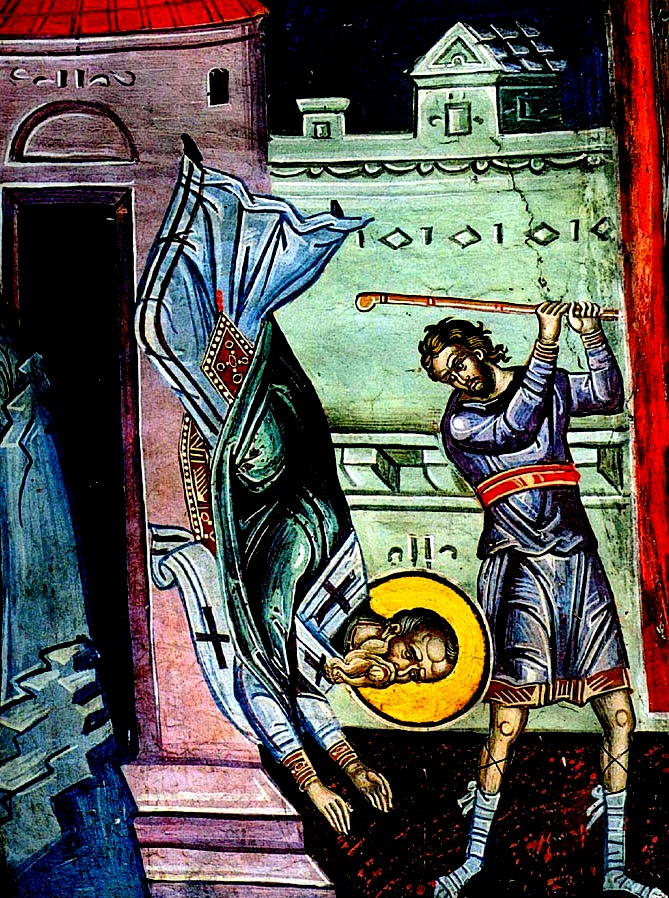
And it came to pass that when the chief priests, and the Scribes, and the Pharisees heard these words from him, they gnashed their teeth at him, and they stopped their ears, so that they might not hear the voice of God from the mouth of Saint James. Then they took counsel together each with the other, and said, “We have done evil, for we have made him to be a witness unto the people that Jesus is the Son of God Almighty; but let us go up against him, and slay him, so that the multitude may not believe in Christ.” Then was fulfilled the prophecy of Isaiah the prophet who said, “The righteous man shall be rewarded, for he that is a harsh man shall not be the anointed one over us; and then shall eat the fruit of their evil work.” And the Jews went up against James in wrath, and they thrust him off from the pinnacle of the temple and threw him down there from, and he fell upon his face, and he knelt down upon his knees like Stephen Protomartyr, and he made supplication unto God, saying, “O God, thou merciful One, be merciful unto them, and show compassion unto them, for they know not what they do;” and they cast him down as he was making this petition.
Now there was a certain priest of the children of Ahaz who bore witness on his behalf. And Jeremiah the prophet cried out unto them, saying, “Wait ye a little, what then is this which ye will do unto the man of God the Good? Behold, he prayeth unto God that he will forgive you your sins.” And there was among the Jews a certain beater of clothes who withdrew not at the voice of James, and he seized the piece of wood wherewith he was wont to beat clothes, and smote James the Just upon his head with it; and James yielded up his spirit on the eighteenth day of the month of Hamlệ (July), and he ended his contending, and they buried him in the synagogue.
And it came to pass after the death of James the Just, the Apostle, and Martyr, and Bishop, who died in the name of Jesus Christ, there came great wrath upon all the Jews and upon those who dwelt in Jerusalem, but it was the greater upon those who had sought to slay James the Just, the Apostle. And ‘Esbậsyậnộs (Vespasian) the Emperor besieged them and spoiled their city and country, and carried them away captives, and every day their disgrace was increased, and they were brought lower by reason of the evil which they had wrought against our Lord Jesus Christ and against his saints. And may it be that we and all Christians who call themselves by his new name may find mercy and forgiveness at the awful place, when our Lord Jesus Christ cometh to judge the living and the dead; to him be glor and honour forever and ever! Amen, Amen, and Amen.
Here ended the Martyrdom of Saint James the Just. May his prayer protect us all the children of this place forever! Amen.
Featured artwork is of traditional Christian iconography
The Apocalypse (Revelation) of Peter is quite the interesting text. Not to be confused with the “Coptic” Apocalypse of Peter that was found in Nag Hammadi (gotta love similar titled texts), this apocalyptic work almost made it into the canon and was used in some early churches. If you are unfamiliar with it, the text deals with Peter and the revelation he is given to of the final day. These revelations include hellish torments but also heavenly blisses. The hell descriptions give off Dante’s Inferno vibes though it obviously predates that work by at least 1100 years. The history of the AoP is quite interesting. I will link the wiki article at the end as I do not want to dive too much into that back story, but if you like reading about how these ‘lost’ texts re-emerge, you should check it out.
The text survives in Greek and Ethiopic versions. The Greek is fragmented while the Ethiopic version is complete. From my research in the past, I noticed a lot of people like to dismiss the Ethiopian versions, even though time and time again, Ethiopian translations stay pretty accurate to the original versions (besides some name changes, etc…). As I have mentioned before, the Ethiopian Christian tradition has a LOT of material that is quite remarkable. Do not discount that tradition and overlook it. For this review of the AoP, I will be following the Ethiopic version (Bart Ehrman translation).
The text starts with Jesus and his disciples on the Mount of Olives. The disciples ask him what will be the signs of his second coming and the end of the world (this conversation is post resurrection). Jesus warns them not to believe in others who will use his name (i.e. the antichrist). He tells them “For the coming of the Son of God shall not be plain; but as the lightning that shines from the east to the west, so will I come upon the clouds of heaven with a great host in my majesty; with my cross going before my face will I come in my majesty; shining seven times brighter than the sun will I come in my majesty with all my saints, my angels. And my Father shall set a crown upon my head, that I may judge the quick and the dead and recompense everyone according to his works.”
Chapter 2 is an interesting description of the fig tree parable. Peter asks Jesus to explain this saying. Jesus responds by stating the fig tree is the house of Israel. He explains “Verily I say to you, when its twigs have sprouted forth in the last days, then all false Christs come and awake expectation, saying ‘I am the Christ who has now come into the world.’ And when they perceive the wickedness of their deeds they shall turn away and deny him whom our fathers praised, the first Christ whom they crucified and therein sinned a great sin. But this deceiver is not the Christ. And when they reject him, he shall slay them with the sword, and there shall be many martyrs. Then shall the twigs of the fig tree, that is, the house of Israel, shoot forth: many shall become martyrs at his hand. Enoch and Elijah shall be sent to teach them that this is the deceiver who must come into the world and do signs and wonders in order to deceive. And therefore those who die by his hand shall be martyrs, and shall be reckoned among the good and righteous martyrs who have pleased God in their life.“
Chapter 3 has Peter and Jesus once again conversating. This time, Jesus holds out his right hand and the souls of all people are shown onto it. He explains how the sinners and the righteous will be separated at the last day. Peter asks him if it would have been better if the sinners were not created. Jesus responds by asking Peter would he resist God and not show compassion for those who were created. He recognizes that Peter is troubled by seeing what will happen to the sinners and then proceeds to tell him what these sinners have done to receive such judgments.
Chapters 4 – 13 go into detail about the final days. Hell is commanded to open up and give up all that is therein. Animals will restore all the flesh that they have eaten, thus every living creature will once again be alive. The archangel Uriel is mentioned in chapter 4 as being sent by God to over see the resurrection of the dead on judgment day. The plants of the earth are all restored and become fruitful. Basically any living entity is brought back to life on this day. However, a surprise is awaiting them all. Cataracts of fire are let loose throughout the world. Darkness and obscurity spreads throughout. All the water is turned into coals of fire. Imagine being brought back to a flesh existence and the whole world goes to hell, literally!
During all this, Christ comes down on an eternal cloud of brightness with the angels behind him. The Father places a crown upon his head and now it’s time for judgment. Uriel is tasked with bringing forth the souls of sinners. Several examples of punishments are provided due to whatever sin(s) that the soul had performed. The archangel Azrael (spelled Ezrael) brings forth the souls of those who have been slain, who will then behold the torment of those who slew them. Azrael also has the job of casting sinners into a place of darkness so their entrails could be devoured for eternally.
The text has a lot of descriptions of tortures for specific sins. I am not going to list them all (I’d end up quoting most of the text if that was the case), but here are a few examples:
“Women are swallowed up therein up to their necks and tormented with great pain. These are they who have caused their children to be born untimely and have corrupted the work of God who created them. Opposite them shall be another place where children sit alive and cry to God. And flashes of lightning go forth from those children and pierce the eyes of those who for fornication’s sake have caused their destruction.”
“And beside those who are there, shall be other men and women, gnawing their tongues; and they shall torment them with red-hot irons and burn their eyes. These are they who slander and doubt my righteousness.”
“And near by this place of torment shall be men and women who are dumb and blind and whose raiment is white. They shall crowd one upon another, and fall upon coals of unquenchable fire. These are they who give alms and say, ‘We are righteous before God,’ whereas they have not sought after righteousness.”
You get the point. One could put together quite the list of ‘sins equals this type of punishment’ with this text! Chapter 13 has the angels bring the righteous and elect to show them the sinners who had torment upon them. It mentions that all the tormented cry out for mercy. The angel Temeluchus (spelled Tatirokos, chief angel of torment) comes along and chastises them with even more torment while saying to them “Now do you repent, when it is no longer the time for repentance, and nothing of life remains.” The torment cry out one last time “Righteous is the judgment of God, for we have heard and perceived that his judgment is good, for we are recompenses according to our deeds.” And that sentence right there is why many scholars believe this text did not make the canon. It is saying that if the sinners were able to ask for repentance during this time, then what does it matter during their lifetime what they do. What good is a church if you can ask for repentance during the day of judgment? Regardless of one’s belief on the subject matter, I think we can all agree this would cause an issue in the order of what the church was to become.
Chapter 14 takes us away from the hellish torments and has Jesus ending his discourse with Peter, telling him to go spread the gospel throughout the world. Before he leaves, Jesus takes all his disciples up the holy mountain where two men are standing. These two beings had a light coming from them so bright it made the sun’s light pale in comparison. The appearances of them had a rose like color to them. Each of them had a crown of nard woven from flowers upon their heads. Their hair was like rainbows. Jesus tells his disciples that two beings are Moses and Elijah. The disciples ask of Abraham, Isaac, Jacob and the other righteous fathers. Jesus shows them a garden full of fair trees and blessed fruits, all of which had a pleasant fragrance that filled the air. Chapters 15 & 16 are descriptions of heaven. Kind of odd that hell gets numerous chapters but heaven only two?
The text ends with a voice from above saying “This is my beloved Son in whom I am well pleased: he has kept my commandments.” Jesus, Moses and Elijah all ascend into heaven. The disciples watched as the three rose through the air and entered. The clouds of heaven closed and the disciples went down the mountain while glorifying God.
Now I want to compare the Greek fragment to the Ethiopian version. In the Greek manuscript that survives, it starts with the introduction of the two heavenly beings as well as a small glimpse into heaven. However it does NOT mention that the two beings are Moses and Elijah. After the showing of heaven, Jesus directs Peter to where the damned are, thus the tour of hell starts. The manuscript ends before all the hellish torments are explored. This fragment was found in a burial tomb of an 8th/9th century monk in Akhmim, Egypt. Many scholars believe this is an edited version of the text and that the Ethiopian version would be more close to the original in its structure. I agree with this statement.
The Revelation to John would win out for inclusion into the New Testament (though itself was almost not included, a story for another time) and the AoP was left out. As I mentioned during the review, that sentence about repentance during judgment would have thrown a major kink into the theology that was being set forth during the formation of an official church. I guess they could have easily edited out that line if need be. The AoP would survive well into medieval times in Europe before copies disappeared (i.e. were just not being copied anymore and not some conspiracy to “silence it”). Thankfully the Ethiopian tradition kept copying the text and we now have it for all to read.
Once again, I invoke the writings of Epiphanius (the Panarion) of the Borborites. The lost text I am writing about today is the “Greater Questions of Mary”. A few lines are quoted by Epiphanius but most of it is his commentary. I will warn you, the content can get pretty explicit.
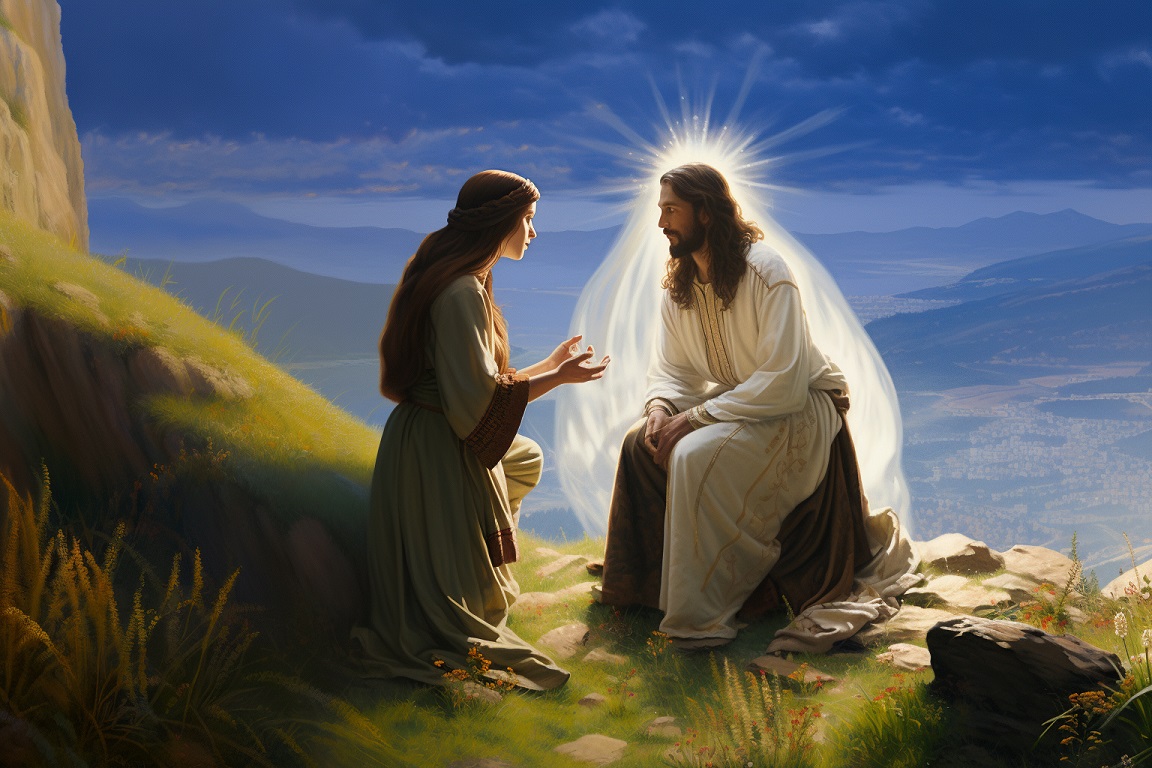
Epiphanius gives a few lines to this lost text. I will follow along with how he describes it since this is the only source that is known to exist. He states that the GQM involves Jesus taking Mary (I presume Mary Magdalene, but it does not specifically say; I sure hope it’s not his mother! lol) up a mountain to pray. While there, Jesus produces a woman from his side, whom he then haves sex with and eventually this woman partakes of his “emission”. This act is in reference to the quote “Thus we must do, that we may live.” This act causes Mary to fall to the ground. Jesus helps her up and says “O thou of little faith, wherefore didst thou doubt?” Epiphanius states that the text is in reference to John 3:12 (I have spoken to you of earthly things and you do not believe; how then will you believe if I speak of heavenly things?) and John 6:62 (Then what if you see the Son of Man ascend to where he was before!), but I’m going to go a step further and include John 6:61 (Aware that his disciples were grumbling about this, Jesus said to them, “Does this offend you?). Epiphanius also relates this text to the John 6:53 saying (Jesus said to them, “Very truly I tell you, unless you eat the flesh of the Son of Man and drink his blood, you have no life in you). This scene being described is obviously an allegory for the Eucharist. With not much else to go on, it is really hard to tell what this scene is trying to portray. If we take it as Epiphanius describes, in a literal context, then yes, I can see it being a perverse allegory of the Eucharist. Mary falling down after witnessing the sex act, it is stated that the Borborites believed this to be the same as when the disciples of Christ found his teaching of the Eucharist to be a “hard teaching” (John 6:60 On hearing it, many of his disciples said, “This is a hard teaching. Who can accept it?”). Mary can’t believe this teaching just as the disciples could not believe the teaching.
The next paragraph in the Panarion will refer to Psalms 1:3 (He is like a tree planted by streams of water that yields its fruit in its season, and its leaf does not wither. In all that he does, he prospers) and Proverbs 5:15 (Drink water from your own cistern, flowing water from your own well). It is stated that the Psalms 1:3 refers to a man’s “dirt (emission)” and that the outpouring from it’s fruit is an allegory for climaxing. The leaf not withering is in reference to another consuming this emission, hence not wasting it. Epiphanius provides no quotation from the GQM for this explanation. The proverbs mention is in reference to a section of the GQM that Epiphanius does not quote either, as he does not want to bring any more harm to the reader, but he states: “When it says that Rahab put a scarlet thread in her window, this was not scarlet thread, they tell us, but the female organs. And the scarlet thread means the menstrual blood, and ‘Drink water from your cisterns’ refers to the same.”
In the final paragraph, I am not sure if this is in reference to the GQM or if it’s just a belief of the Borborites. Regardless, I am going to include it here as it is quite an interesting read. It is stated that the flesh must perish and cannot be raised as it belongs to the archon. However, the power of the soul is within everything, be it man, animal, plant, insect, bread, etc…. so we are doing a favor by eating any and all of this, as it will then elevate the soul of that entity to the heavens with us. A form of mercy is shown by doing this. This sort of reminds me of saying 7 from the Gospel of Thomas (Jesus says: “Blessed is the lion which a man eats so that the lion becomes a man. But cursed is the man whom a lion eats so that the man becomes a lion!”). Epiphanius being in line with orthodox tradition would believe in the resurrection of the flesh, so I can see how he would be at odds with the statement, but if one was in the Gnostic tradition and did not believe in that concept, this “gathering of souls” to ascend with you into the heavens makes sense. I like it!
While this fragment of the GQM may be shocking upon first reading it, looking at it through a different interpretation, it makes sense whether you believe in their line of thinking. Personally I wouldn’t get so graphic with my interpretation and allegorical use, but I understand what the group was trying to convey.
Once again I dip back into the Panarion by Epiphanius, this time referencing the lost text, “The Gospel of Eve.” This Gnostic (Borborite) text survives in two quotations. Keep this in mind when reading the following because there is no context behind what is being said, either from within the gospel itself or the purpose of Epiphanius’ slandering (he goes on and on ranting about the group, lol). For this first quotation, I changed the wording slightly to make for an easier modern English reading.
I stood upon a high mountain and saw a tall man, and another of short stature, and heard as it were a sound of thunder and went nearer in order to hear. Then he spoke to me and said: I am you and you are I, and where you are, there am I, and I am sown in all things; and where you wilt, you gathered me, but when you gathered me, then gathered yourself.
Now with no context in mind, nor do we know who is saying this (is it Eve? another character?), what can we take from this fragment? I see this as some sort of vision where the higher power is revealing itself to be a part of everything. We have in all of us sparks of divinity from the true “God”, thus in all of us and everything, there in lies the divine source. This phrase also reminds me of the Gospel of Thomas saying 77:
Jesus said, “I am the light that is over all things. I am all: from me all came forth, and to me all attained. Split a piece of wood; I am there. Lift up the stone, and you will find me there.”
There is a second fragment that exists and Epiphanius claims it is in reference to the group’s ritual partaking of ingesting menstrual blood. Now the evidence of such claims can not be verified, so I can’t really comment one way or another on the claim. That being said, here is the fragment:
I saw a tree bearing twelve manner of fruits every year, and he said unto me, This is the tree of life.
So if we take Epiphanius at his words, this tree would be represented by a female and the twelve manner of fruits would be the monthly menstrual cycle. He claims that the group see menstrual blood to be the blood of Christ. He goes on a rant about the group speaking of how they have sex for enjoyment, not for procreation, and if by some chance any of the women get pregnant, an abortion is performed. The fetus is then mixed with honey, pepper, and other spices. Finally, all the members perform an act of cannibalism and eat this “dish”. This is apparently to mock the archon of lust. As I mentioned before, these claims can’t be verified and perhaps Epiphanius is projecting some sort of deep emotions within himself, lol. Then again, he could be right. This act would definitely be a mockery towards the archon of lust.
This is all that survives of this text unless it somehow emerges from the sands of Egypt (fingers crossed!). I will be revising Epiphanius and his rants against the Borborites in future posts. Stay tuned!!
Artwork is midjourney created, based on the first fragment.
When I started this blog a few years ago, I had no idea how long I would keep it up. I figured I would eventually run out of things to talk about. Boy was I wrong. This blog entry is #100! I figure with this post I will comment on the demiurge, Yaldabaoth. I don’t mention the ruler of this world very often but recently I conjured up a piece of A.I. art (via Midjourney) of Sophia giving birth to Yaldabaoth. I figured I would display the photo here and along with it, I will include various texts that describe this event. The gist of the story involves Sophia (Divine Wisdom) breaking from her male aeon counterpart and wanting to create life on her own. This corruption of the cosmic harmony resulted in an abomination that horrified Sophia, who then discarded this creature into the abyss. This aborted entity acting on it’s own believes that itself is God and ruler of all. He begins to create reality around him (the world of matter). There are many interpretations of the demiurge. Some see him as bad, others (including myself) see the demiurge as just another part of the overall cosmic cosmology playing a part. Just like Judas in the Jesus story, we all have a role in this divine play. Below is the artwork I conjured up:
I use the Midjourney A.I. program to produce this photo. This is from their version 5 of the program. Yaldabaoth has always been a problem trying to get right with the program in previous versions. Version 1 of the program, I could never get anything close to the entity. Later versions I was able to come up with some good results. See below:
Not too bad! Anyway, let’s get to the texts involving the birth of the chief archon. First snippet is from the Secret Book of John, translation by Stevan Davies:
A Crisis that Became the World
It happened that the realm (aeon) Wisdom (Sophia) Of conceptual thought (Epinoia), Began to think for herself, She used the thinking (enthymesis) And the foreknowledge (prognosis) Of the Invisible Spirit.
She intended to reveal an image from herself To do so without the consent of the Spirit, Who did not approve, Without the thoughtful assistance of her masculine counterpart, Who did not approve.
Without the Invisible Spirit’s consent Without the knowledge of her partner She brought it into being.
Because she had unconquerable Power Her thought was not unproductive. Something imperfect came out of her Different in appearance from her.
Because she had created it without her masculine counterpart She gave rise to a misshapen being unlike herself.
Sophia saw what her desire produced. It changed into the form of a dragon with a lion’s head And eyes flashing lightning bolts. She cast him far from her, Outside of the realm of the immortal beings So that they could not see him.
[She had created him in ignorance.]
Sophia surrounded him with a brilliant cloud, Put a throne in the center part of the cloud So that no one would see it. [Except for the Holy Spirit called the Mother of the Living] She named him Yaldabaoth.
Yaldabaoth is the chief ruler. He took great Power (dynamis) from his mother, Left her, and moved away from his birthplace. He assumed command, Created realms for himself With a brilliant flame that continues to exist even now.
Up next is On the Origin of the World, translated by Hans-Gebhard Bethge and Bentley Layton:
Now the eternal realm (aeon) of truth has no shadow outside it, for the limitless light is everywhere within it. But its exterior is shadow, which has been called by the name ‘darkness’. From it, there appeared a force, presiding over the darkness. And the forces that came into being subsequent to them called the shadow ‘the limitless chaos’. From it, every kind of divinity sprouted up […] together with the entire place, so that also, shadow is posterior to the first product. It was <in> the abyss that it (shadow) appeared, deriving from the aforementioned Pistis.
Then shadow perceived there was something mightier than it, and felt envy; and when it had become pregnant of its own accord, suddenly it engendered jealousy. Since that day, the principle of jealousy amongst all the eternal realms and their worlds has been apparent. Now as for that jealousy, it was found to be an abortion without any spirit in it. Like a shadow, it came into existence in a vast watery substance. Then the bile that had come into being out of the shadow was thrown into a part of chaos. Since that day, a watery substance has been apparent. And what sank within it flowed away, being visible in chaos: as with a woman giving birth to a child – all her superfluities flow out; just so, matter came into being out of shadow, and was projected apart. And it did not depart from chaos; rather, matter was in chaos, being in a part of it.
And when these things had come to pass, then Pistis came and appeared over the matter of chaos, which had been expelled like an aborted fetus – since there was no spirit in it. For all of it (chaos) was limitless darkness and bottomless water. Now when Pistis saw what had resulted from her defect, she became disturbed. And the disturbance appeared, as a fearful product; it rushed to her in the chaos. She turned to it and blew into its face in the abyss, which is below all the heavens.
And when Pistis Sophia desired to cause the thing that had no spirit to be formed into a likeness and to rule over matter and over all her forces, there appeared for the first time a ruler, out of the waters, lion-like in appearance, androgynous, having great authority within him, and ignorant of whence he had come into being. Now when Pistis Sophia saw him moving about in the depth of the waters, she said to him, “Child, pass through to here,” whose equivalent is ‘yalda baoth’.
Since that day, there appeared the principle of verbal expression, which reached the gods and the angels and mankind. And what came into being as a result of verbal expression, the gods and the angels and mankind finished. Now as for the ruler Yaltabaoth, he is ignorant of the force of Pistis: he did not see her face, rather he saw in the water the likeness that spoke with him. And because of that voice, he called himself ‘Yaldabaoth’. But ‘Ariael’ is what the perfect call him, for he was like a lion. Now when he had come to have authority over matter, Pistis Sophia withdrew up to her light.
Here is the dialogue between the angel Eleleth and Norea, the daughter of Eve, in the Reality of the Rulers (aka Hypostasis of the Archons), translated by Willis Barnstone and Marvin Meyer:
The great angel Eleleth, understanding, spoke to me: “Incorruptibility inhabits limitless realms. Sophia, who is called Pistis, wanted to create something, alone, without her partner, and what she created was celestial.
“A veil exists between the world above and the realms below, and shadow came into being beneath the veil. That shadow became matter, and that shadow was projected apart. And what she had created came to be in matter, like an aborted fetus. It assumed a shape molded out of shadow, and became an arrogant beast resembling a lion. It was androgynous, as I have already said, because it derived from matter.
“Opening his eyes he saw a vast quantity of endless matter, and he turned arrogant, saying, ‘I am god, and there is no one but me.’
“When he said this, he sinned against all. And a voice came from above the realm of absolute power, saying, ‘You are wrong, Samael,’ that is, god of the blind.
“And he said, ‘If any other thing exists before me, let it become visible to me!’ Immediately Sophia pointed her finger and introduced light into matter, and she pursued it down to the region of chaos. And she returned up to her light. Once again darkness returned to matter.
I am currently reading “The Apocryphal Gospels” translated by Simon Gathercole. It features numerous non-canonical texts, some gnostic, some that are not, as well as fragments. As I have mentioned elsewhere, it is always a pleasure to read new translations of various texts which gives me a new perspective (and in the case of Gospel of Judas, can drastically change the meaning of the story). This blog post is regarding a fragment by Epiphanius. I have made posts about his works before and knew I would come back to him. The story I am referring to is a Gnostic lost text titled “The Book of Mary”. Epiphanius describes a scene from the book detailing the death of John the Baptist’s father, Zacharias. Here is the actual English translation of Epiphanius’ commentary, from “The Panarion of Epiphanius of Salamis”:
“They blaspheme not only Abraham, Moses, Elijah and the whole choir of prophets, but the God who chose them as well. Indeed, they have ventured countless other forgeries. They say that one book is a “Birth of Mary,” and they palm some horrid, baneful things off in it and say that they get them from it. On its authority they say that Zacharias was killed in the temple because he had seen a vision, and when he wanted to reveal the vision his mouth was stopped from fright. For at the hour of incense, while he was burning it, he saw a man standing there, they say, with the form of an ass. And when he had come out and wanted to say “Woe to you, whom are you worshiping?” the person he had seen inside in the temple stopped his mouth so that he could not speak. But when his mouth was opened so that he could speak, then he revealed it to them and they killed him. And that, they say, is how Zacharias died. This, they say, is why the priest was ordered to wear bells by the lawgiver himself. Whenever he went in to officiate, the object of his worship would hear them jangle and hide, so that no one would spy the imaginary face of his form.”
In Simon Gathercole’s book, he offers his own commentary regarding this section and states that pagans would taunt Jews (and by default, Christians) as worshipping a donkey headed deity. There is the infamous Alexamenos graffito piece that depicts Jesus as a donkey headed deity:
This “Book of Mary” fragment is an explanation of this group to side with the pagans in describing the Jewish god (i.e. the demiurge) and oddly enough, give an explanation on why priests wear bells into the temple. I thought this fragment would be great to test out in the Midjourney A.I. art program, so behold, the donkey deity:
I want to bring attention to another unknown gospel, that being the so-called “Gospel of the Hebrews”. This gospel only survives in fragments and that is in thanks to the church fathers quoting the text. Otherwise, it is a lost text (until a copy emerges, fingers crossed!). I will be posting all the known fragments without any of the church fathers’ notes or comments. There is some interesting stuff here!
When Christ wished to come upon the earth to men, the good Father summoned a mighty power in heaven, which was called Michael, and entrusted Christ to the care thereof. And the power came into the world and it was called Mary, and Christ was in her womb seven months.
Upon reading various texts regarding Mary’s time carrying Jesus in her womb, I’ve seen the time range vary by a few months. Just an observation.
And it came to pass when the Lord was come up out of the water, the whole fount of the Holy Spirit descended upon him and rested on him and said to him: My son, in all the prophets was I waiting for thee that thou shouldest come and I might rest in thee. For thou art my rest; thou art my first-begotten Son that reignest for ever.
Even so did my mother, the Holy Spirit, take me by one of my hairs and carry me away on to the great mountain Tabor.
These two fragments deal with the Holy Spirit. Notice how the Holy Spirit is said to be the mother of Christ. In traditional Christian dogma, this is not the case, but this is the thought in various gnostic groups like the Valentinians. The Holy Spirit is usually identified with Sophia (Divine Wisdom) or even Barbelo (whom would be the source of all these emanations). This thinking brings us to a trinity of the Father – Mother – Son, an idea that permeates throughout world religions.
He that marvels shall reign, and he that has reigned shall rest.
He that seeks will not rest until he finds; and he that has found shall marvel; and he that has marveled shall reign; and he that has reigned shall rest.
These fragments sound eerily familiar. This is basically the same as saying 2 from the Gospel of Thomas (Jesus said, “Those who seek should not stop seeking until they find. When they find, they will be disturbed. When they are disturbed, they will marvel, and will reign over all. And after they have reigned they will rest.”) Another “lost” gospel (like my previous posts about the Gospel of the Savior) where a Thomas saying pops up. Love it!
And never be ye joyful, save when ye behold your brother with love.
He that has grieved the spirit of his brother.
“Brotherly love” is a concept that is not unfamiliar in the Christian world even if some don’t seem to practice it like they should.
And when the Lord had given the linen cloth to the servant of the priest, he went to James and appeared to him. For James had sworn that he would not eat bread from that hour in which he had drunk the cup of the Lord until he should see him risen from among them that sleep. And shortly thereafter the Lord said: Bring a table and bread! And immediately it added: he took the bread, blessed it and brake it and gave it to James the Just and said to him: My brother, eat thy bread, for the Son of man is risen from among them that sleep.
This fragment shows the importance of James the Just, brother of Jesus. I always feel James does not get as much attention as he should. The Gospel of Thomas saying 14 has the line, “No matter where you are you are to go to James the Just, for whose sake heaven and earth came into being”, which shows how important James really is. Based off of that, James should have been the successor of the group, but we all know how that played out. This also points out how the Gospel of the Hebrews would be more Jewish oriented as James has always been more associated with traditional Jewish beliefs in the Christian theology.
That is all the fragments that are known to exist. Some small summaries of pieces show up elsewhere, but I am not including them. I suggest reading the wiki page on the Gospel of the Hebrew for those summaries and a bit of history on this missing gospel. Let’s hope the sands of Egypt (or perhaps hidden away in some monastery) brings forth this lost text!
To continue on with the Gospel of the Savior, we start at page 108, which continues the narrative from the previous page. This page is fragmented thus disrupts the flow of text. Here are some highlights. Jesus speaks of the plan against him and that he is a stranger to him. The person he is referring to is unknown due to a missing section. Jesus then states “Therefore now, behold, I suffer because of the sins of the world. But I rejoice over you for you have continued well in the world.” After this, the text really fragments and we get select pieces here and there for half a column. When the text stabilizes, Jesus announces joy for the world and not to weep, but rather rejoice. He has overcome the world and not to let it overcome you. He has become free from the world, and you will become free from it as well. Jesus also mentions that he will be pierced on his side and he who sees it, let him bear true in his witness.
Now the text really comes apart (literally). The next two pages have a decent amount of content with the remainder of the gospel being fragmented pieces. Page 113 has what best describes as some sort of vision the apostles have. The text states that the apostles witness the world becoming dark before them, and then they became “as those among the Aeons of glory.” To me, this reads with a gnostic slant as obviously it is referring to the divine beings that are called Aeons in the gnostic mythos. The text mentions the apostles seeing their savior after he attained to the fourth heaven. Again, another gnostic reference. Traditionally there are not four (or more) heavens in mainstream Christian thought, but there is in gnostic cosmology (“Gospel of Mary” and “Books of Jeu” quickly come to mind). The text now gets really fragmented and with what remains, it mentions angels and archangels fleeing. Cherubim are mentioned but not what they do. When a more coherent fragment resumes, it states “they cast their crowns down at the front of the throne of the Father. All the holy ones received their robes…..” There’s a break in the text until it resumes with a passage of someone weeping and distressed so that the angelic host is disturbed.
Page 114 is our last page with a lot of text before we come to fragmented tidbits. The first column of the page is missing quite a bit, but it has Jesus speaking to the Father. The second column, particularly the first half, remains mostly intact. It has Jesus saying “…to die with joy and pour out my blood upon the human race. Yet I weep only for my beloved, who are Abraham and Isaac and Jacob, that they may be able to stand in the day of judgment. I will sit upon my throne and I will judge the world. They will say to me that……” The remainder of the column is missing quite a bit but still has Jesus speaking to the Father.
The book lists pages 115, 116, 121 and 122. All these are various fragments. 122 has a section that states “in three days, and I will take you to heaven with me, and teach you. Since your desire….” Obviously, this is Jesus speaking, but to whom? The rest of the book has fragments that belong to no particular page and have no context. I will not list them all but will pull out a few select examples.
Fragment 5F: “A little longer, O cross, and that which is lacking is perfected, and that which is diminished is full. A little longer, O cross, and that which fell arises. A little longer, O cross, and all the pleroma is perfected.“
Fragment 19F: “They will not remember his generation, since his wife will be widowed and his children will be fatherless.“
Fragment 19H: “…it (feminine) gives milk, another one (fem.) gives honey. As for you, rest yourselves by the spring of the water of life.“
I may revisit this gospel in a future post once I get the Ehrman translation. It will be interesting to see how similar (or different) it is to this one. Be sure to pick up the Hedrick / Mirecki book of the Gospel of the Savior. They offer up facsimiles of the papyrus, a commentary and history of the text.
I love finding new “lost manuscripts” that don’t get the publicity they should. Some discoveries make headlines for decades and others barely a mention. This particular text is one that has been over looked. The so called “Gospel of the Savior” is from a collection of fragments at the Berlin Egyptian Museum and was purchased from a dealer back in 1967. It would not be until the 1990s that the fragments came out of hiding to be conserved and translated. I am using the book Gospel of the Savior by Charles W. Hedrick and Paul A. Mirecki for referencing. Bart Ehrman has made a translation of this gospel in the early 2000s, but I do not have a copy (right now), so I can’t compare the two translations. The name “Gospel of the Savior” is not the text’s true name. That has been lost, but like other ancient texts in a similar situation, it has been given a title. This collection of fragments is a dialogue gospel. It features Jesus talking to his disciples. It survives in Sahidic Coptic and dates after the fourth century. It is believed to be from a Greek source, possibly second century. I won’t get into any of the technical analysis of the text, the book I mentioned earlier does a pretty good job of that and I highly recommend picking up a copy. That being said, what does the text say?
As I mentioned earlier, this is a collection of various fragmented pieces. A lot of pages have missing content and only scattered words remain. I will not comment too much on those pages, but rather focus on the pages that remain intact enough to follow a comprehensive narrative. I will refer to the page numbers that are given to the text in the book. If you get a copy, you will know what I am talking about. If you don’t, it may seem odd.
Page 97 has Jesus conversating with Andrew. Jesus states a few lines such as “Blessed is the one who will eat with me in the kingdom of the heavens. You are the salt of the earth, and you are the lamp that illuminates the world.” Other fragment parts include “Do not sleep nor slumber…” and “the garment of the kingdom, which I bought with the blood of the grape (or vine)…” Andrew replies but his response is missing. The text continues on the next page with Jesus stating “If I have cared for the things of the world, it is also fitting for me to go down to Hades because of the souls that are bound in that place.” So referring back to the first line of Jesus, that is very similar to Luke 14:15 (“Blessed is everyone who will eat bread in the kingdom of God!” ESV) The salt of the earth and lamp reference is mentioned in Matthew 5:13 & 14 (13 “You are the salt of the earth, but if salt has lost its taste, how shall its saltiness be restored? It is no longer good for anything except to be thrown out and trampled under people’s feet. 14 “You are the light of the world. A city set on a hill cannot be hidden.” ESV).
Page 98 has quite a bit of text that survives. It has Jesus giving a revelation with joy. He mentions that “now therefore while you are in the body, do not let matter rule over you: Arise, let us go away from this place. For the one who will hand me over is near.” As you can see, this is taking place right before Judas betrays him. Jesus mentions that they will all flee from him and be left alone. He states “but I do not remain alone for my Father is with me. I and my Father, we are a single one.” Page 99 continues on this narrative. Jesus states he is the good shepherd and will lay down his life for you, and that you should do the same for your friends, as this will please the Father. He mentions there is no greater commandment than this. Jesus also mentions he was divine, but became human and then the text cuts off. It resumes with one of the disciples asking how much time will pass before they are summon out of the world, and the text cuts off.
Page 100 is pretty fragmented but there is a section that describes a viewing of the ascension to heaven. One of the disciples is talking about becoming spiritual bodies and approaching the heavens. Entities in that realm were afraid of seeing them ascend. A vision of the savior is mentioned before the text abruptly ends.
The next page is 105 and it is very fragmented. There is one complete sentence intact which states “The one who does not receive my body and my blood, this one is a stranger to me.” A very pro-Eucharist stance there! Page 106 is extremely fragmented but what is left, it seems like it is Jesus telling his disciples not to weep over him but rejoice for his impending bodily end.
Page 107 remains mostly intact. It starts with Jesus telling his disciples not to be disturbed when they see him (in regards to post resurrection). The disciples asks him what kind of body will he appear in when he reveals himself. John then speaks and asks that the Lord not to reveal himself in all his glory, but rather a different form of this glory so that they (the disciples) could see him without fear and despair. Jesus tells them that he will appear to them in a form that they can witness him, but not to touch him until he goes to the Father. This is similar to when Jesus tells Mary Magdalene in John 20:17 (Jesus said to her, “Do not cling to me, for I have not yet ascended to the Father; but go to my brothers and say to them, ‘I am ascending to my Father and your Father, to my God and your God.’” ESV). Now the really interesting tidbit comes next when Jesus says “And if one is near to me, he will burn. I am the fire that blazes; who is near to me, is near to the fire; who is far from me, is far from life.” Sound familiar? Why, this parallels saying 82 of the Gospel of Thomas! That saying is: “Jesus said, “Whoever is near me is near the fire, and whoever is far from me is far from the (Father’s) kingdom.“I absolutely love the fact a Thomas saying pops up in another discovered text! The text fragments a bit after this before continuing with Jesus stating “As for me, I am in your midst as a child. Amen. A little longer I am in your midst.”
My next post will finish up the Gospel of the Savior. If this text sounds interesting to you, be sure to pick up the book I mentioned at the beginning!