Gospel of the Hebrews

I want to bring attention to another unknown gospel, that being the so-called “Gospel of the Hebrews”. This gospel only survives in fragments and that is in thanks to the church fathers quoting the text. Otherwise, it is a lost text (until a copy emerges, fingers crossed!). I will be posting all the known fragments without any of the church fathers’ notes or comments. There is some interesting stuff here!

When Christ wished to come upon the earth to men, the good Father summoned a mighty power in heaven, which was called Michael, and entrusted Christ to the care thereof. And the power came into the world and it was called Mary, and Christ was in her womb seven months.

Upon reading various texts regarding Mary’s time carrying Jesus in her womb, I’ve seen the time range vary by a few months. Just an observation.

And it came to pass when the Lord was come up out of the water, the whole fount of the Holy Spirit descended upon him and rested on him and said to him: My son, in all the prophets was I waiting for thee that thou shouldest come and I might rest in thee. For thou art my rest; thou art my first-begotten Son that reignest for ever.

Even so did my mother, the Holy Spirit, take me by one of my hairs and carry me away on to the great mountain Tabor.

These two fragments deal with the Holy Spirit. Notice how the Holy Spirit is said to be the mother of Christ. In traditional Christian dogma, this is not the case, but this is the thought in various gnostic groups like the Valentinians. The Holy Spirit is usually identified with Sophia (Divine Wisdom) or even Barbelo (whom would be the source of all these emanations). This thinking brings us to a trinity of the Father – Mother – Son, an idea that permeates throughout world religions.

He that marvels shall reign, and he that has reigned shall rest.

He that seeks will not rest until he finds; and he that has found shall marvel; and he that has marveled shall reign; and he that has reigned shall rest.

These fragments sound eerily familiar. This is basically the same as saying 2 from the Gospel of Thomas (Jesus said, “Those who seek should not stop seeking until they find. When they find, they will be disturbed. When they are disturbed, they will marvel, and will reign over all. And after they have reigned they will rest.”) Another “lost” gospel (like my previous posts about the Gospel of the Savior) where a Thomas saying pops up. Love it!

And never be ye joyful, save when ye behold your brother with love.

He that has grieved the spirit of his brother.

“Brotherly love” is a concept that is not unfamiliar in the Christian world even if some don’t seem to practice it like they should.

And when the Lord had given the linen cloth to the servant of the priest, he went to James and appeared to him. For James had sworn that he would not eat bread from that hour in which he had drunk the cup of the Lord until he should see him risen from among them that sleep. And shortly thereafter the Lord said: Bring a table and bread! And immediately it added: he took the bread, blessed it and brake it and gave it to James the Just and said to him: My brother, eat thy bread, for the Son of man is risen from among them that sleep.

This fragment shows the importance of James the Just, brother of Jesus. I always feel James does not get as much attention as he should. The Gospel of Thomas saying 14 has the line, “No matter where you are you are to go to James the Just, for whose sake heaven and earth came into being”, which shows how important James really is. Based off of that, James should have been the successor of the group, but we all know how that played out. This also points out how the Gospel of the Hebrews would be more Jewish oriented as James has always been more associated with traditional Jewish beliefs in the Christian theology.

That is all the fragments that are known to exist. Some small summaries of pieces show up elsewhere, but I am not including them. I suggest reading the wiki page on the Gospel of the Hebrew for those summaries and a bit of history on this missing gospel. Let’s hope the sands of Egypt (or perhaps hidden away in some monastery) brings forth this lost text!

Wiki: https://en.wikipedia.org/wiki/Gospel_of_the_Hebrews

Featured artwork made by Midjourney, based on the Holy Spirit fragments

bP

Gospel of the Savior (2 of 2)

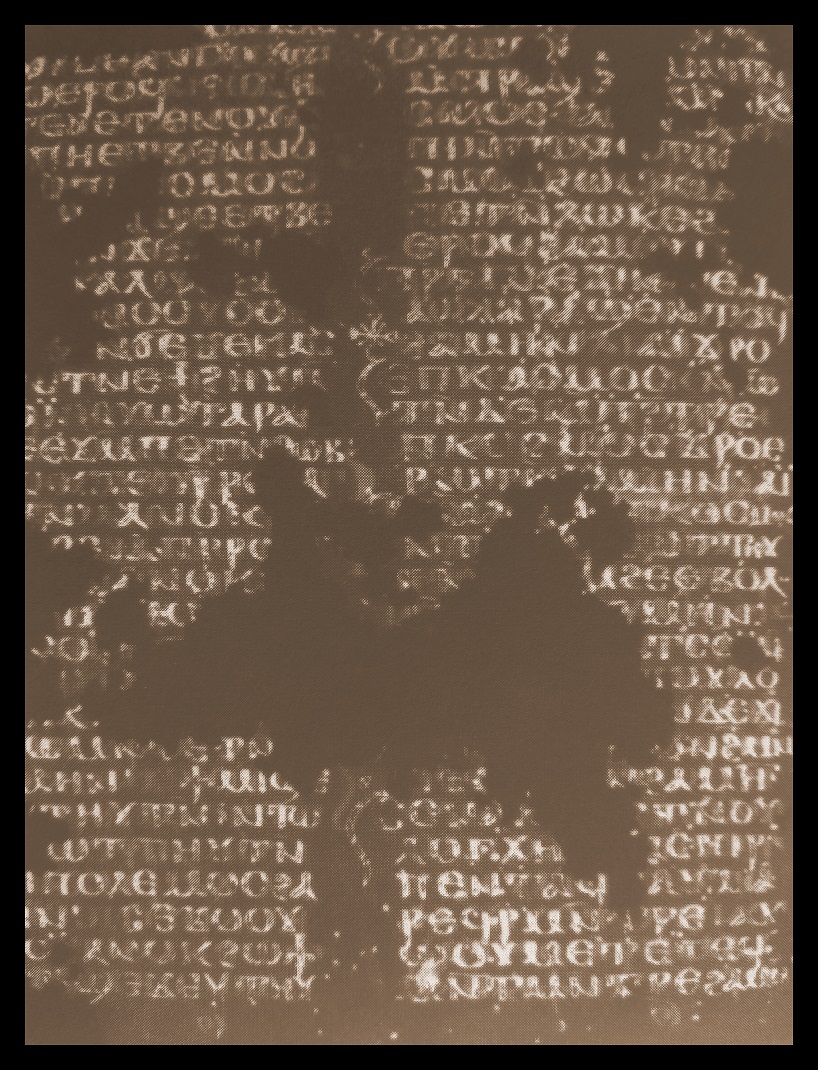
To continue on with the Gospel of the Savior, we start at page 108, which continues the narrative from the previous page. This page is fragmented thus disrupts the flow of text. Here are some highlights. Jesus speaks of the plan against him and that he is a stranger to him. The person he is referring to is unknown due to a missing section. Jesus then states “Therefore now, behold, I suffer because of the sins of the world. But I rejoice over you for you have continued well in the world.” After this, the text really fragments and we get select pieces here and there for half a column. When the text stabilizes, Jesus announces joy for the world and not to weep, but rather rejoice. He has overcome the world and not to let it overcome you. He has become free from the world, and you will become free from it as well. Jesus also mentions that he will be pierced on his side and he who sees it, let him bear true in his witness.

Now the text really comes apart (literally). The next two pages have a decent amount of content with the remainder of the gospel being fragmented pieces. Page 113 has what best describes as some sort of vision the apostles have. The text states that the apostles witness the world becoming dark before them, and then they became “as those among the Aeons of glory.” To me, this reads with a gnostic slant as obviously it is referring to the divine beings that are called Aeons in the gnostic mythos. The text mentions the apostles seeing their savior after he attained to the fourth heaven. Again, another gnostic reference. Traditionally there are not four (or more) heavens in mainstream Christian thought, but there is in gnostic cosmology (“Gospel of Mary” and “Books of Jeu” quickly come to mind). The text now gets really fragmented and with what remains, it mentions angels and archangels fleeing. Cherubim are mentioned but not what they do. When a more coherent fragment resumes, it states “they cast their crowns down at the front of the throne of the Father. All the holy ones received their robes…..” There’s a break in the text until it resumes with a passage of someone weeping and distressed so that the angelic host is disturbed.

Page 114 is our last page with a lot of text before we come to fragmented tidbits. The first column of the page is missing quite a bit, but it has Jesus speaking to the Father. The second column, particularly the first half, remains mostly intact. It has Jesus saying “…to die with joy and pour out my blood upon the human race. Yet I weep only for my beloved, who are Abraham and Isaac and Jacob, that they may be able to stand in the day of judgment. I will sit upon my throne and I will judge the world. They will say to me that……” The remainder of the column is missing quite a bit but still has Jesus speaking to the Father.

The book lists pages 115, 116, 121 and 122. All these are various fragments. 122 has a section that states “in three days, and I will take you to heaven with me, and teach you. Since your desire….” Obviously, this is Jesus speaking, but to whom? The rest of the book has fragments that belong to no particular page and have no context. I will not list them all but will pull out a few select examples.

Fragment 5F: “A little longer, O cross, and that which is lacking is perfected, and that which is diminished is full. A little longer, O cross, and that which fell arises. A little longer, O cross, and all the pleroma is perfected.

Fragment 19F: “They will not remember his generation, since his wife will be widowed and his children will be fatherless.

Fragment 19H: “…it (feminine) gives milk, another one (fem.) gives honey. As for you, rest yourselves by the spring of the water of life.

I may revisit this gospel in a future post once I get the Ehrman translation. It will be interesting to see how similar (or different) it is to this one. Be sure to pick up the Hedrick / Mirecki book of the Gospel of the Savior. They offer up facsimiles of the papyrus, a commentary and history of the text.

bP

Gospel of the Savior (1 of 2)

I love finding new “lost manuscripts” that don’t get the publicity they should. Some discoveries make headlines for decades and others barely a mention. This particular text is one that has been over looked. The so called “Gospel of the Savior” is from a collection of fragments at the Berlin Egyptian Museum and was purchased from a dealer back in 1967. It would not be until the 1990s that the fragments came out of hiding to be conserved and translated. I am using the book Gospel of the Savior by Charles W. Hedrick and Paul A. Mirecki for referencing. Bart Ehrman has made a translation of this gospel in the early 2000s, but I do not have a copy (right now), so I can’t compare the two translations. The name “Gospel of the Savior” is not the text’s true name. That has been lost, but like other ancient texts in a similar situation, it has been given a title. This collection of fragments is a dialogue gospel. It features Jesus talking to his disciples. It survives in Sahidic Coptic and dates after the fourth century. It is believed to be from a Greek source, possibly second century. I won’t get into any of the technical analysis of the text, the book I mentioned earlier does a pretty good job of that and I highly recommend picking up a copy. That being said, what does the text say?

As I mentioned earlier, this is a collection of various fragmented pieces. A lot of pages have missing content and only scattered words remain. I will not comment too much on those pages, but rather focus on the pages that remain intact enough to follow a comprehensive narrative. I will refer to the page numbers that are given to the text in the book. If you get a copy, you will know what I am talking about. If you don’t, it may seem odd.

Page 97 has Jesus conversating with Andrew. Jesus states a few lines such as “Blessed is the one who will eat with me in the kingdom of the heavens. You are the salt of the earth, and you are the lamp that illuminates the world.” Other fragment parts include “Do not sleep nor slumber…” and “the garment of the kingdom, which I bought with the blood of the grape (or vine)…” Andrew replies but his response is missing. The text continues on the next page with Jesus stating “If I have cared for the things of the world, it is also fitting for me to go down to Hades because of the souls that are bound in that place.” So referring back to the first line of Jesus, that is very similar to Luke 14:15 (“Blessed is everyone who will eat bread in the kingdom of God!” ESV) The salt of the earth and lamp reference is mentioned in Matthew 5:13 & 14 (13 “You are the salt of the earth, but if salt has lost its taste, how shall its saltiness be restored? It is no longer good for anything except to be thrown out and trampled under people’s feet. 14 “You are the light of the world. A city set on a hill cannot be hidden.” ESV).

Page 98 has quite a bit of text that survives. It has Jesus giving a revelation with joy. He mentions that “now therefore while you are in the body, do not let matter rule over you: Arise, let us go away from this place. For the one who will hand me over is near.” As you can see, this is taking place right before Judas betrays him. Jesus mentions that they will all flee from him and be left alone. He states “but I do not remain alone for my Father is with me. I and my Father, we are a single one.” Page 99 continues on this narrative. Jesus states he is the good shepherd and will lay down his life for you, and that you should do the same for your friends, as this will please the Father. He mentions there is no greater commandment than this. Jesus also mentions he was divine, but became human and then the text cuts off. It resumes with one of the disciples asking how much time will pass before they are summon out of the world, and the text cuts off.

Page 100 is pretty fragmented but there is a section that describes a viewing of the ascension to heaven. One of the disciples is talking about becoming spiritual bodies and approaching the heavens. Entities in that realm were afraid of seeing them ascend. A vision of the savior is mentioned before the text abruptly ends.

The next page is 105 and it is very fragmented. There is one complete sentence intact which states “The one who does not receive my body and my blood, this one is a stranger to me.” A very pro-Eucharist stance there! Page 106 is extremely fragmented but what is left, it seems like it is Jesus telling his disciples not to weep over him but rejoice for his impending bodily end.

Page 107 remains mostly intact. It starts with Jesus telling his disciples not to be disturbed when they see him (in regards to post resurrection). The disciples asks him what kind of body will he appear in when he reveals himself. John then speaks and asks that the Lord not to reveal himself in all his glory, but rather a different form of this glory so that they (the disciples) could see him without fear and despair. Jesus tells them that he will appear to them in a form that they can witness him, but not to touch him until he goes to the Father. This is similar to when Jesus tells Mary Magdalene in John 20:17 ( Jesus said to her, “Do not cling to me, for I have not yet ascended to the Father; but go to my brothers and say to them, ‘I am ascending to my Father and your Father, to my God and your God.’” ESV). Now the really interesting tidbit comes next when Jesus says “And if one is near to me, he will burn. I am the fire that blazes; who is near to me, is near to the fire; who is far from me, is far from life.” Sound familiar? Why, this parallels saying 82 of the Gospel of Thomas! That saying is: “Jesus said, “Whoever is near me is near the fire, and whoever is far from me is far from the (Father’s) kingdom. I absolutely love the fact a Thomas saying pops up in another discovered text! The text fragments a bit after this before continuing with Jesus stating “As for me, I am in your midst as a child. Amen. A little longer I am in your midst.

My next post will finish up the Gospel of the Savior. If this text sounds interesting to you, be sure to pick up the book I mentioned at the beginning!

bP

Mary Magdalene and the resurrected Christ

With this post, I wanted to compare all the instances where Mary Magdalene meets the resurrected Christ. There have been countless articles / books on the importance of how this plays out, but for me, it shows the importance of Mary. She is the first to see the resurrected Christ, which in turn, will be the first to announce to the apostles of the resurrection (i.e. the Apostle to the Apostles). I will not delve into the conspiracy theories of the relationship between Jesus and Mary but will state she obviously was an important person to Jesus. Everyone has a role to play (even Judas). With Mary’s huge inclusion in the “gnostic” / non-canonical texts, she was definitely seen as important to early Christian groups in the first few centuries of the common era. This post will include the Gospels of Matthew, Luke, John, Peter and the Epistula Apostolorum. I am not including Mark 16:9 – 11. I am of the opinion, as are many other scholars and evidence, that Mark ended at 16:8 and the “extended ending” was added later (it’s rather apparent this is the case). I will be using the ESV translation of the canonical gospels. Up first is Matthew 28:1-10:

Now after the Sabbath, toward the dawn of the first day of the week, Mary Magdalene and the other Mary went to see the tomb. And behold, there was a great earthquake, for an angel of the Lord descended from heaven and came and rolled back the stone and sat on it. His appearance was like lightning, and his clothing white as snow. And for fear of him the guards trembled and became like dead men. But the angel said to the women, “Do not be afraid, for I know that you seek Jesus who was crucified. He is not here, for he has risen, as he said. Come, see the place where he lay. Then go quickly and tell his disciples that he has risen from the dead, and behold, he is going before you to Galilee; there you will see him. See, I have told you.” So they departed quickly from the tomb with fear and great joy, and ran to tell his disciples. And behold, Jesus met them and said, “Greetings!” And they came up and took hold of his feet and worshiped him. Then Jesus said to them, “Do not be afraid; go and tell my brothers to go to Galilee, and there they will see me.”

Luke 24:1 – 12:

But on the first day of the week, at early dawn, they went to the tomb, taking the spices they had prepared. And they found the stone rolled away from the tomb, but when they went in they did not find the body of the Lord Jesus. While they were perplexed about this, behold, two men stood by them in dazzling apparel. And as they were frightened and bowed their faces to the ground, the men said to them, “Why do you seek the living among the dead? He is not here, but has risen. Remember how he told you, while he was still in Galilee, that the Son of Man must be delivered into the hands of sinful men and be crucified and on the third day rise.” And they remembered his words, and returning from the tomb they told all these things to the eleven and to all the rest. Now it was Mary Magdalene and Joanna and Mary the mother of James and the other women with them who told these things to the apostles, but these words seemed to them an idle tale, and they did not believe them. But Peter rose and ran to the tomb; stooping and looking in, he saw the linen cloths by themselves; and he went home marveling at what had happened.

Both of those accounts are pretty similar, though Luke does add a bit more dialogue and a few more characters in the mix. John mixes this up a bit by eliminating some characters and re-arranging the events. However, Mary Magdalene is still prominently featured. John 20:1 – 18:

Now on the first day of the week Mary Magdalene came to the tomb early, while it was still dark, and saw that the stone had been taken away from the tomb. So she ran and went to Simon Peter and the other disciple, the one whom Jesus loved, and said to them, “They have taken the Lord out of the tomb, and we do not know where they have laid him.” So Peter went out with the other disciple, and they were going toward the tomb. Both of them were running together, but the other disciple outran Peter and reached the tomb first. And stooping to look in, he saw the linen cloths lying there, but he did not go in. Then Simon Peter came, following him, and went into the tomb. He saw the linen cloths lying there, and the face cloth, which had been on Jesus' head, not lying with the linen cloths but folded up in a place by itself. Then the other disciple, who had reached the tomb first, also went in, and he saw and believed; for as yet they did not understand the Scripture, that he must rise from the dead. Then the disciples went back to their homes.

Jesus Appears to Mary Magdalene
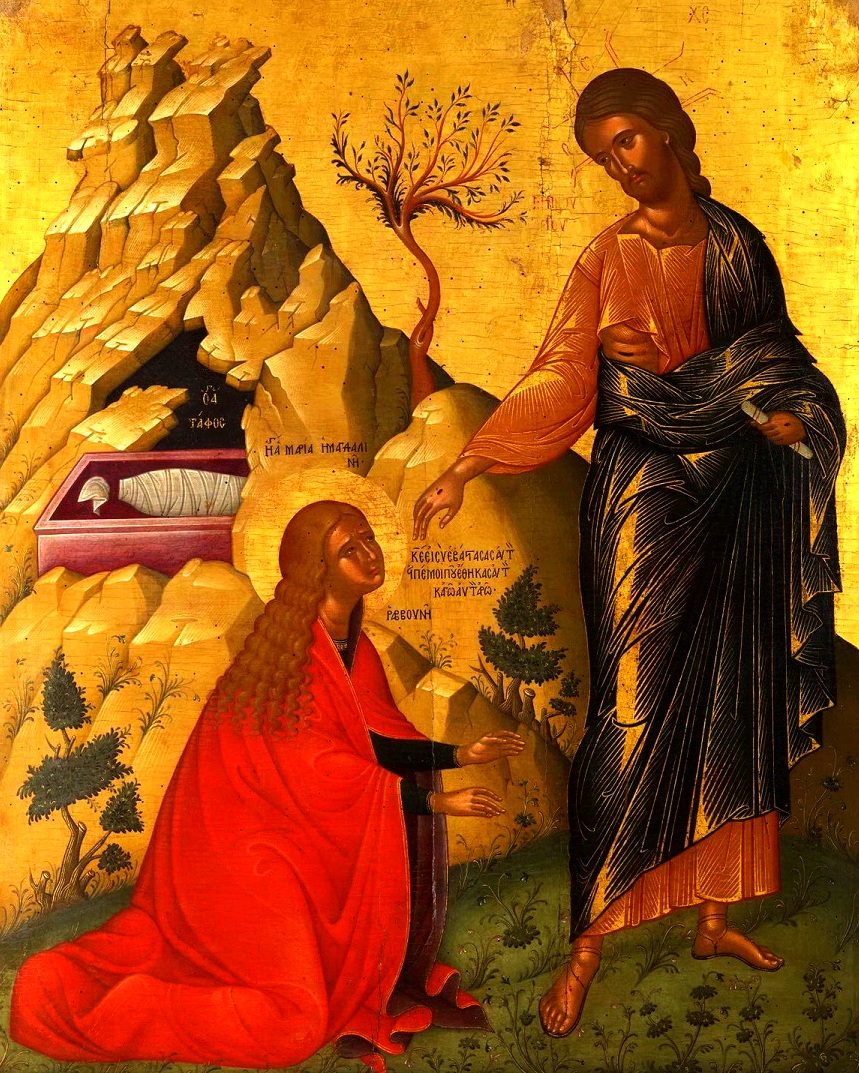
But Mary stood weeping outside the tomb, and as she wept she stooped to look into the tomb. And she saw two angels in white, sitting where the body of Jesus had lain, one at the head and one at the feet. They said to her, “Woman, why are you weeping?” She said to them, “They have taken away my Lord, and I do not know where they have laid him.” Having said this, she turned around and saw Jesus standing, but she did not know that it was Jesus. Jesus said to her, “Woman, why are you weeping? Whom are you seeking?” Supposing him to be the gardener, she said to him, “Sir, if you have carried him away, tell me where you have laid him, and I will take him away.” Jesus said to her, “Mary.” She turned and said to him in Aramaic, “Rabboni!” (which means Teacher). Jesus said to her, “Do not cling to me, for I have not yet ascended to the Father; but go to my brothers and say to them, ‘I am ascending to my Father and your Father, to my God and your God.’” Mary Magdalene went and announced to the disciples, “I have seen the Lord”—and that he had said these things to her.

The Gospel of John scene is the one that has been romanticized throughout history in art and other works. The emotions expressed in this section are very powerful. One can really feel the excitement Mary has once Jesus reveals himself to her. Now we move onto the non-canonical sources. The first one is the Gospel of Peter, and if you have not read that gospel, I highly recommend you do so! It features an account of the actual resurrection of Jesus in the tomb, an account not told elsewhere (unless I am mistaken). Peter 50-57:

Now at the dawn of the Lord's Day Mary Magdalene, a female disciple of the Lord (who, afraid because of the Jews since they were inflamed with anger, had not done at the tomb of the Lord what women were accustomed to do for the dead beloved by them), having taken with her women friends, came to the tomb where he had been placed. And they were afraid lest the Jews should see them and were saying, 'If indeed on that day on which he was crucified we could not weep and beat ourselves, yet now at his tomb we may do these things. But who will roll away for us even the stone placed against the door of the tomb in order that, having entered, we may sit beside him and do the expected things? For the stone was large, and we were afraid lest anyone see us. And if we are unable, let is throw against the door what we bring in memory of him; let us weep and beat ourselves until we come to our homes.'

And having gone off, they found the sepulcher opened. And having come forward, they bent down there and saw there a certain young man seated in the middle of the sepulcher, comely and clothed with a splendid robe, who said to them: 'Why have you come? Whom do you seek? Not that one who was crucified? He is risen and gone away. But if you do not believe, bend down and see the place where he lay, because he is not here. For he is risen and gone away to there whence he was sent.' Then the women fled frightened.

The Gospel of Peter does not currently survive intact. It cuts off before Jesus appears to any of his disciples. However, technically Jesus appear in front of some Roman guards right after his resurrection. Below are chapters 35 – 42 from Peter:

But in the night in which the Lord's day dawned, when the soldiers were safeguarding it two by two in every watch, there was a loud voice in heaven; and they saw that the heavens were opened and that two males who had much radiance had come down from there and come near the sepulcher. But that stone which had been thrust against the door, having rolled by itself, went a distance off the side; and the sepulcher opened, and both the young men entered. And so those soldiers, having seen, awakened the centurion and the elders (for they too were present, safeguarding). And while they were relating what they had seen, again they see three males who have come out from the sepulcher, with the two supporting the other one, and a cross following them, and the head of the two reaching unto heaven, but that of the one being led out by a hand by them going beyond the heavens. And they were hearing a voice from the heavens saying, 'Have you made proclamation to the fallen-asleep?' And an obeisance was heard from the cross, 'Yes.' 

Yes, you read that right, the cross TALKED! That point aside, the two angels, who are carrying out Jesus, reach into the heavens but Jesus himself is even larger. This is such a visual awkward scene. Like I have mentioned before, one can never take esoteric texts literally. But if you do, this is quite the image! The Mary Magdalene aspect from Gospel of Peter is very similar to Matthew and Luke, as it is. We do not have the ending to this text, so unfortunately, we do not know if Jesus actually speaks to her first or another disciple (or disciples).

Finally, we come to the “Epistula Apostolorum”, a second century text that is pretty anti-gnostic. I will dive into those aspects at some point in the future. This text is pieced together from Coptic and Ethiopic fragments, so names get mixed up as you will see. Here are chapters 9 – 12:

Concerning whom we testify that the Lord is he who was crucified by Pontius Pilate and Archelaus between the two thieves (and with them he was taken down from the tree of the cross, Eth.), and was buried in a place which is called the place of a skull (Kranion). And thither went three women, Mary, she that was kin to Martha, and Mary Magdalene (Sarrha, Martha, and Mary, Eth.), and took ointments to pour upon the body, weeping and mourning over that which was come to pass. And when they drew near to the sepulcher, they looked in and found not the body (Eth. they found the stone rolled away and opened the entrance).

And as they mourned and wept, the Lord showed himself unto them and said to them: For whom weep ye? weep no more, I am he whom ye seek. But let one of you go to your brethren and say: Come ye, the Master is risen from the dead. Martha (Mary, Eth.) came and told us. We said unto her: What have we to do with thee, woman? He that is dead and buried, is it possible that he should live? And we believed her not that the Saviour was risen from the dead. Then she returned unto the Lord and said unto him: None of them hath believed me, that thou livest. He said: Let another of you go unto them and tell them again. Mary (Sarrha, Eth.) came and told us again, and we believed her not; and she returned unto the Lord and she also told him.

Then said the Lord unto Mary and her sisters: Let us go unto them. And he came and found us within (sitting veiled or fishing, Eth.), and called us out; but we thought that it was a phantom and believed not that it was the Lord. Then said he unto us: Come, fear ye not. I am your master, even he, O Peter, whom thou didst deny thrice; and dost thou now deny again? And we came unto him, doubting in our hearts whether it were he. Then said he unto us: Wherefore doubt ye still, and are unbelieving? I am he that spake unto you of my flesh and my death and my resurrection. But that ye may know that I am he, do thou, Peter, put thy finger into the print of the nails in mine hands, and thou also, Thomas, put thy finger into the wound of the spear in my side; but thou, Andrew, look on my feet and see whether they press the earth; for it is written in the prophet: A phantom of a devil maketh no footprint on the earth.

And we touched him, that we might learn of a truth whether he were risen in the flesh; and we fell on our faces (and worshipped him) confessing our sin, that we had been unbelieving. Then said our Lord and Saviour unto us: Rise up, and I will reveal unto you that which is above the heaven and in the heaven, and your rest which is in the kingdom of heaven. For my Father hath given me power (sent me, Eth.) to take you up thither, and them also that believe on me.

In this text, Jesus appears to a group of women and they try to tell the male disciples about the resurrected Christ, and apparently none of the guys are having it. Take from that what you will. Once Jesus goes with the group, then the male disciples believe he has risen. Mary Magdalene’s role here is similar to the other takes, except for John. The Gospel of John’s Mary / Jesus scene takes the encounter to a whole other level. That being said, Mary Magdalene is present in all these accounts and even the addition that was added to Mark still includes her (which could have easily not been the case). There was definitely something special about Mary that these early Christians knew.

UPDATE! Since posting this, I have come across another source of Mary and the resurrected Christ story and that is the 4th century Manichaean Psalms of the Lord Heracleides. I have posted that entire psalm collection on my blog (see link below), but will provide the post resurrection scene below:

Read the Gospel of Peter at: http://www.earlychristianwritings.com/text/gospelpeter-brown.html

Read the Epistula Apostolorum here: https://en.wikisource.org/wiki/The_Apocryphal_New_Testament_(1924)/Epistles/The_Epistle_of_the_Apostles

Read the Psalms of the Lord Heracleides here: https://culminationofwisdom.org/2025/05/05/mary-magdalene-in-the-psalms-of-the-lord-heracleides/

bP

The Flight into Egypt

Recently I read the “Gospel of Pseudo-Matthew”, which is a text that combines the “Protoevangelium of James” and “Infancy Gospel of Thomas” but bridges the two with a flight into Egypt narrative. With this post I would like to highlight that middle storyline. The other two stories will be covered on this blog at some other point.

Just a quick note, I am using the edition that was edited by James Orr.

Chapter 17 is where the Egyptian flight narrative begins. It has Herod being extremely mad at the Magi for not returning to him, which results in the “slaughter of the innocents.” Joseph was warned in his sleep to flee to Egypt with Mary and the child.

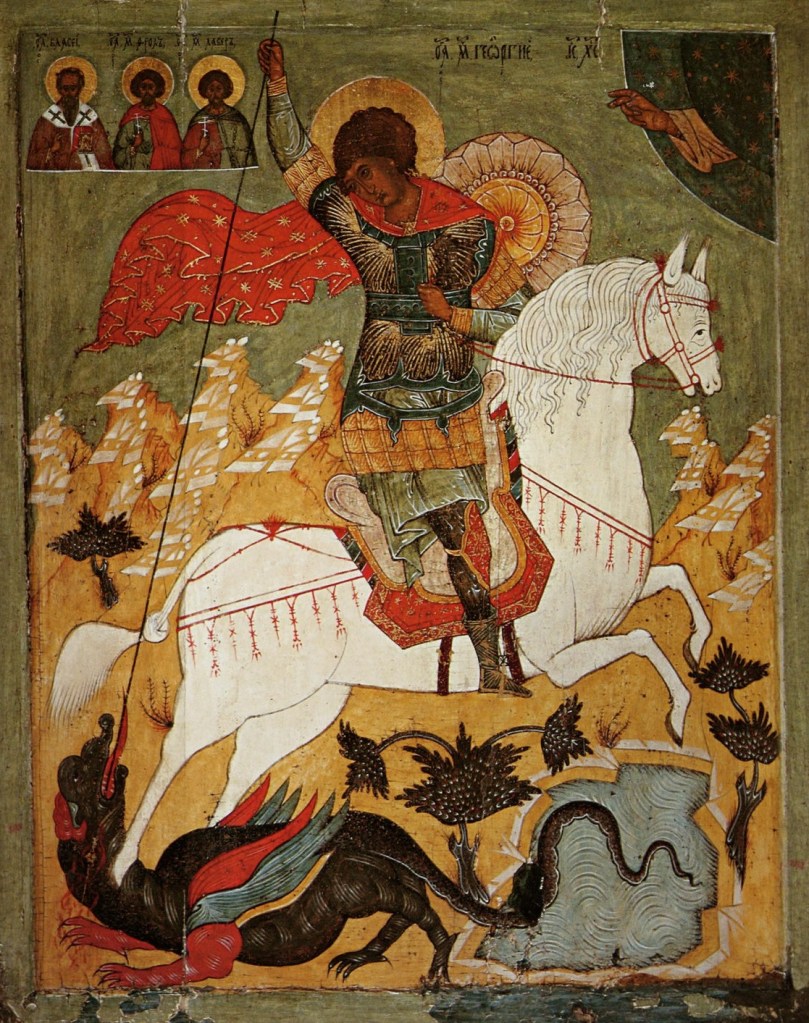
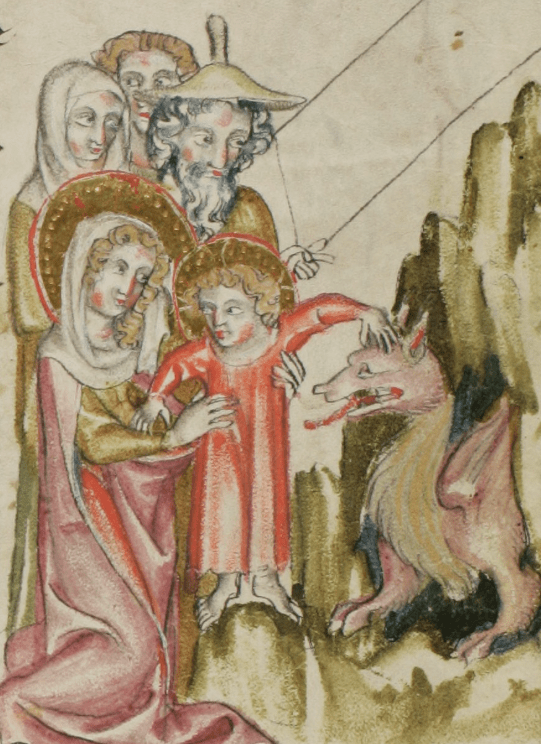
Chapter 18 has the crew (Joseph, Mary, Jesus, three other boys and a girl) taking a break in front of a cave entrance. Out from the cave emerges “many dragons”! Not sure what type of dragons these are but I like to believe they were dragons that are similarly associated with St. George iconography, see pic below.

Here is artwork from the Klosterneuburger Evangelienwerk that depicts this scene. The dragons do appear somewhat similar!

Everyone was afraid of these beasts except for Jesus. He went from the bosom of his mother and stood before the dragons. This caused the dragons to fall into adoration and eventually retreated. To calm everyone, Jesus said to them “Do not be afraid, and do not consider me to be a little child; for I am and always have been perfect; and all the beasts of the forest must needs be tame before me.” Keep in mind, this is an infant Jesus doing this. I understand what the author of the text is trying to get across, but imaging an infant doing this, no matter if he’s divine or not, paints an…..interesting, if somewhat humorous, image in one’s mind. This interaction between Jesus and the dragons refers to Psalms 148:7:

Praise the Lord from the earth, ye dragons, and all deeps. (KJV)

Chapter 19 has more beasts submitting to Jesus. As the group travels through the desert, lions and panthers come to adore Jesus and then walk beside him. Other animals merged with the group but no person or beast were harmed. This chapter is set up to portray Isaiah 65:25:

The wolf and the lamb shall feed together, and the lion shall eat straw like the bullock: and dust shall be the serpent's meat. They shall not hurt nor destroy in all my holy mountain, saith the LORD. (KJV)

Chapter 20 deals with the miracle of the palm tree. If you read my posts on the “Book of Mary’s Repose“, this is going to sound familiar. I just love how these books interconnect with each other. While in the desert, Mary becomes fatigue. Joseph sits her down underneath a palm tree in the shade. She looks up and sees fruit hanging from the tree. She wishes to have some, but since it’s up so high, Joseph is unable to grant her request. Jesus steps in and says “O tree, bend thy branches, and refresh my mother with thy fruit.” So what does the tree, why bend over to the feet of Mary! The tree remains down until Jesus commands it to stand tall and from its roots, to gush out water from the earth. The tree does what is commanded of it and water flows from out of the ground.

Chapter 21 continues with the palm tree. Jesus turns to the tree and says “This privilege I give thee, O palm tree, that one of thy branches be carried away by my angels and planted in the paradise of my Father. And this blessing I will confer upon thee, that it shall be said of all who conquer in any contest, you have attained the palm of victory.” After saying this, an angel descends and takes a branch off the tree and ascends back into heaven. The tree falls over dead instantly which terrifies the group. Jesus reassures them that the palm tree has been transferred to paradise. An interesting story showing how one, even if it’s a plant, is able to ascend due to the words of Jesus.

Chapter 22 starts with Joseph complaining to Jesus about the distance the group must still endure while in the blistering heat. This journey has 30 days left. Jesus instantly shortens the journey from 30 to just one day. As the two were speaking to each other, the city they were heading towards start to appear in the distant horizon. Upon entering the city, they went to a temple to seek hospitality. This temple had 350 idols which the locals would pay daily tribute. The narrative continues into chapter 23. Mary enters the temple with the infant Jesus and all the idols fall onto the ground, breaking into pieces. This is another prophecy from the Old Testament that is fulfilled, Isaiah 19:1:

The burden of Egypt. Behold, the Lord rideth upon a swift cloud, and shall come into Egypt: and the idols of Egypt shall be moved at his presence, and the heart of Egypt shall melt in the midst of it. (KJV)

In chapter 24, Affrodosius (Governor of the city) hears of the broken idols and assembles his army to go to the temple to see what is happening. Upon entering the temple, he sees Mary holding the infant. Affrodosius proclaims that their gods would have only fallen down in front of the true God. He admits that this is the work of the true God and does not want to repeat what happened to the Pharaoh King and the army that was drowned at sea. This of course is another callback to an Old Testament story, that being the Moses/Exodus tale. Chapter 25 ends the Egyptian narrative as an angel calls Joseph back to the land of Judah.

There you have it, the flight into Egypt! I am not sure of the source of this story is from. Was it made by the person(s) who assembled this Pseudo-Matthew gospel or did it originate from a story that no longer survives on it’s own? And if it was on it’s own, was it longer? I would like to believe the family spent some time there before returning so soon. I know I would have!

St. George iconography is traditional artwork. The other artwork featured on the post is from the klosterneuburger evangelienwerk, which can be viewed online at: https://www.e-codices.unifr.ch/en/searchresult/list/one/sbs/0008

bP

Lefāfa Ṣedeḳ: Book of Life (3 of 3)

If you haven’t read the previous two posts regarding the Lefāfa Ṣedeḳ, check them out. Now to the final post!

The fifth section starts with a prayer for the journey of the soul from the earth to heaven. Here’s part of the prayer:

Protect thou me, O Christ, so that the angels of darkness may not obstruct my soul.  And let there be sent unto me the angels of light.  Michael and Gabriel -- those august angels -- and the Paraclete, and the Spirit of Righteousness, so that the angels of darkness may never obstruct my soul, and that the Lord may not make me to stand in the darkness amid the gnashing of teeth.

The prayer continued a bit until God spoke to the twelve apostles and the seventy-two disciples, commanding them to write copies of the Lefāfa Ṣedeḳ and recite the words to true believers. He states that whoever writes down these words, and wears it around their neck, having been baptized, they shall live until the end of days, be shown mercy and spared from the fires of Gehenna. This book will also drive away devils. As I have mentioned before, this book is essentially an amulet. The text goes on to list the seven divine names of Jesus. They are:

The section ends with the closing of the ritual, similar to how the others ended.

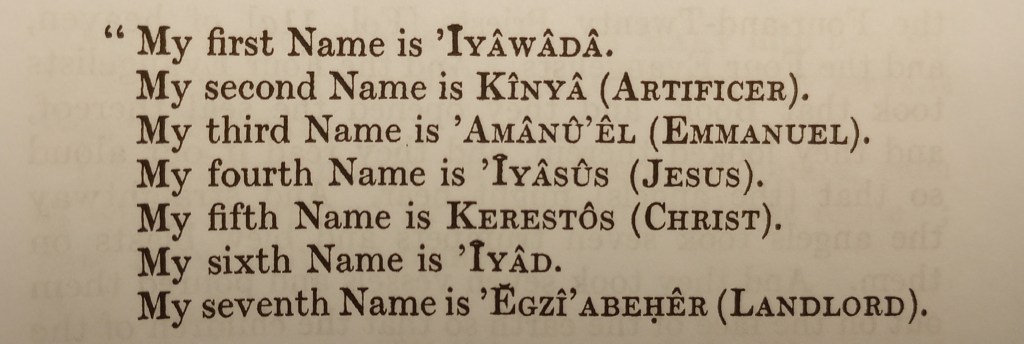
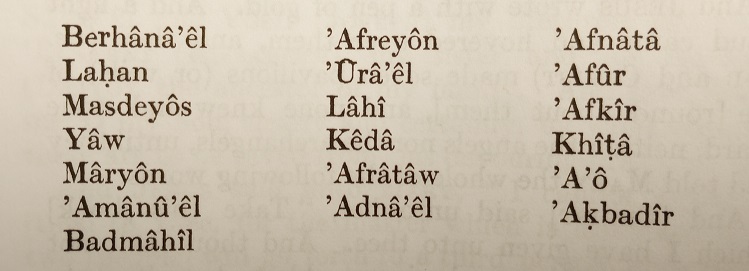
Section six has the disciples asking Jesus his hidden name. He agreed to give it to them, with the condition that it only be given to others who are believers of the faith. Jesus proclaimed the following names:

Jesus informs them that none knew these names except the four-and-twenty priests of heaven and his mother, Mary. Jesus proclaims: “By this my Name ye shall be saved, and your sins shall be remitted unto you. And as with you even so shall it be with him that keepeth it, and doth believe. He shall be saved, and he shall not be put to shame before me, and he shall not see the smoke. Of all the prayers which are written in this, my book, there is no formula greater than this. Whosoever believeth in this prayer I swear by my throne, and by my exalted head, and by the stool which is under my feet, and by Mary, my mother, that I will show mercy unto him. This I swear by my holy angels and I will neither do violence to my righteousness, nor will I make my word to be a lie. And I will not befoul my covenant.”

And again, Jesus said unto them: “Blessed is the man who hath read this prayer. Blessed is the man who hath washed himself in the water of prayer. Blessed is the man who hath heard this prayer with his ear. His strength shall be like the strength of the rock. He shall hear the sound thereof as if it were the roaring of a lion. And I myself will protect him with my own might and strength. And I will love him as if he were my disciple. Blessed is the man who shall bear this prayer. No unclean spirits shall draw nigh unto him. Nothing shall be able to disturb the body and the soul of the man who hath this prayer with him. Neither pain, nor weariness, nor hunger shall enter his house. And he shall be able to drive away even Satan, who shall not be able to draw night to his habitation. And the thief shall not be able to steal from him, and his foe shall not be able to overpower him; and he shall be able to exhaust the strength of every enemy of his. And his house and his children shall be blessed. And the angels shall never be far away from him. The blessing of the Prophets and the Apostles, and the Spirit of God shall rest upon him at all times. And the Spirit of Satan shall be remote from him.”

The sixth section ends by addressing the reader of the book stating that if you believe in this prayer, recite it, washed yourself in the water of prayer, then you shall vanquish and overcome your enemies and foes.

The seventh section has Jesus speaking to the apostle Andrew. Jesus tells Andrew to go to the “eater of men” city (refer to the apocrypha text “The Acts of Andrew and Matthias” for more on that) and get Matthias, who is imprisoned there. Andrew asks Jesus how he can get there quickly as it is a two-year journey and that a great sea separates the city and where Matthias is being held. Jesus reveals a “formula” to Andrew that will allow him to march into the city without trouble. He gives Andrew three different sets of names. The first set of names belong to the Father:

The second set of names belong to Jesus:

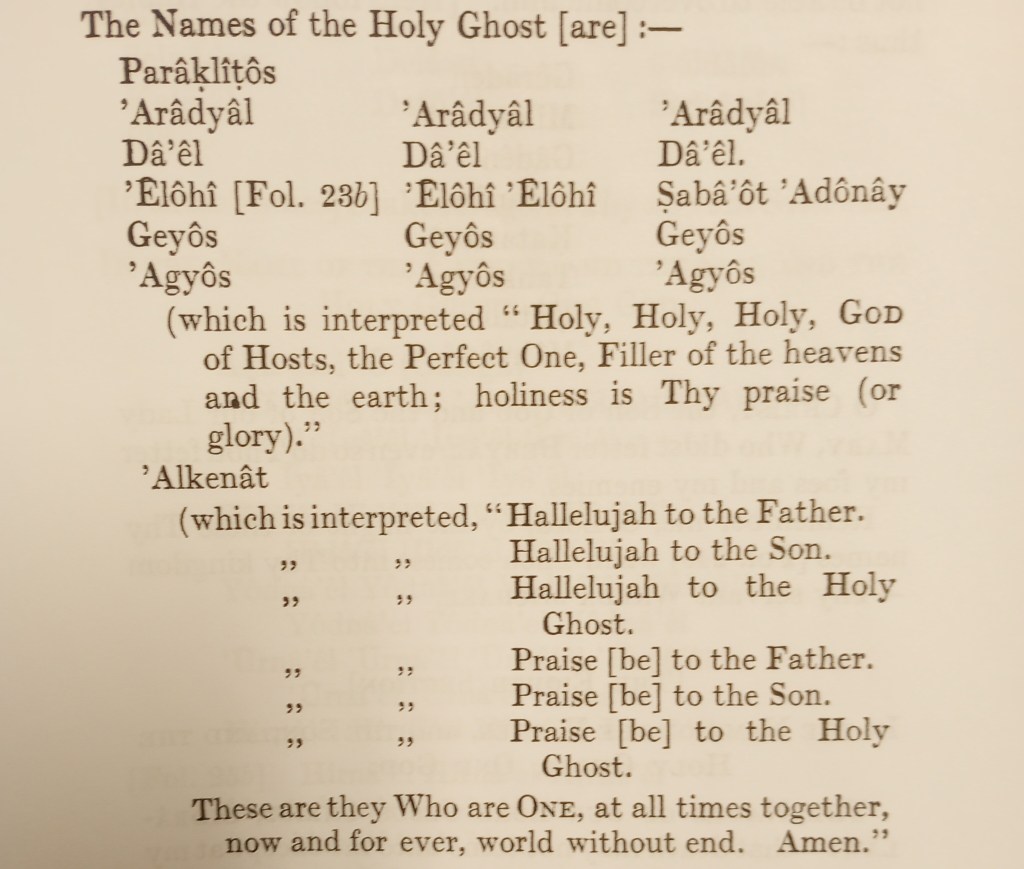
The third set of names belong to the Holy Ghost:

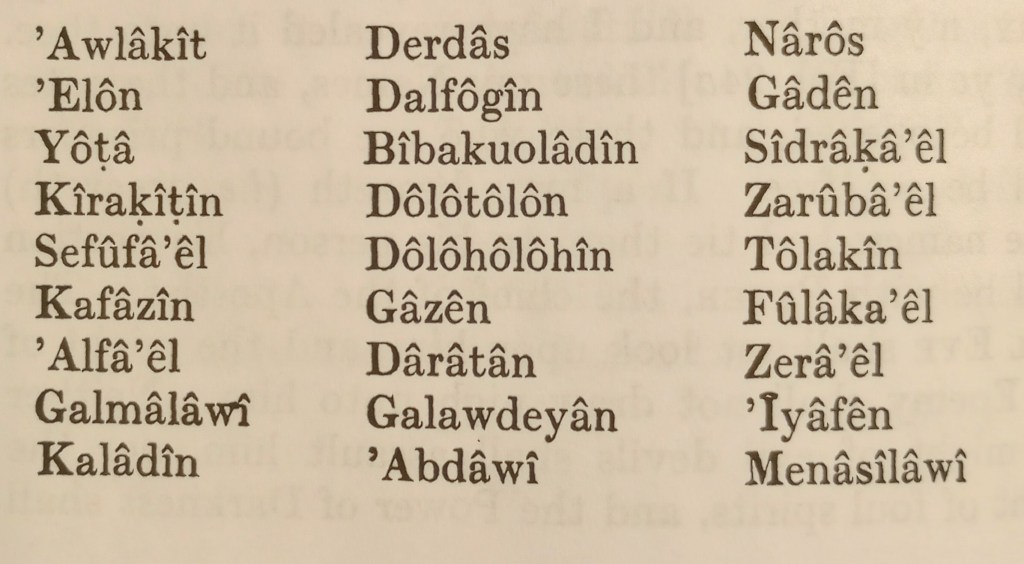
Jesus tells Andrew that no one knows of this formula except him, and Mary (mother). Praying to these names will open the gates and set the prisoners free. The final part of this section reveals yet another set of divine names. These eight names will allow the wearer of these written down names protection again the evil eye and demons. The names are:

I like how the seventh section breaks off into a side story and relates to another apocrypha text. The eighth section consists of more divine names with two purposes. The first set of names are to be used to avoid death until the appointed time:

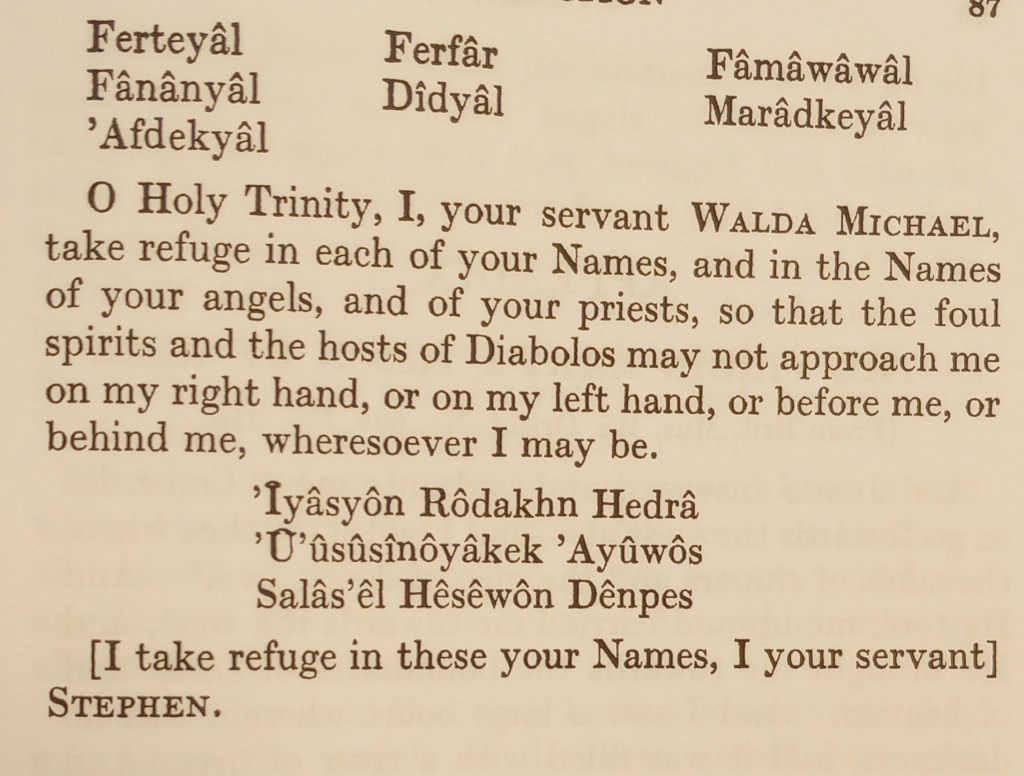
The next LONG set of divine names prevents demonic spirits from approaching you. The names are:

Now that is a long set of names!!! This concludes the Lefāfa Ṣedeḳ. A truly fascinating work that combines several traditions. I will be diving more into the Ethiopian literature in the future as I feel it’s vastly under represented in the English language. If you are curious about the “Eater of Men” story, check out: http://gnosis.org/library/actanm.htm

Featured photo is of Mary and Jesus, 17th century Ethiopian iconography

bP

Lefāfa Ṣedeḳ: Book of Life (2 of 3)

Now we continue with the Lefāfa Ṣedeḳ! Please refer to post 1 if haven’t already.

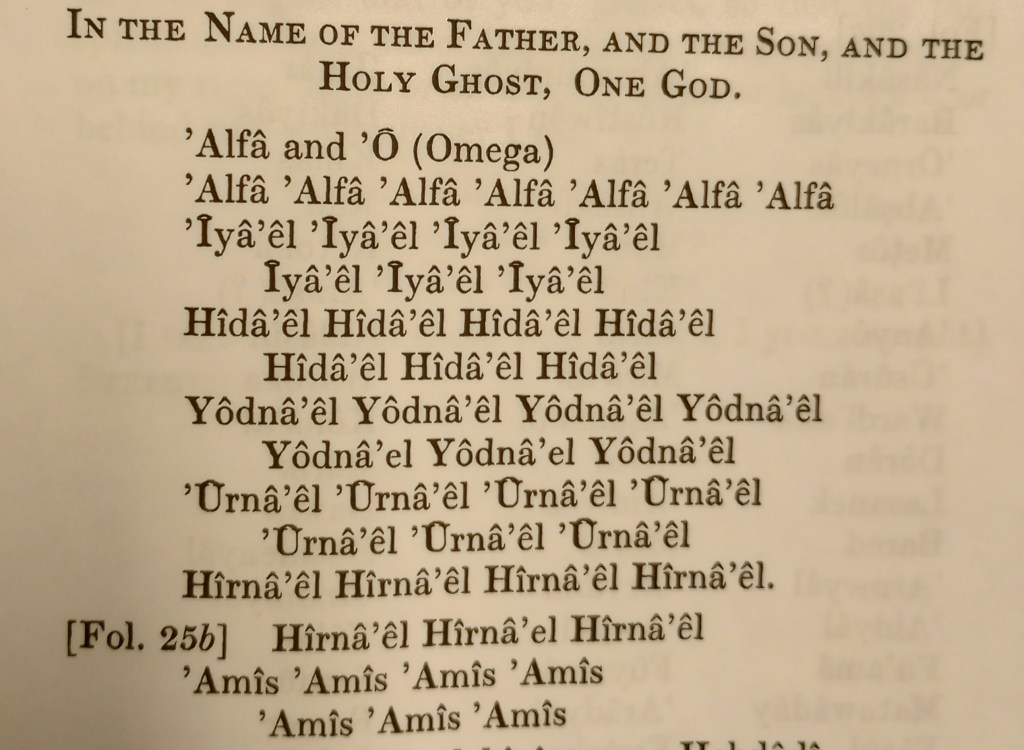
Section three starts “In the Name of the Father, and the Son, and the Holy Ghost, One God” and follows with a prayer concerning the carry of the deceased. It is as follows:

DEKÂS BATRÔN KÛGÛYÂ, GÂNÔN, KÂWES KÎREL

This prayer is to be recited on the last day of the funeral of an individual. The text shifts to what will be said on the day of judgment. It has prayers that re-enforces Christians’ beliefs in Christ as the son, and the trinity as a whole. It also mentions the anti-Christ and states that who believes in the son of Satan will be condemned to punishment in the place of torment. The servants WALDA and STEPHEN are mentioned as they are given instructions on the prayers to say. The archangel Michael makes an appearance in the text and speaks to God. Michael asks, “What now is this noise of thunder which I hear?” God replies, “It is that which cometh from the place of torment, which is the habitation of sinners, and of those who have not performed the Will of My Father; it arises through the destruction of the souls of those who have treated His word with contempt.” God proceeds to explain that whoever wears this book (Lefāfa Ṣedeḳ) around their neck will never see Gehenna, and on that day the sun will never set, light will never be extinguished, the sound of their reward shall never be silenced and praised of His kingdom will never be rooted out.

There were other angels there and they asked, “Recite to us Thy Name, so that we may praise Thee, and sin hymns unto Thee.” God responded with:

“If there be a man who hath placed his confidence in these names, and who hath performed a ceremony of commemoration of me, I will show him mercy and will save him from this devouring fire, and the worm that never sleep, and the fire which is never extinguished, and the smoke which never die down.”

God told Michael that any one who has performed a ceremony of commemoration of me (God), put their trust in me and wear this book around their neck or kept it in their house and have firm faith in his prayer, that the torment of hell will not become onto them. The book was sealed by the trinity and could only be opened by the twenty four priests of heaven (refer to Revelation 4:10) and the four Evangelists. The four Evangelists took the book, opened the seal (that didn’t take long!) and read it out aloud so that the angels might hear. You will notice a pattern of “seven” appearing in the following portion:

And straightway the angels took seven trumpets and blew blasts on them. And they took seven vessels and poured them out on the face of the earth so that the children of good and righteous folk might be sanctified, and that they might be free of the heavens and the earth, and the Seven Gates, and the Seven Luminarites (or Regions of Light), and the Seven Bearers of the Throne of God. By this His Awful Name was made known to the Prophets and to the Apostles, in the places where they were, and in the Holy Mountain. On the sixteenth day of the month of Maskaram (September), at the sanctification of her body in purity through the honorable Cross of CHRIST, and the tomb of our Lord JESUS CHRIST. He made mercy to appear on us, according to His holy word. And He declared unto His saints, with honorable…, the Word of God.

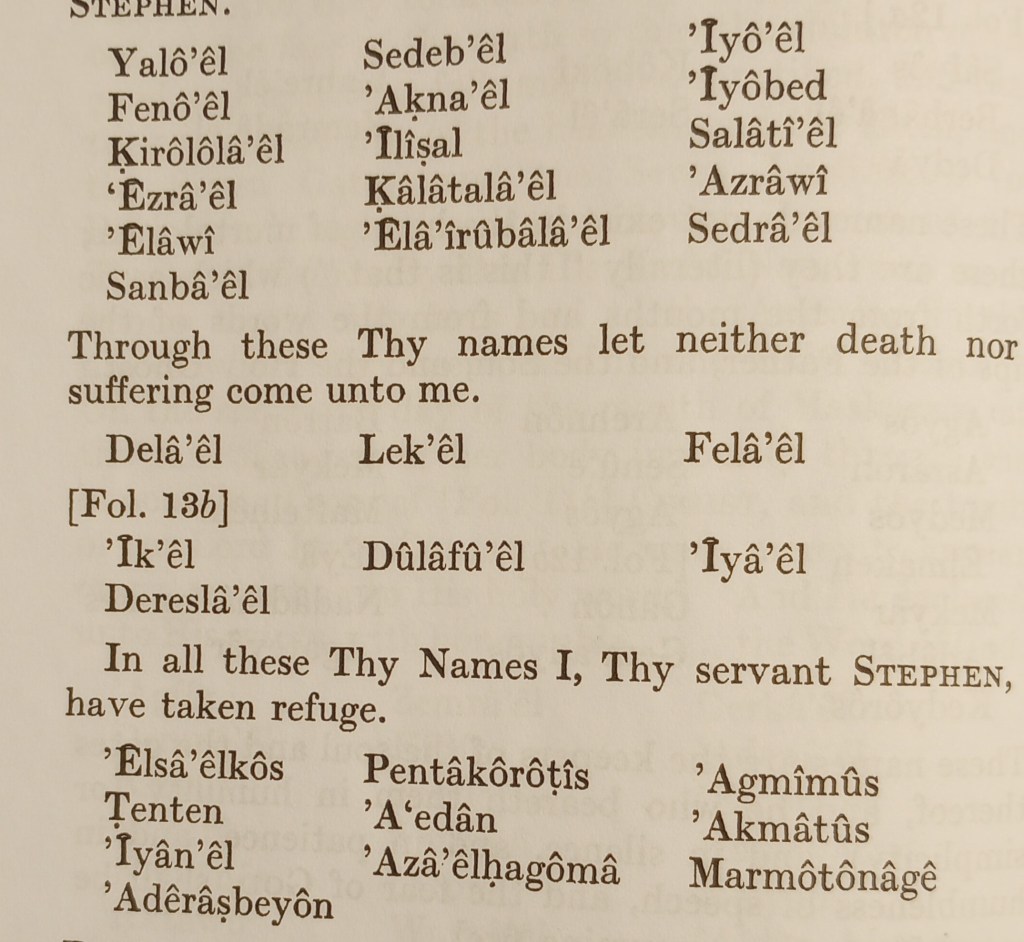
The servant WALDA MICHAEL is given seven holy names for ascension. They are:

The second group of divine names are those who are “keepers of the soul and the gates thereof”. These names will also save one from the consuming fires of Gehenna.

We now have yet more divine names! This section is full of them. These names are given to the servant STEPHEN for refuge:

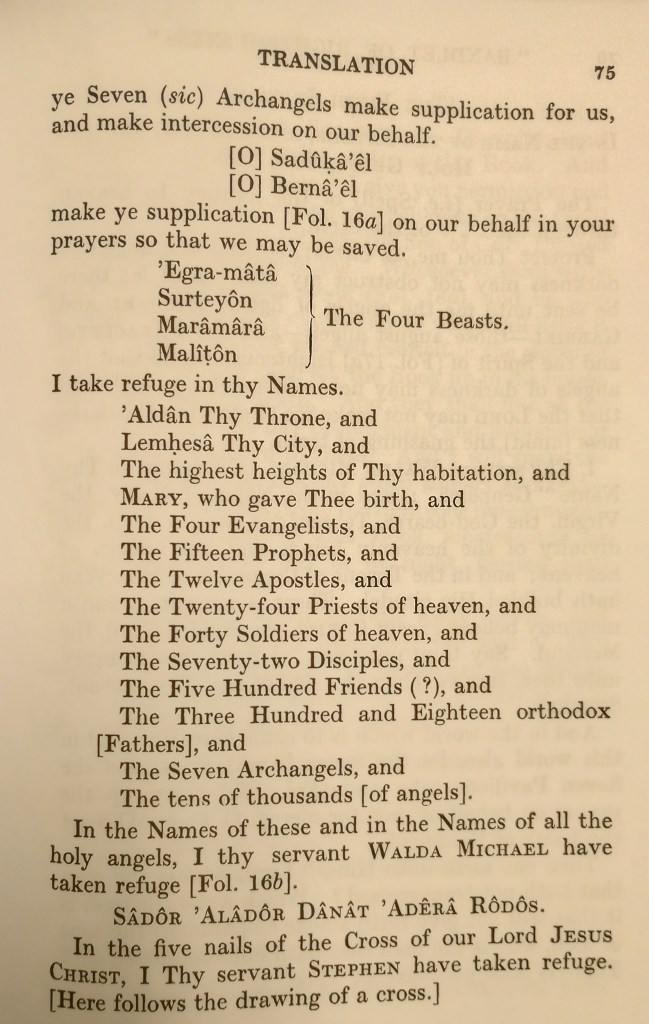
The five nails of the cross are recited (SÂDÔR ‘ALÂDÔR DÂNÂT ‘ADÊRÂ RÔDÂS) and the section ends.

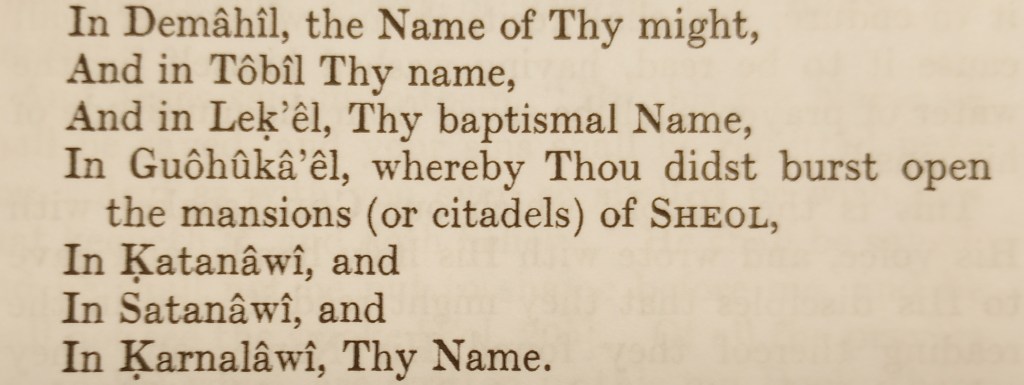
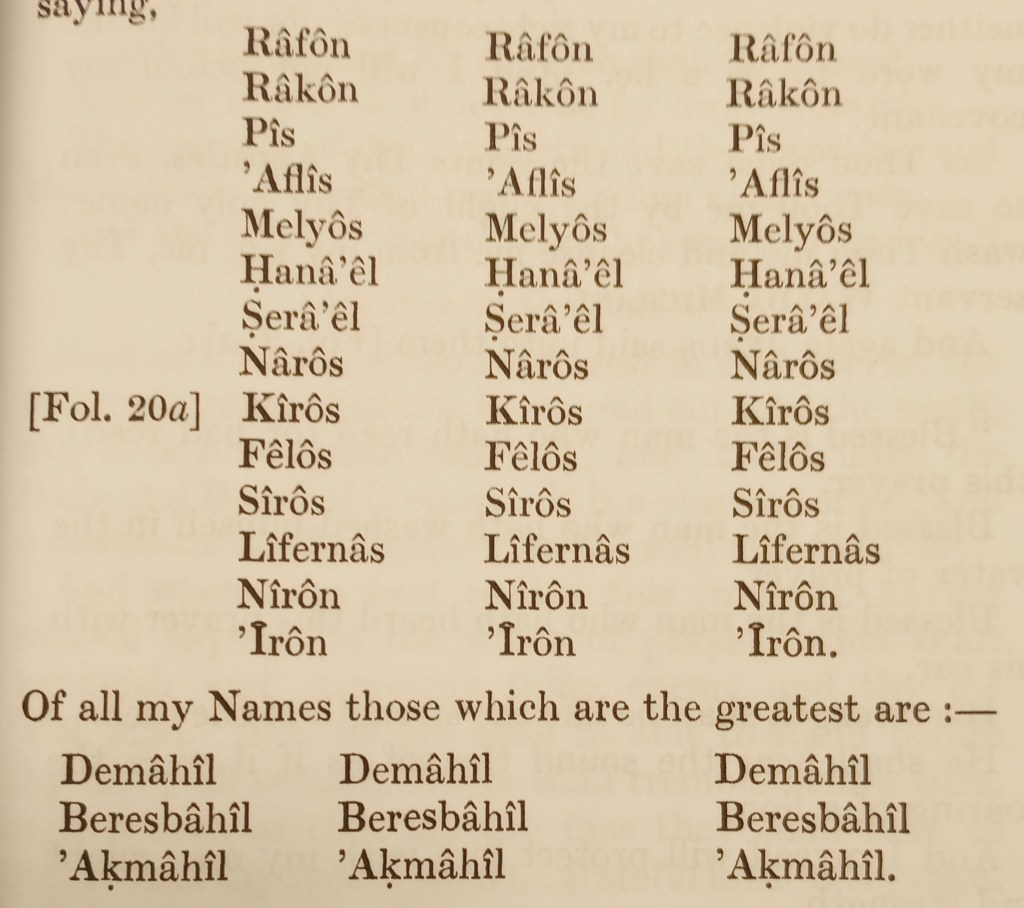
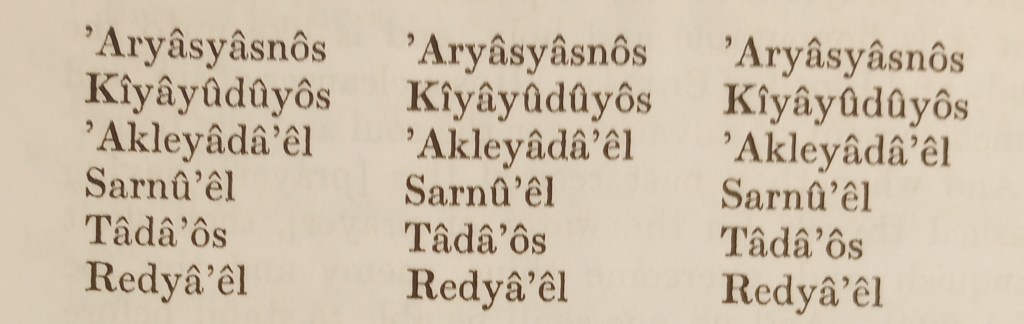
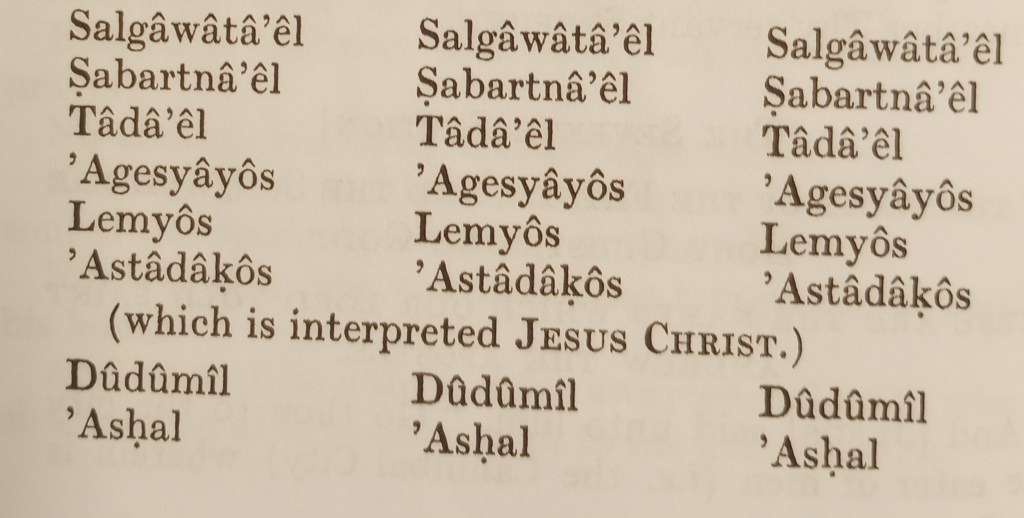
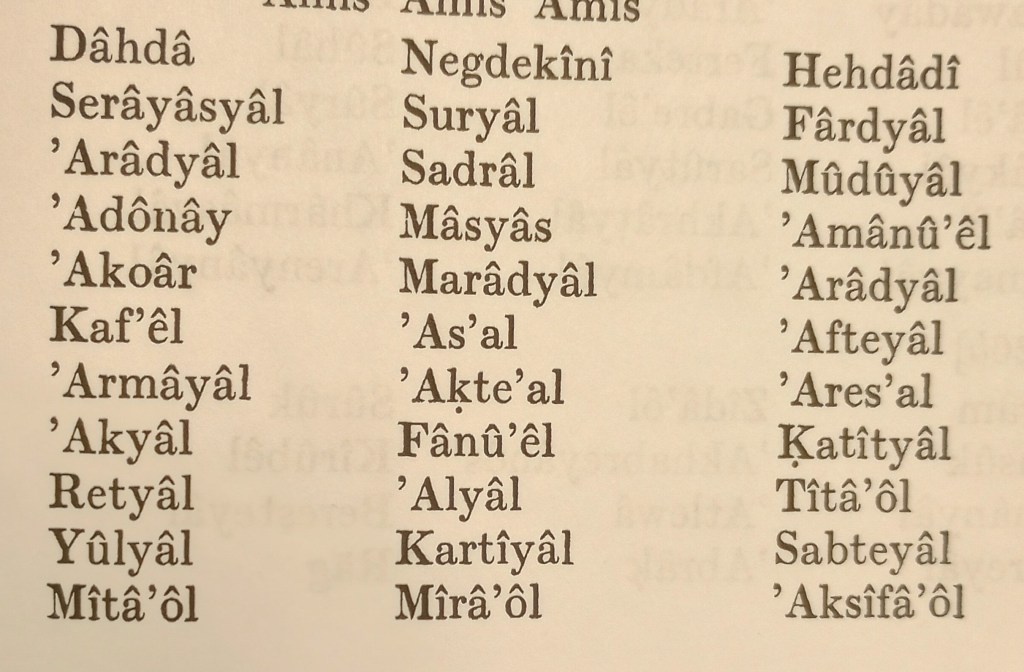
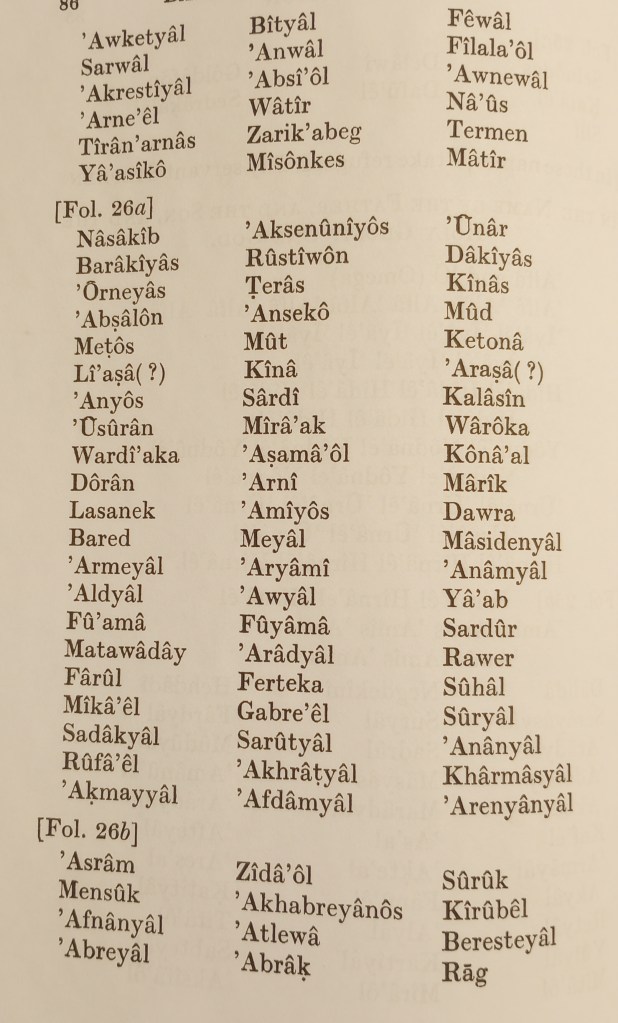
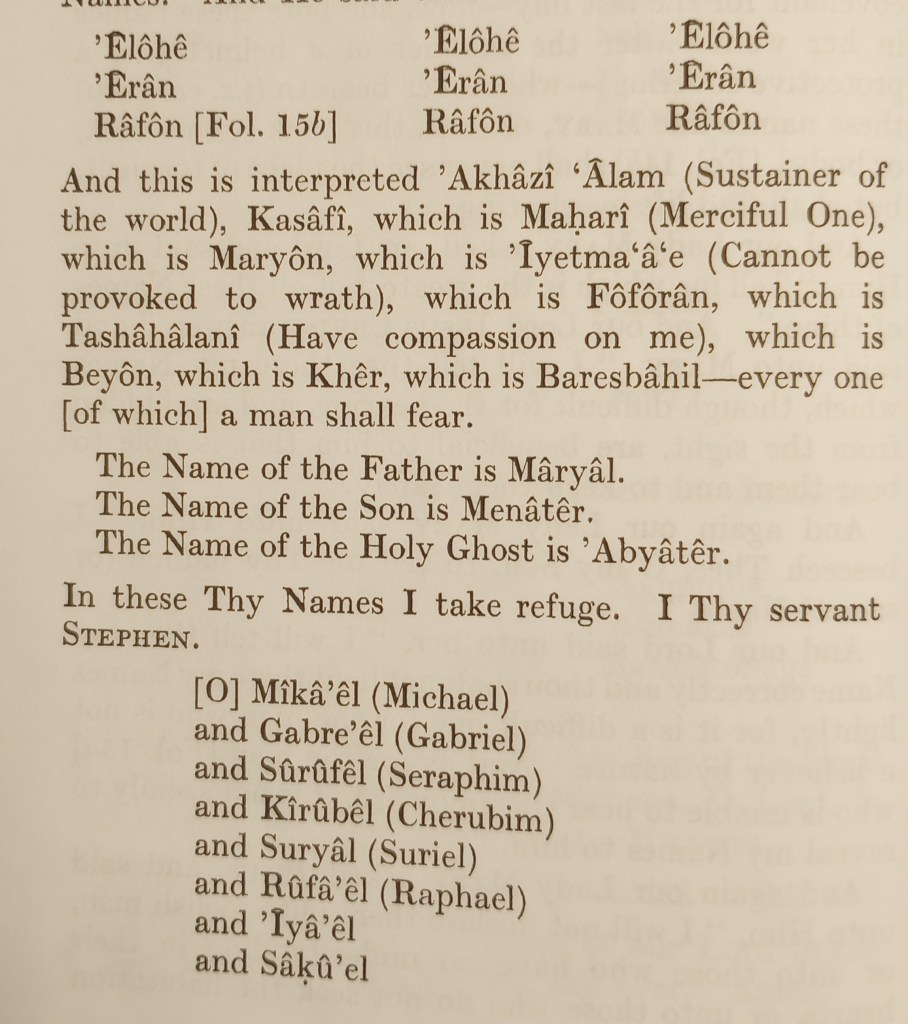
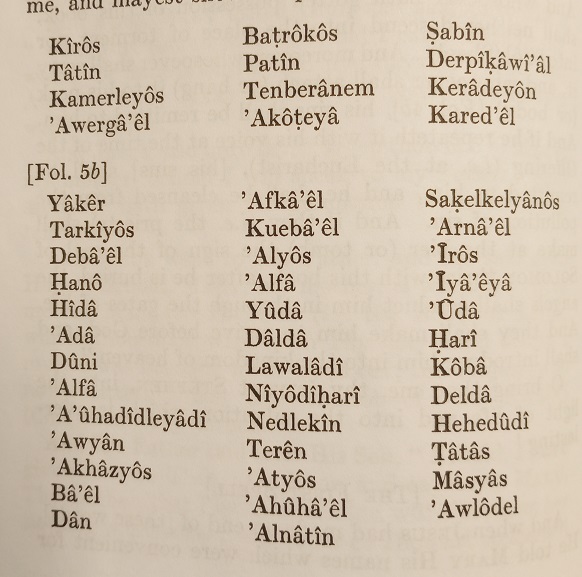
Section four brings Mother Mary back into the story. She asks her son “Tell me which is the greatest of all these names of thine.” Jesus responds, “I will tell thee these my Names which, though difficult for the hearing, and are hidden from the sight, are beneficial to him that is able to bear them and to keep them safely.” Mary again asks him for the secret names. Jesus obliges but states these names are not to be given to the unfaithful and foolish, as they are not to be held lightly. Mary agrees to these conditions. Jesus proclaims he will give her the names and at once, he stands on a pillar of cloud and fire! Rather than typing all these out, here are pics of the text:

Thus concludes blog post 2 of 3. The other four sections are not quite as long, but they do feature a LOT more divine names!

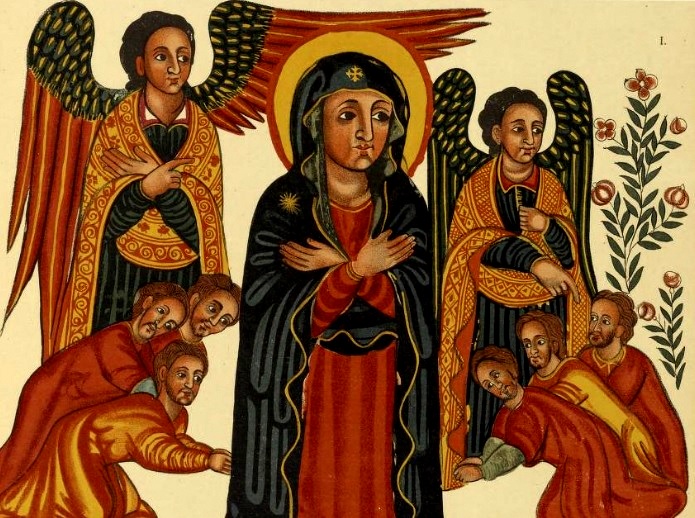
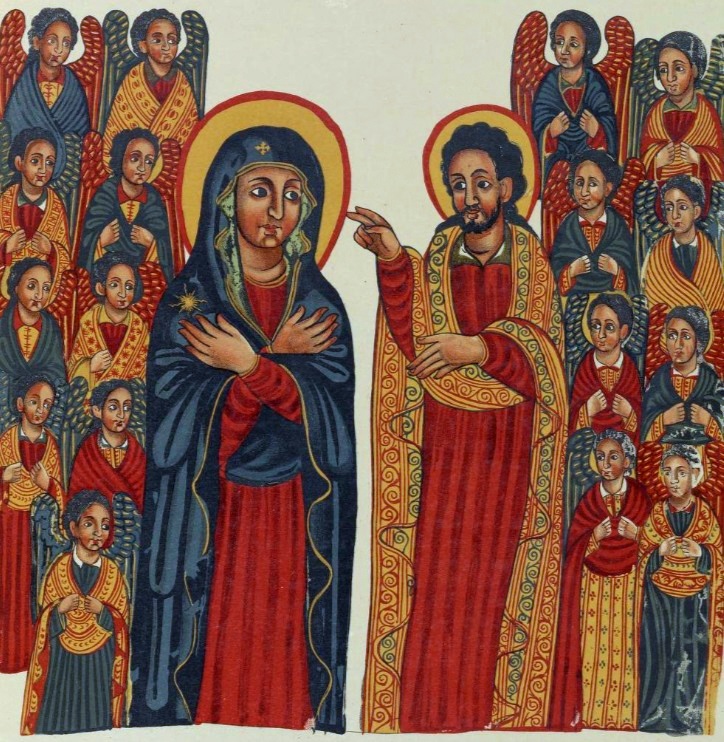
Featured artwork is 17th century Ethiopian iconography of the Virgin Mary in heaven.

bP

Lefāfa Ṣedeḳ: Book of Life (1 of 3)

This post (part 1 of 3) is about the “Lefāfa Ṣedeḳ: Book of Life”, also known as the “Bandlet of Righteousness” with the subtitle “An Ethiopic Book of the Dead.” The book of the dead subtitle is definitely a play on the Egyptian Book of the Dead, but is this a similar style text? Actually, it is. This Ethiopic text is quite the interesting read as it features a discussion between Mary and Jesus where she asks how to escape the tortures of Gehenna and he gives her the various secret divine names that she will use to bypass hell. The text is heavily influenced by Egyptian literature and has the Gnostic thought of using “secret names” to bypass the rulers for ascension. If you recall reading my three part posts regarding the “Liber Requiei Mariae” (Book of Mary’s Repose), Jesus gives Mary the secret names that will allow her to bypass the rulers of the world. The text, at least the English translation I read, did not include any such names. The Lefāfa Ṣedeḳ does! I see this text as a companion piece that goes with the Liber Requiei Mariae. So, with that in mind, let’s take a look at this fascinating text!

The text is split into eight sections. The intro to the text describes this book written by the Father before Christ was born onto Mary. Knowing this information would be later requested, hence why it is written before the “events” that would later come about. The first section of the book has Christ appearing to Mary in the “place where the righteous have their habitation in the Garden, and in the place where sinners dwell in torment in hell”. Witnessing this, Mary becomes troubled and asks her son how they (she and her kinfolk) are to be spared from the devouring fire. Jesus denies her request as he states once this information is out, it will spread onto others and eventually be used by sinners to escape any responsibility for their actions (a “Get out of Jail FREE” card if you will). Mary says to him “Wherefore did I carry Thee in my womb for nine months and five days?” and begins to weep a great deal afterwards. This causes Jesus to feel empathic towards his mother. He says he will go speak to his Father regarding this situation.

Jesus went before his Father and said “Behold, Mary, my mother is weeping. Give me the Mashafa Haywat (i.e. the Book of Life), which thou didst write with Thy holy hand before I myself was brought forth by Mary, the Virgin who now sitteth upon her chariot of the Kîrûbêl (cherubim), thy Throne.” The Father fulfills this request and tells Jesus to give Mary the information she seeks and to inform her that nothing will be hidden from her.

With a gold pen, Jesus begins to write in a book. As he was doing this, a light cloud hovered over them. Seven pavilions (veils) of fire surround them and no one knew what was being written until Christ spoke to Mary. He said to her “Take this book which I have given unto thee. And thou shalt not reveal it to the man who is not able to bear it, or to keep guard over this Book, but only to the wise who believe on Me, and who walk in My commandments. And whosoever hath gotten possession of this book, shall neither descend into the place of torment nor into Sî’ôl (Sheol). And moreover, whosoever shall carry it, and whosoever shall attach it to his neck, his sins shall be remitted to him. And if he repeateth it with his voice at the time of the Offering (Eucharist), his sins shall be remitted to him, and he shall be cleansed from the pollution of sin. And if they (priests) shall make at the bier (tomb) the sign of the seal of SOLOMON thrice with this book, after he is buried, the angels shall conduct him in through the gates of life. And they shall make him to arrive before God, and shall introduce him into the kingdom of heaven.”

Now this is very interesting! This book, or as I would like to call it, an “amulet”, is present in the “Liber Requiei Mariae” but amulets are commonplace in all types of traditions from antiquity to the present. Various gnostic groups used amulets (I have a few from antiquity, perhaps a future blog post subject) that typically had the Greek letters ΙΑΩ on them, usually around the figure of Abrasax/Abraxas, though that deity was not always present. As you can see, this text is a Christian incantation ritual guide. The Egyptian influences will definitely become more and more apparent.

The next step Jesus takes is to tell his mother his secret names for procuring life and salvation. With the two is a servant by the name of STEPHEN. He will show up in the text quite a bit, along with another servant by the name of WALDA. Rather than trying to type out these divine names, I will take a picture of the text. Here is the first group:

The next set of secret names, the servant STEPHEN says so that mercy and compassion will be shown upon him:

After the recitation of these names, Jesus tells Mary that the mercy of his Father is complete and perfect, and if men believe his name, he will judge them life and salvation.

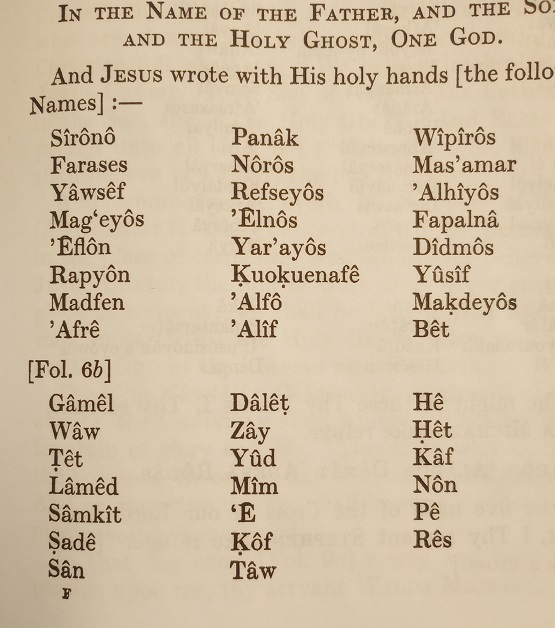
The second section (spell) starts right away with the phrase “In the Name of the Father, and the Son, and the Holy Ghost, One God.” Jesus then wrote the following names:

These names were directed towards the servant STEPHEN to recite to avoid the smoke of the place of torment. The servant WALDA then requested from the Lord the names that were given to Peter. These are the names that were given to her:

After the recital of these names, the following phrase is proclaimed:

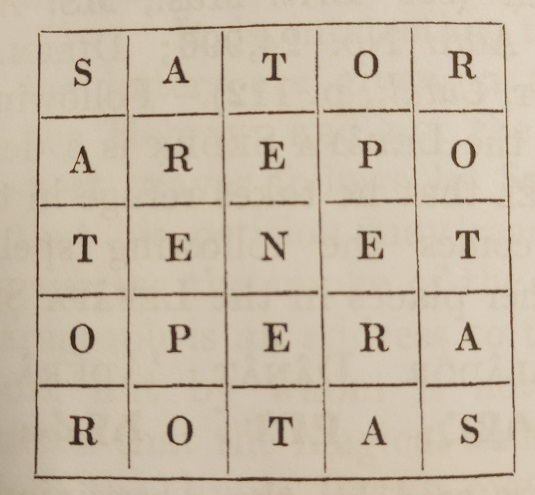
SÂDÔR ‘ALÂDÔR DÂNÂT ‘ADÊRÂ RÔDÂS

What exactly are these five words? According to the translator, these words are a corruption of the phrase: SATOR AREPO TENET OPERA ROTAS. This phrase is a palindrome; hence it can be read the same forwards and backwards (in simplistic terms, think of the word RACECAR). This phrase was also used to form a magical square, such as:

The translator also states that this wording comes from an even earlier Roman phrase: “SAT ORARE POTENter ET OPERAre RatiO TuA sit”. In terms of this particular story, the phrase that is to be recited to close the ritual represents the five wounds of Jesus Christ, or as the text likes to state, “In the five nails of the Cross of our Lord Jesus Christ”.

My first blog entry of this fascinating text will end here. Those interested in reading this text, I could not find it online anywhere. Ethiopic non-canonical Christian texts, particularly those of an esoteric nature, are pretty hard to come by, especially in English. I found on Amazon a reprint of the 1929 book “Bandlet of Righteousness: An Ethiopian Book of the Dead” by E.A. Wallis Budget. It’s pretty cheap and the version I purchased was by Kessinger’s Legacy Reprints. Unfortunately, no photos of the actual Ge’ez text accompany the text.

Featured artwork: 17th century Ethiopian iconography of Mother Mary and Jesus

-bP

The Virgin Mary’s Vision of Hell

Here lately I have been going down the rabbit hole of Ethiopic Christianity, particularly the apocrypha texts from that tradition. It has been a fascinating journey and I am only getting started. I am working on a blog entry about the “Lefāfa Ṣedeḳ” but in the meantime, I wanted to post about this text that involves the Theotokos and her vision of Hell. Now there are numerous stories involving such a concept, so the premise is nothing new. I am basing this blog entry on a text that survives in the British Museum collection. I am not sure where else it survives nor do I have any other information on it. This story is included in a book I recently read, so I do apologize about not having more source material of it’s origin. From my viewpoint, the Ethiopic Christian tradition is not very well represented in the English speaking world on the internet. Trying to find material on the matter usually leads me to books published in the later half of the 19th and early 20th centuries. That being said, let us take a look at this interesting short text.

This story is told by Mary. Jesus tells her that he will take her to the west and show her where the “souls of the sinners and the men of deceit live”. This area is at the boundary of the earth and heaven. No darkness was present but rather a river of fire. Mary asked her son for an explanation of the river and who dwelt within, and he said “These were not wholly cold, and they were not poor.” Looking around, Mary saw many men, women and children. She saw some men immersed in fire up to their breasts, some to their lips and others to their skulls. Then Mary saw a great abyss that appeared to have no bottom to it. She asked for whom this abyss is for and Jesus replied “For all those who have committed fornication, and those who have lain with men and beasts…These are they who shall enter this abyss, and this shall be their punishment forever.”

The next sight Mary saw was an old man who received a special punishment of his own. Fourteen “cruel” angels of darkness carried this man into the river of fire, which proceeded to engulf him. They then set the man upon a throne of fire which flared up to his breasts. The angels of darkness mockingly hurled red-hot darts into his side and poured fire onto him from a vessel! No reason was given why this man was being tortured as he was.

These types of visions continue. The next one involves a man whom the angels smote until he fell down on his face and blood was pouring out of his mouth before being thrown into the river of fire. Another man was being pounded with red hot stones and rods of lightning. Another man was beaten with rods of lightning until his face was blackened, then his tongue was cut out with a red hot razor and his nose sliced off with a sword!

Multitudes of people were scattered about the river of fire, some suspended on pillars of fire, others being gnawed on by worms. Virgins were chained around their necks and being dragged into the fire. Panthers and lions of fire were biting people through their throats and legs. Some areas had sweet fruits and water within a little more than an arm’s reach to taunt the damned.

These descriptions continued a little bit more, but you get the idea. The souls trapped were shown no mercy. Mary saw Gehenna was sealed with seven seals. Jesus cried out “Open ye the doors of Jahannam that Mary, my Mother, may see.” Interesting note that the word “Jahannam” is used, which is more associated with Islam than Christianity. Once the doors were opened, Mary asked what is this river. Jesus said that it’s name is Jahannam and said that the people who dwell within it are those who denied the Son of God. The tortured souls saw Mary and cried out “Blessed art thou, O Mary and blessed is the Fruit of thy womb. Blessed are the eyes that see thee.” Hearing this, Mary asks Jesus to have mercy upon them for her sake and that there is no man without sin.

Jesus responds with “From the Eve of the Sabbath until the dawn of the second day of the week, the sinners shall have respite from their torture (those in Jahannam). Be not sorrowful, my Mother. He who hath celebrated thy Commemoration, or hath written a history of thy words, on him will I show mercy to the twelfth generation for thy sake, O thou who didst give me birth. This I swear unto thee by my Father, and his Son, myself, and by the flow of blood from my side, for the redemption of the world, and by his Spirit, my Spirit.” Upon hearing this, Mary gives thanks upon her son.

Thus ends this particular text, at least the version I have read of it. The story offers up another example of intercession by Mary for those who pray to her. The graphic detail of the damned fits along the narrative of a Hell-ish afterlife for those who fall out of line. Definitely an interesting four page story!

This story is featured in the appendix of the Kessinger’s Legacy Reprints of the “Bandlet of Righteousness” by E.A. Wallis Budge. I will be referring to this book some more in the future.

Featured artwork is Midjourney based.

bP

Hymn of the Savior

The Apocryphon of John, The Secret Revelation of John, The Secret Book of John…..whatever you want to refer to it, this particular text, next to the Gospel of Thomas, is perhaps the most well known “Gnostic” text out there. It survives in at least four manuscripts, more so than any other gnostic text. I do not plan to tackle this text in a single blog post but rather just a hymn that is included towards the end of the text. I will be using Marvin Meyer’s translation and the hymn I am referring to is what he refers to as the “Hymn of the Savior.”

Now I, the perfect forethought of all, transformed myself into my offspring. I existed first and went down every path.

I am the abundance of light,

I am the remembrance of fullness.

I went into the realm of great darkness and continued until I entered the midst of the prison. The foundations of chaos shook, and I hid from them because of their evil, and they did not recognize me.

Again I returned, a second time, and went on. I had come from the inhabitants of light — I, the remembrance of forethought.

I entered the midst of darkness and the bowels of the underworld, turning to my task. The foundations of chaos shook as though to fall upon those who dwell in chaos and destroy them. Again I hurried back to the root of my light so they might not be destroyed before their time.

Again, a third time, I went forth—

I am the light dwelling in light,
I am the remembrance of forethought—

so that I might enter the midst of darkness and the bowels of the underworld. I brightened my face with light from the consummation of their realm and entered the midst of their prison, which is the prison of the body.

I said, Let whoever hears arise from deep sleep.

A person wept and shed tears. Bitter tears the person wiped away, and said, Who is calling my name? From where has my hope come as I dwell in the bondage of prison?

I said,

I am the forethought of pure light,
I am the thought of the virgin spirit, who raises you to a place of honor.

Arise, remember that you have heard
and trace your root,
which is I, the compassionate.

Guard yourself against the angels of misery,
the demons of chaos and all who entrap you,
and beware of deep sleep
and the trap in the bowels of the underworld.

I raised and sealed the person in luminous water with five seals, that death might not prevail over the person from that moment on.

This hymn concludes the book, but it feels like a later addition to the story. That being said, taken on its own, this hymn presents the story of achieving gnosis through divine intervention. I have never shared my story of divine intervention (perhaps for another time) but the situation was pretty similar to this set up, particularly this section: “I said, Let whoever hears arise from deep sleep. A person wept and shed tears. Bitter tears the person wiped away, and said, Who is calling my name? From where has my hope come as I dwell in the bondage of prison?” I have this hymn printed out and included in my special binder (which includes various pieces of gnostic scriptures) that I often meditate upon. I highly recommend the readers of this post reflect upon this passage. It’s a very powerful hymn.

Read the entire translation of the Secret Book of John here: http://www.gnosis.org/naghamm/apocjn-meyer.html

bP
Featured artwork is midjourney based and created using part of this text.