
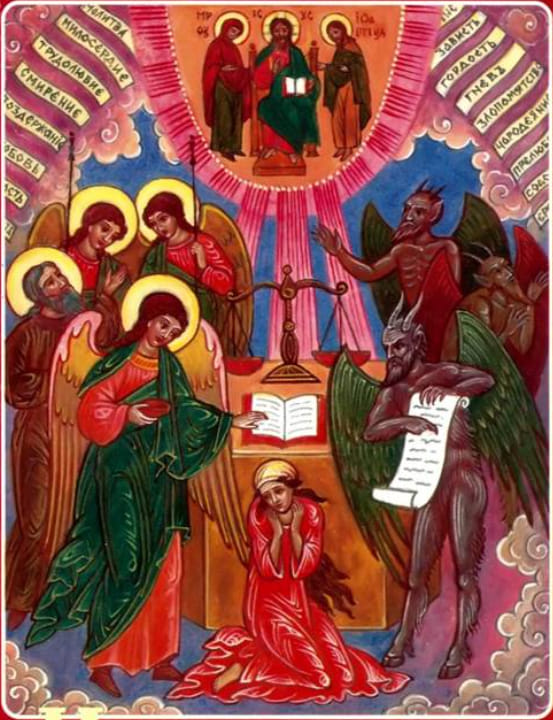
The Gospel of Mary is probably the most famous non-Nag Hammadi library text out there. Despite it not being complete, an interesting teaching arises from this text. I am going to solely focus on the toll houses presented in this story. If you did not catch my previous blog entry about toll houses (click HERE), this concept is that after death, the soul, usually along with it’s guardian angel, stops at various “toll houses” to confront a demon and the soul is then judged. The featured icon I have for this post illustrates a “literal” scene of this concept however this should be viewed as a metaphor of spiritual warfare that we face throughout life. The toll houses feature a demon that represents a sin of the world. This is very well illustrated in the Gospel of Mary.
This gospel, as it is currently preserved (we are missing the first seven pages and fragments throughout) is a post resurrection text. Christ has a final word with the group before heading out and the apostles ask Mary Magdalene to give them a teaching that Jesus gave to her. She explains the soul’s journey after death. Part of this story is missing, so we start at the second toll house:
And Lust said: ‘I did not see you when you descended, but now I see you as you ascend. So why do you lie, given that you belong to me?’

The soul replied, and said: ‘I saw you; you neither saw me, nor did you recognize me. To you I was a garment, and you did not recognize me.’

After saying this, it left, greatly rejoicing.
The third toll house:
Next, it approached the third power, which is called ‘Ignorance.’

It interrogated the soul, saying: ‘Where are you going? You are fettered in adultery. You are truly fettered, so judge not!’

And the soul said: ‘Why are you judging me, when I have not passed judgment?

I have been fettered, yet I have not fettered.

I was unrecognized, yet I have recognized that the All is dissolving, both earthly and heavenly things.’
Notice a pattern? Mary proceeds to speak of the final power of her story (as it is currently preserved):
When the soul had conquered the third power, it ascended and saw the fourth power; it had seven forms.

The first form is darkness, the second is lust, the third is ignorance, the fourth is jealousy that brings death, the fifth is the kingdom of the flesh, the sixth is foolish fleshly insight, the seventh is wrathful wisdom. These are the seven powers of Wrath.

They interrogate the soul: ‘Where do you come from, you who kill men, or where are you going, you who overcome space?’

The soul replied and said: ‘What fetters me has been slain, and what surrounds me has been defeated, and my lust has been finished, and ignorance has died.

In a world, I was set free from a world and in a type from a heavenly type, and from the fetter of forgetfulness, which endures for a season.

Beginning at this moment, I will reach the repose of the time of the season of the aeon inside Silence.’”
Mary ends her story there. It is a shame the beginning of the story does not currently survive, as I would love to see how this ascension process begins. Hopefully the sands of Egypt reveals this to us at some point.
Gospel of Mary translation: The Gospel of Mary
Featured picture is an Orthodox icon of unknown date/tradition. Will update if I ever find the source.
bP

