

July 12 is the feast day for Saint Veronica. But who is she? She is best known as the woman who wipes the face of Jesus during the sixth station of the cross. This particular event did not happen in the gospels but has been a part of the western tradition. So where does this come from? The main source for a woman named Veronica is the Gospel of Nicodemus. I have referenced this Gospel before when I wrote about the Harrowing of Hell (click HERE to read that). The first part of the Gospel references the Passion of Christ and in this is where we find this quote:
And a certain woman named Bernice (Beronice Copt., Veronica Lat.) crying out from afar off said: I had an issue of blood and touched the hem of his garment, and the flowing of my blood was stayed which I had twelve years. The Jews say: We have a law that a woman shall not come to give testimony.
Notice the note that in Latin manuscripts, it is the name “Veronica” that is given for the woman, which means “true icon”. So when you have Veronica’s veil, it’s basically “a veil of the true icon”, i.e. the face of Christ. Also take note of the reference to the “issue of blood” and that by touching Christ, she was cured. This is referenced in Matthew, Luke and Mark. Here are the quotes:
Luke 8:43-48 ESV:
And there was a woman who had had a discharge of blood for twelve years, and though she had spent all her living on physicians, she could not be healed by anyone. She came up behind him and touched the fringe of his garment, and immediately her discharge of blood ceased. And Jesus said, “Who was it that touched me?” When all denied it, Peter said, “Master, the crowds surround you and are pressing in on you!” But Jesus said, “Someone touched me, for I perceive that power has gone out from me.” And when the woman saw that she was not hidden, she came trembling, and falling down before him declared in the presence of all the people why she had touched him, and how she had been immediately healed. And he said to her, “Daughter, your faith has made you well; go in peace.”

Mark 5:25-34 ESV:
And there was a woman who had had a discharge of blood for twelve years, and who had suffered much under many physicians, and had spent all that she had, and was no better but rather grew worse. She had heard the reports about Jesus and came up behind him in the crowd and touched his garment. For she said, “If I touch even his garments, I will be made well.” And immediately the flow of blood dried up, and she felt in her body that she was healed of her disease. And Jesus, perceiving in himself that power had gone out from him, immediately turned about in the crowd and said, “Who touched my garments?” And his disciples said to him, “You see the crowd pressing around you, and yet you say, ‘Who touched me?’” And he looked around to see who had done it. But the woman, knowing what had happened to her, came in fear and trembling and fell down before him and told him the whole truth. And he said to her, “Daughter, your faith has made you well; go in peace, and be healed of your disease.”

Matthew 9:20-22 ESV:
And behold, a woman who had suffered from a discharge of blood for twelve years came up behind him and touched the fringe of his garment, for she said to herself, “If I only touch his garment, I will be made well.” Jesus turned, and seeing her he said, “Take heart, daughter; your faith has made you well.” And instantly the woman was made well.
Now it wouldn’t be until medieval Europe that the “sixth station”, i.e. Veronica showing compassion to Christ during the Via Dolorosa, came together. We can thank the Franciscans for putting the stations of the cross together so anyone who could not journey to the Holy Land can recreate this journey of Christ’s suffering at their home and/or church. There’s not a definitive source on why this station was created, but it appears that perhaps a veil with the image of Christ’s face was in possession of the Roman church and what better way to give it credence by putting together this story. Though in my opinion, the “holy face” imprint is secondary. I find the wiping of Jesus’ face by the woman to be an act of compassion towards Christ especially if she is the woman cured by him earlier; this is her way of giving back to him.
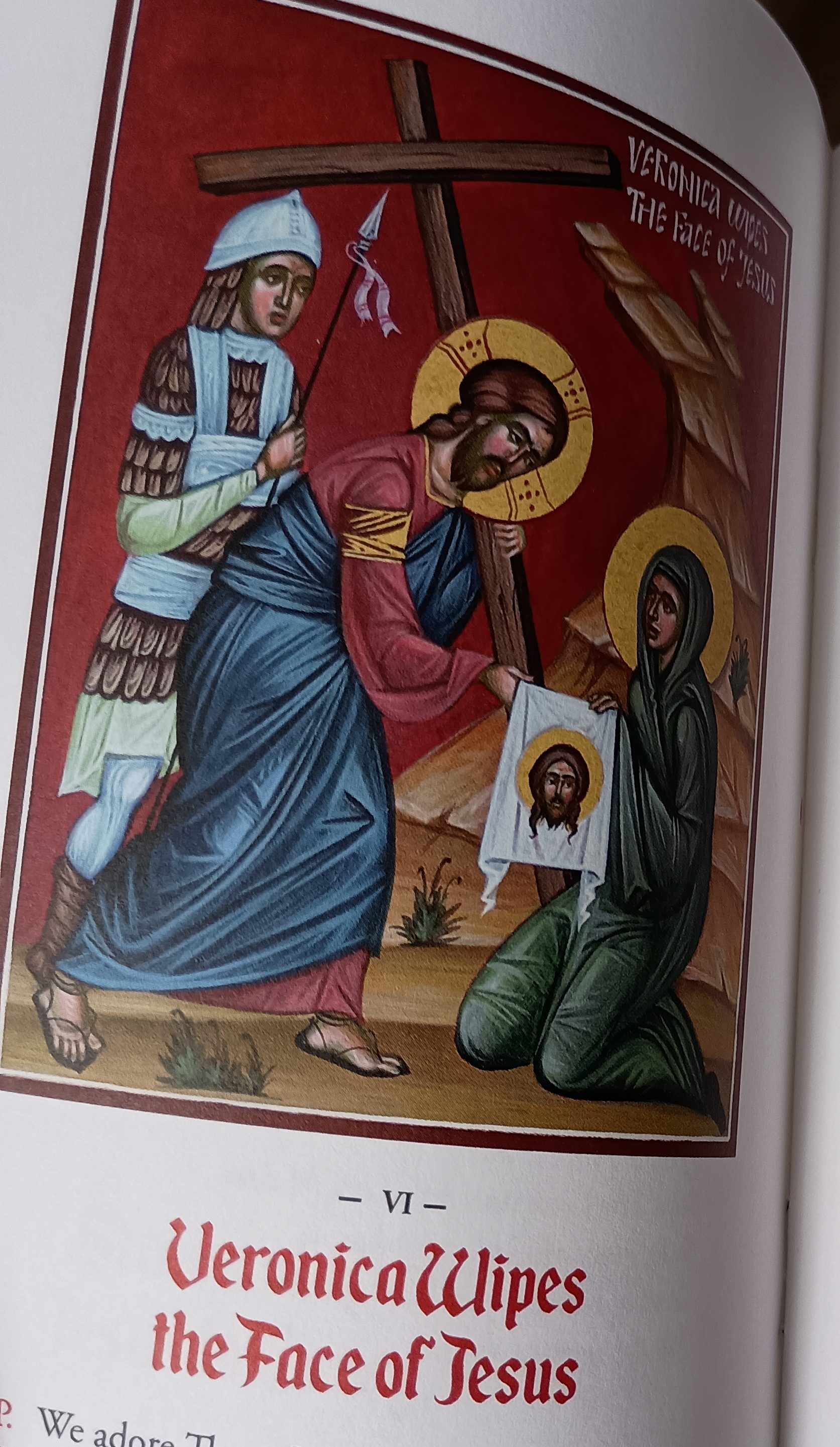
Speaking of this holy face, the “icon not made by hands” actually comes from an earlier story, one that I wrote about previously which had Jesus writing a letter to King Abgarus (click HERE to view the post) in which the letter includes an imprint of Jesus’ face (a detail that was added to the story throughout it’s history). The letter acts as a sort of amulet for the person(s) who come in contact with it. This kind of goes back to the Veronica story in which she carries it as an amulet / reminder of her cured status thanks to Jesus. The “Holy Face” of Christ has also created devotions dedicated to it. I became familiar with the 19th century devotion of the Holy Face awhile back and recite it occasionally. If you’re familiar with the rosary and other similar Roman Catholic chaplets, you’ll be right at home with this one. Here is the chaplet I follow for such devotion (click HERE).
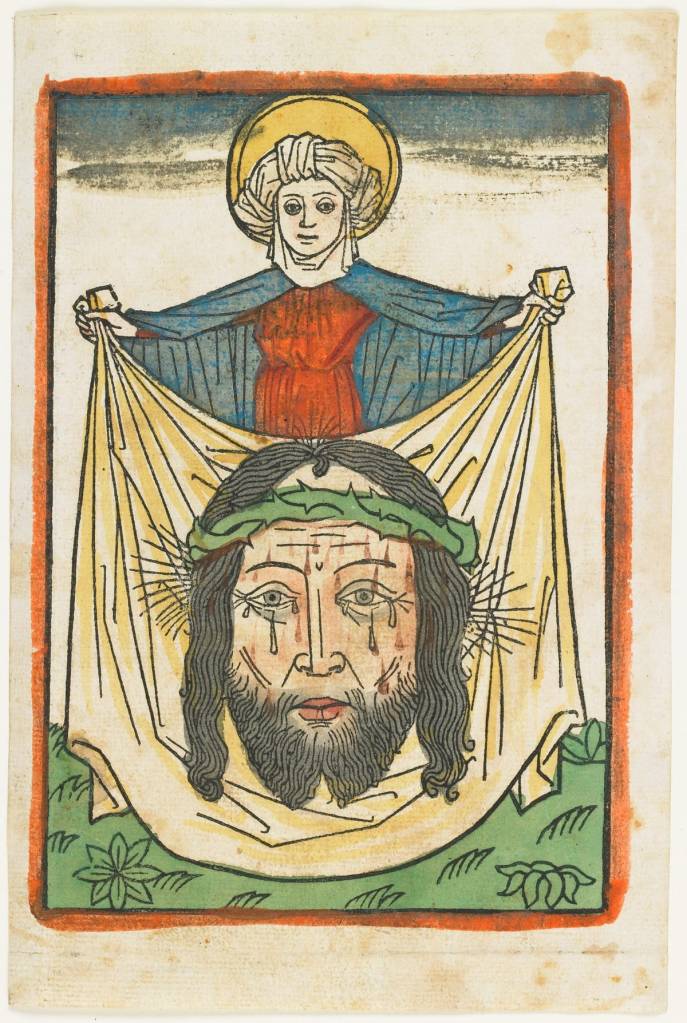
When you commemorate Saint Veronica this July 12, think of what she represents and how you can apply that lesson of compassion towards others. And while you’re at it, spend some time reflecting upon the holy face of Christ. 😉
Featured image is by Guido Reni (1575-1642). Second image taking from the Way of the Cross booklet that legacyicons sells on their website. Third image is from 1475 Germany.
The Gospel of Nicodemus can be read in it’s entirety here: The Gospel of Nicodemus
-bP

