The “Tenchi” – sacred text of the Kakure Kirishitan (2 of 3)

Part 2 (of 3) of my posts regarding the “Tenchi”, the sacred book of the hidden Christians of Japan, aka, the Kakure Kirishitan.

Book 5, The Tribulations of Santa Maruya, is quite long and begins with Maruya (Mary) arriving home to her parents and they find her pregnant. Being unmarried and pregnant, they are angry at her and cast her from the house. She leaves and stays at various homes of strangers until she wanders into Beren (Bethlehem) and gives birth to “The Holy One (Jesus).” An interesting part involving that cold night goes as follows:

On account of the intense cold in the stable, the Holy One's body was in danger of freezing.  But the cows and horses that surrounded the mother and child breathed their warm breath on the newborn.  Thanks to them the holy body was warmed and endured the winter cold.  In a manger in that stable the new born also took his first bath.  Because of the great compassion that the horses and cattle showed, we are not allowed to eat meat or poultry on Wednesdays.

This saying shares a little bit with the apocrypha text “the Gospel of Pseudo-Matthew.” The next morning, the stable owners find Maruya and child in the stable and takes them in. This next part of the text is interesting because this will come back into play later on in the tenchi.

After three days had passed, Maruya requested a bath.  When the bath was over she said to the lady of the house, "Please, let your son bathe in the same water."  But the woman answered, "I am grateful for your thoughtfulness, but my son is diseased and his life is hanging by a thread.  Excuse my rudeness if I refuse."  But Maruya encouraged her, saying, "Please, let him get in."  So the boy's mother put her sickly son in the bath and his disease vanished and he was cured instantly.  The power of that water had restored his very life.

Another part of this book involves the three kings visit to the child. Interestingly enough, the book names the kings as: Menteo the King of Turkey, Gasuparu the King of Mexico and Bautozaru the king of France. After the kings leave, the king of Beren sends his two retainers Ponsha and Piroto to search and kill this child. Ponsha and Piroto is Pontius Pilate but split into two people. Maruya and the child escape this pursuit, which involves the “grain miracle” that pops up in medieval apocrypha. Following this incident, the Holy One receives his baptism in a river by San Jiwan, who was born just seven months prior. The text does not suggest San Jiwan is John the Baptist. At the fortieth day following the Holy One’s birth, he is summoned to heaven by Deusu and has a face-to-face chat and is giving a rank and crown. The fiftieth day involves the Holy One entering a sanctuary where he is taught by Sagaramento (who is from the heavenly realm) for seven days and nights. The fortieth and fiftieth days are special days that are celebrated among the KK.

Book 6 is rather short and titled The Five Mysteries of the Morning. This text really goes in on the combining of Christian and Buddhist mythologies. There is a re-telling of a pre-teen Jesus missing for three days and nights but rather in a temple, he was studying Buddhist scriptures with a teacher by the name of Gakujuran. During one of the lessons, Gakujuran speaks about what happens after death and the Holy One starts asking questions. This leads to Gakujuran stating that he (The Holy One) speaks quite a bit and would like him to explain his reasoning. Below is what the Holy One said:

The Holy One thus gave his sermon: "From the depth of the earth to the height of heaven measures more than 80,000 jo (jo = ~3 yards).  As for the one you worship as Buddha, he is called Deusu, Lord of Heaven.  He is the Buddha who introduced the salvation to help humankind in the world yet to come.  This Buddha made heaven and earth, the sun and the moon, the heaven called Paraiso, the human creation, and everything else that exists.  Indeed, there is nothing that this Buddha cannot make.  What's more, at the time he made man he blew in his own breath and created humankind.  But later people sighed so much that these sighs became an evil wind and these winds gathered together on the island into a typhoon that wrought destruction.  Trees and plants were blown down and the human seed was near to extinction.  But from heaven Buddha stopped it, althought its destruction had already covered an expanse of 75 ri (ri = 2.44 miles)." 

From this sermon, the students at the sanctuary decided to follow the Holy One instead of Gakujuran, and thus we have the twelve disciples. Gakujuran would eventually turn to the disciple role and follow the Holy One to Roma (Rome).

A Nationwide Search is the seventh book and starts with King Yorotetsu of Beren commanding an infanticide of all children from newborns up to seven years of age. The number killed reached a total of 44,444. Once the Holy One received this news, he withdrew into the forest of Zeze-Maruya and there he received an oracle from Deusu that states:

Thousands of infants lost their lives on your account.  I fear they may now forfeit the pleasure of Paraiso.  For their sake in the next world, you must be tortured and trodden upon, suffer and give up your body.

Thus the reasoning for the Holy One’s eventual crucifixion. The story introduces Judatsu (Judas) who is suddenly possessed by an evil idea of turning in the Holy One for a reward. The way the Holy One announces who will betray him is quite…interesting:

"The person who eats his rice with soup every morning is the one who will betray me."

After Judatsu informs the King of the Holy One’s whereabouts, he is transformed by having his nose grow huge and his tongue long. He returns to the disciples and they scold him, even stating he is a “treacherous bastard.” This leads to Judatsu’s suicide by hanging.

Book 8, titled Yorotetsu Captures the Holy One, has the king sending Ponsha and Piroto, along with an army, to Rome to apprehend the Holy One. After the army surrounded the temple where the Holy One was at, the Holy One asked of Judatsu and was informed of his betrayal. He said:

As it was preordained that I suffer and give up my life tortured, how I regret Judatsu's end.  Even though he betrayed me, I would have helped him if he had not killed himself first."

The army captures the Holy One with a rope around his neck and bounded his arms behind his back. They dragged him back to Beren. Once in front of the King, the Holy One was beaten by a bamboo stick that broke his bones. Bitter and spicy things were rammed down his throat and then a metal crown placed on his head that caused blood to run down his face. King Yorotetsu ordered the crucifixion of the Holy One upon Karuwaryu Hill.

Part 2 ends here. I really like the inclusion of some apocrypha mythology as well as Buddhist ideas. Fascinating stuff!

The “Tenchi” – sacred text of the Kakure Kirishitan (1 of 3)

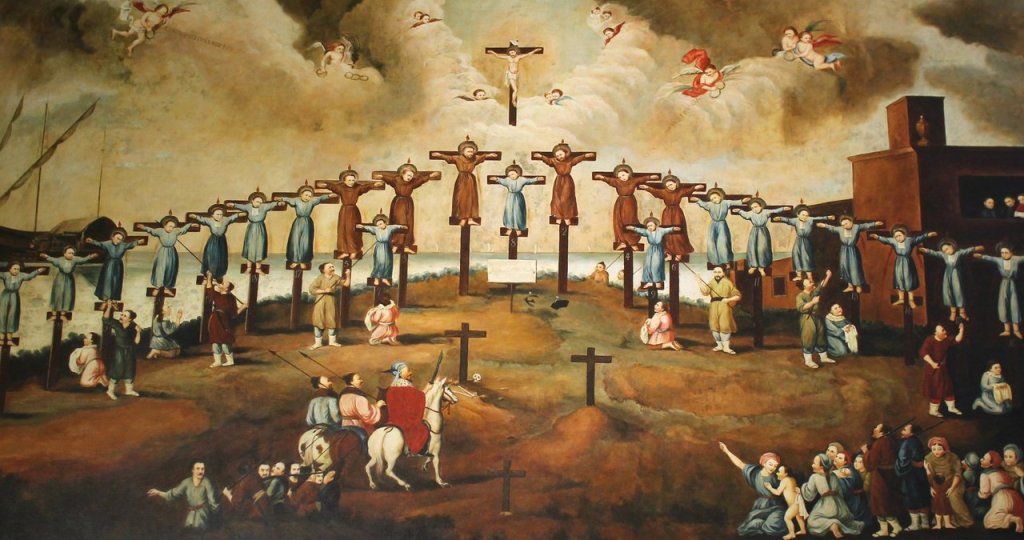
Awhile back, I fell down the rabbit hole of the Kakure Kirishitans, aka, Japan’s Hidden Christians. While a simple blog post can not begin to go into detail about this group, I will give a brief run down. In 1549, the Jesuit missionary St. Francis Xavier introduced Catholicism to Japan. Over the next half century, Christianity would spread in Japan. However, due to VARIOUS reasons (mainly political), Christianity would be outlawed in Japan in the early 1600s. Thousands would be executed. Those who survived took their practice underground.

See https://acatholiclife.blogspot.com/2019/02/the-26-holy-martyrs-of-japan-mass-in.html for more info.

The above painting is from the 1597 execution of priests and common folk. See the link I provided below the painting for more info.

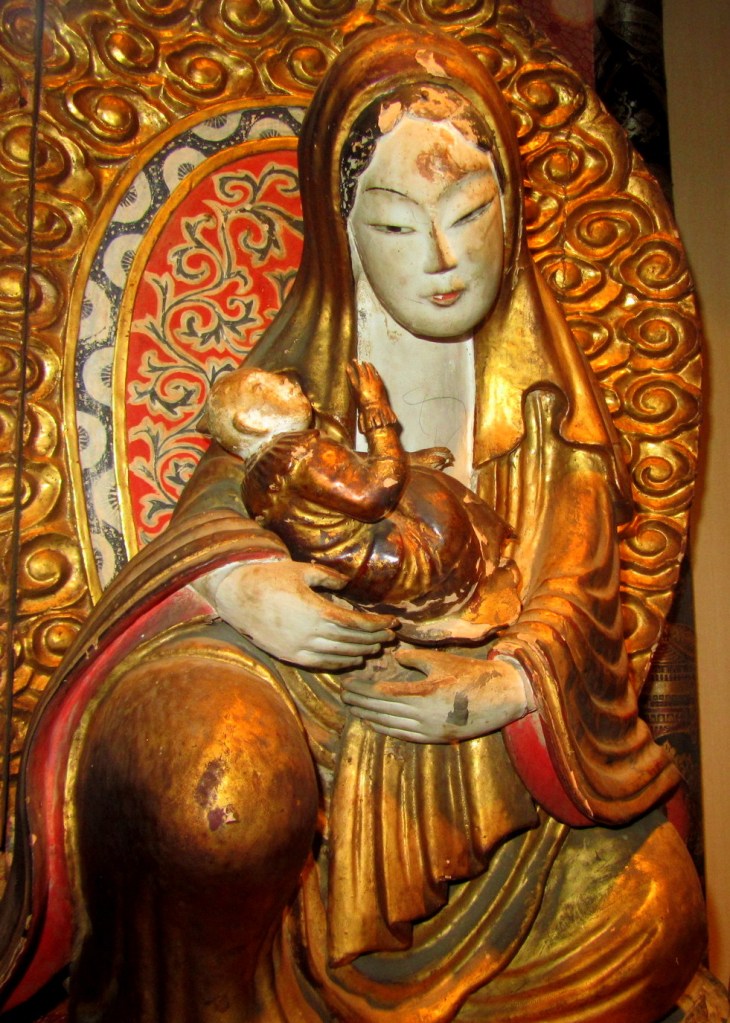
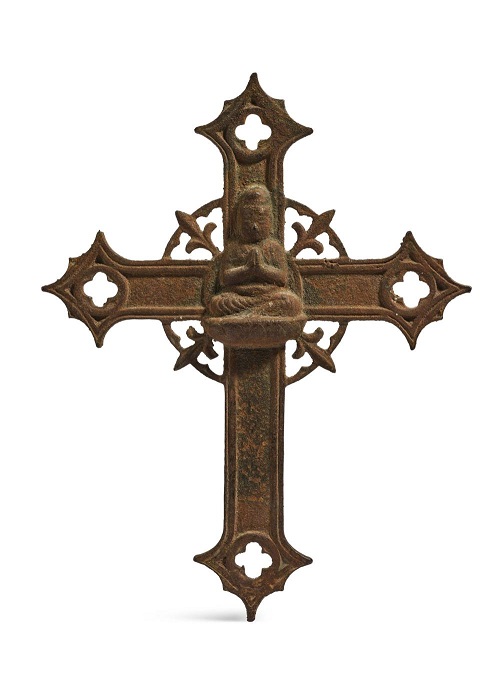
To protect themselves, Japanese Christians would integrate Christianity with Shinto and Buddhism. This created an interesting mish mash of beliefs. Since there were no “Catholic” priests in the country, the people had to go off their memories of what previous priests had preached of. These would not be written down because if these writings were found, it mean death. Below are two items of that time period that mixed Buddhism with the Christian faith.

Maria Kannon

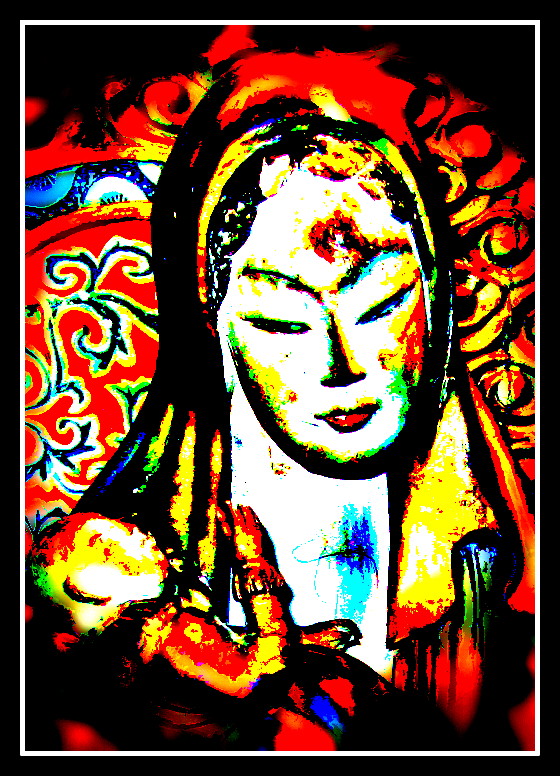
Above is the Maria Kannon with child. Kannon, the Buddhist Goddess of Mercy, takes the place of the Virgin Mary. The child in her arm is detachable, thus if the authorities were inspecting a home with this statue on display, the said Christian could remove the child and just state this is a statue of Kannon. But in prayer, the child would be reattached and the statue be viewed as Mary and Jesus.

Above is a Christian Cross, but it has the Buddha attached to it. It was not until around 1865-ish that Christianity became legal in Japan. Once it did, these hidden Christians would come out of hiding and integrate with the Catholic Church. However, some decided to remain hidden. The tradition still exists to this day, though the practice is almost extinct. It is believed less than 100 still practice this tradition. If you want to know more, just google / youtube search on the subject and you’ll find all kinds of fascinating information.

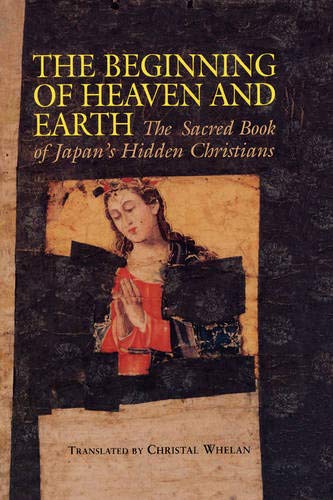
What brings me to post about this group is their text, the “Tenchi”. This text is the only known scripture from this group. An English translation of this can be found in the book “The Beginning of Heaven and Earth: The Sacred Book of Japan’s Hidden Christians” by Christal Whelan. The book features a history of the text, how it was viewed by the KK, and a commentary / notes section after the scripture. The Tenchi itself is about 30 pages long. It is a very interesting retelling of the Christian Mythology. It covers the creation story, Adam & Even, the Flood, Mary’s life leading up to the birth of Jesus, then follows Jesus until death and after that, it features an “end of the world” story and another story that seems out of place (most likely added later on). What is great is that there are 10 known copies of this text, which is awesome for someone who is translating it. If we could only be so lucky with gnostic texts!

The “Tenchi” is gnostic in how it retells these stories. The stories also like to recount tales that would explain various sayings. Here is an example.

From Book 1: The Beginning of Heaven and Earth
.... When Adan (Adam) came home, Ewa (Eve) told him the story and showed him the fruit she had set aside for him.  When she handed it to Adan, he had some doubts but took it in his hands anyway and ate it.  At that moment, how eerie it was, for a voice as if from nowhere spoke out: "Adan...whhhy?  That is the evil fruit."  It was the voice of Deusu (God), and Adan, shaken, stood transfixed in amazement, but no matter how hard he tried to vomit up the fruit it remained lodged deep in his throat.  What a pitiful sight it was, for Ewa and Adan too lost the glory of heaven and were transformed on the spot.  They offered the Salve Regina, cried out to heaven, and bowed to the ground.  Tears of blood flowed from their eyes, and although they had a thousand regrets it was no use.  This incident is the origin of the Contrition orassho.

As you can see, it sort of stays with the canon, though a bit of a difference. Book 1 starts with the creation, which kind of reads like a Buddhist style scripture. Below is the first paragraph of Book 1:

In the beginning, Deusu was worshiped as Lord of Heaven and Earth, and Parent of humankind and all creation.  Deusu has two hundred ranks and forty-two forms, and divided the light that was originally one, and made the Sun Heaven, and twelve other heavens.  The names of these heavens are Benbo or Hell, Manbo, Oribeten, Shidai, Godai, Pappa, Oroha, Konsutanchi, Hora, Koroteru, and a hundred thousand Paraiso and Gokuraku.

Book 2, titled The Evil Fruit Cast to Middle Heaven, is about the children of Adam and Eve going to “Middle Earth” (i.e. outside of Paradise) and the flood. The flood retailing is quite interesting. It involves lion dogs outside a temple. Once the eyes of these statues become red, a great tsunami will destroy the world. Some kids thought this prophecy was ridiculous and painted the eyes red and once Pappa Maruji (the Noah archetype) saw this, he got his children into a canoe he prepared and was saved when this wave of water came and destroyed the world. No animals on board, nor would there be room! lol This flood was brought to the earth because of three beings that had came to the world: Ambition, Covetousness, and Selfishness.

Book 3, The Division of Deusu’s Body for the Salvation of Humankind, is about Maruya (the Virgin Mary). This is an interesting backstory for her as it states when she was twelve, she was given an oracle that would shape her life. The story later speaks of a King who wants to marry Maruya and even tempts her with various worldly treasures. She explains why she does not care and I really like how this plays out. Here is some of the scripture:

Without so much as a glance at the king's treasures Maruya responded, "Your treasures are temporary and pertain to an ephemeral present.  Once you have used them up, they are useless.  But now I will show you my secret arts."  Turning her face to the heavens above, pressing her palms together and gathering all her force to the center of her being in prayer, the girl Maruya worshiped and invoked while these words flooded from her:  "Reveal to us your mystery and power this instant."

This causes food to suddenly appear in front of the king and then Maruya does another miracle that brings snow to the area, which is in their hottest month of the year. At the end of the story, Maruya ascends to heaven.

Book 4, The King’s Death, starts with Maruya in heaven speaking to Deusu and it involves the plan of Deusu descending to Earth and using Maruya as a vessel.

Kneeling before the Biruzen Santa Maruya, the anjo said, "The Lord of Heaven is due to descend to earth, so please let us use your young and fresh body for the purpose."  Maruya answered, "How marvelous indeed.  Just as I was sitting here wondering where he might come, you have come to tell me that it is to me he will come."  She was exceedingly glad and assured the anjo, saying, "Your wish is my command."  The anjo added, "In the middle of the second month the Lord will come to earth, so please comply with this favor we have asked you."  With those words the anjo disappeared into the heavens.

Later in the book, it mentions the origins of the “Hail Mary” and the “Our Father.” Here is the explanation provided:

Izaberuna, greatly surprised when she saw her friend, leaped backwards and then bowed with her head to the ground, and uttered the words: "Maruya, full of grace, to you I bow.  The Lord is with you and blessed are you among all other women.  Precious is the Jisusu who is in your womb."  Maruya listened and said, "Our Father who is in heaven, hallowed is your name.  He will come and may your will be done on earth as it is in heaven.  From heaven give us our daily nourishment."

Very interesting stuff! I have decided to split my thoughts on the Tenchi to 3 blog posts, so I will end here for now.

A Naassene Psalm

I wanted to share this fragmented text from a Naassene source. Despite being a fragment, it works quite well as is. The text/psalm can relate to the soul, as well as Sophia. The following is based on a G.R.S. Mead translation:

First [was there] Mind the Generative Law of All;
Second to the Firstborn was Liquid Chaos;
Third Soul through toil received the Law.
Wherefore, with a deer's form surrounding her,
She labours at her task beneath Death's rule.
Now, holding sway, she sees the Light;
And now, cast into piteous plight, she weeps;
Now she weeps, and now rejoices;
Now she weeps, and now is judged;
Now is judged, and now she dieth;
Now is born, with no way out for her; in misery
She enters in her wandering the labyrinth of ills.
And Jesus said: O Father, see!
[Behold] the struggle still of ills on earth!
Far from Thy Breath away she wanders!
She seeks to flee the bitter Chaos,
And knows not how she shall pass through.
Wherefore, send me, O Father!
Seals in my hands, I will descend;
Through Æons universal will I make a Path;
Through Mysteries all I'll open up a Way!
And Forms of Gods will I display;
The secrets of the Holy Path I will hand on,
And call them Gnosis.

There are a few other translations that can be found at: http://www.gnosis.org/library/naas.htm. All are pretty good, so check them out.

(Updated 4/12/23) I have added a video reading of this psalm:

Mary Magdalene in the “Speculum Sacerdotale” (2 of 2)

Here is the second (and final) part of the Mary Magdalene story from the “Speculum Sacerdotale“. As I have mentioned before, I’m not a professional, so if there are errors, I do apologize. Please keep in mind that the medieval Mary Magdalene would also take on the contributes of other women/Marys of the bible.

And after time of her passage, there was such a savour smell that it lasted for five days.  And then the priest respectfully buried her holy body, and after his death, he made it that he should be buried with her.

Mary, the sister of Lazarus, who Christ raised from the dead, and also sister of Martha, who did much attending to Christ, as it is read in the Gospel.  But Mary chose the best part, for she set by the feet of our Lord and heard his holy words, and she followed him to the cross, and she walked on the day of Passover to his burial tomb to anoint him.  And after that, he had risen up, she was the first that saw him.  And therefore in our litany, we take her before all virgins except the mother of God, which not only is set and prayed before virgins, but also before all other saints after her son.
 
And our Lord had showed for Mary such a miracle.  A raging river that caused a flood, there was a ship filled with men and women.  So it happened that there rose up a wind and such a storm, that the ship filled up with water and sunk.  And then all that were in the ship were so troubled with the fear of death, that they were no prayers to God or to any other good saints.  But as many were in danger, it came into the mind of a certain woman that she should cry and speak with as high a voice as she might, in these words: “O’ Saint Mary Magdalene, so well beloved with Christ, I prayed thee by thy bitter tears that thou wettest Christ’s feet with, for to deliver me from this peril of death.”

And this same woman was pregnant with child, and she made a vow to God to give her child, if it should be a man, to be made a monk in an abbey nearby.  Within a moment there appeared to her a woman of gentle shape, who put her hand onto the woman and took her by the chin and brought her up to the bank, safe and sound.  And so the woman was delivered, through the help of God and of Mary Magdalene.  So afterward, when the woman had became pregnant, she was advised of her vow that she had made.  She offered the child to God and to Saint Mary Magdalene, and he was her servant for life.

Also there was a knight slayed in battle, who had made yearly pilgrimages to the sepulchre of Mary Magdalene.  As his friends wept and sorrowed for him, beholding him on the ground, they were angry with Mary Magdalene and asked why she let her servant die without confession, penance, and contrition.  Suddenly the dead body, to great marvel to all men, rose from the dead and made a priest come to him.  And when he had confessed to him and received God’s grace, he passed again to rest.

Also there was a clerk of Flaundres who fell into a stream of multiple crimes, and he was in such vices that he would neither do good nor hear of it.  Nevertheless he had great devotion to Mary Magdalene.  He worshiped her on her feast and fasted for her devoutly.  So in time, he had visited her sepulchre.  As he lay in his devotion, he had fallen into a half awake, half sleeping state, Mary Magdalene appeared to him.  She appeared as a celestial body, appearing in between two angels.  She said to him “Answer me now.  Why does thou act so wickedly against the prayers and merits that I make for thee?  I make for thee great instance and speak to my Lord, that thou should not perish, and thou will not amend, for I have prayed for thee to God, for the great devotion that thou has had for me.  Therefore, rise and amend it, and I shall never leave thee until thou be reconciled to God.”  And at that moment, this clerk felt the grace of God and Mary Magdalene, that he forsake the world and entered into religion and was of an exceptionally perfect life.  At the time of his death, Mary Magdalene was seen standing with angels beside his bed.  She took up his soul, like a white dove, to heaven.

Here is the original text I used: https://d.lib.rochester.edu/teams/text/reames-middle-english-legends-of-women-saints-mary-magdalen-speculum-sacerdotale

2021 translation/modernization by Bill Piper.

Mary Magdalene in the “Speculum Sacerdotale” (1 of 2)

My medieval translations continue, this time from the fifteenth century collection of sermons titled the “Speculum Sacerdotale.” This modernization was a bit more tricky but I think I was able to get the point across, for the most part. I decided to split this up into two different blog posts. Like the Golden Legend, this story has given Mary the same attributes that typically are cast on her during this time period, so keep that in mind. I have provided a link at the end of the post to the original text I used.

In a day, we shall have the feast of Saint Mary Magdalene, who was the sinful woman and served to have fleshly desires, and to whom God afterward gave such grace that she was given forgiveness of her sins.

For when Christ was in the house of Simon the Leper, as soon as Mary heard of him, she thought in herself by divine aspiration and grace that it come time to convert and make sorrow and penance of her life that she had lead before.  And she took an ointment in a vessel and went into the house of Simon where Jesus was and kneeled to the feet of Jesus and washed them with her tears, and wiped them with her hair and then anointed them with her ointment.

The Pharisees Simon had become angry that Christ would allow such a sinful woman to come to him, and Jesus said him “Simon, see that I came into your house and you neither kissed my feet, nor washed or anointed them, but this woman had done this since she had come.”  And there fore said Christ to Simon, “Her many sins are forgiven, because she loved me so much.”  And then he said to the woman, “Woman, for you have showed me love, your sins are forgiven.  Go, your faith has made you safe.”

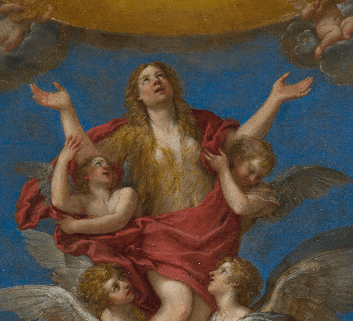
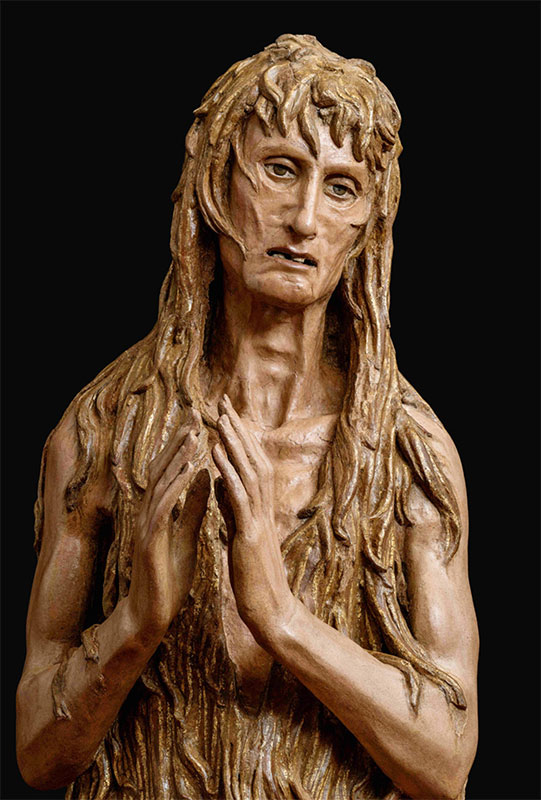
Joseph tells us that Mary Magdalene, for the great burning love that she showed God, would never have a husband after the ascension of Christ.  But she will go into the desert and there she will dwell for the span of thirty years, unknown to all, never eat meat or have drink.  But in time, the angels of Heaven would come to her and raise her up into the air, and there she would pray to God.

After the space of thirty years, there was a holy priest who used the time of fasting and prayer to dwell in the desert.  And in time, he saw how the angels of God would come down from Heaven and there took a person or thing and bare it up between him and after, brought it again and left it where they took it.  At the last time, this priest thought in himself that there was some saint residing there that would often visit with angels.  And at the excitation of the Holy Spirit, he went to the place where the angels were going to, and there he found an enclosed den.  He kneel down and cried, saying “I conjure thee by virtue of the Father, the Son and the Holy Ghost, that whether thou be man or what creature that thou be, that is in this place, that thou speak with me.  And if thou be a spirit, then thou answer to me!”

And then a voice spoke to him from out of the den and said “For that thou has so conjured me by the holy Trinity, therefore I shall answer and speak to thee and show to thee what I am.  Has thou never heard or read in the Gospel of Mary, the great sinner, that watered the feet of her Saviour and wiped them with her hair, and deserved so to have forgiveness of her sins?”

And he answered and said “Yes, I have heard and read it, and now it is the holy Gospel over all the world.”  And then Mary said to him again, “Sire, I am the same Mary; and for the great love that I have to my lord, I may see no man.  And therefore, soon after his ascension, I went into this wilderness and have dwelled here for thirty years, and in all this time, I never saw or heard a man until now.  Each day, at the canonical hour, angels of my Lord would come to me and lead me to my praying place toward Heaven.  And there they showed me the sweetness of the bliss, and then they bring me back to this den.  And for this sweetness of Heaven and fairness of the angels, I never desired of man nor be hungry or thirsty for thirty years.  And sire, now I know well that the day of my passage out of this world has come near, that I may dwell in the sight of my Lord for eternity.  And therefore I pray thee, do now at my prayers, as I have done at thee; go home and come again at the seventh day and bring with thee a weaving cloth, for I will end in the same manner as other men do.”

And then the priest went and brought such a cloth and cast it at the door of the den.  And then Mary prayed to him that he should bring her to some place of men that she might end her life there.  And he brought her home to his brethren, and there Mary was communed with the body and blood of our Lord Jesus Christ.  And she then lift up her head and hands to God, and so passed her spirit.

Here is the original text I used: https://d.lib.rochester.edu/teams/text/reames-middle-english-legends-of-women-saints-mary-magdalen-speculum-sacerdotale

2021 translation/modernization by Bill Piper.

Hildegard – Story of a Sinning Soul

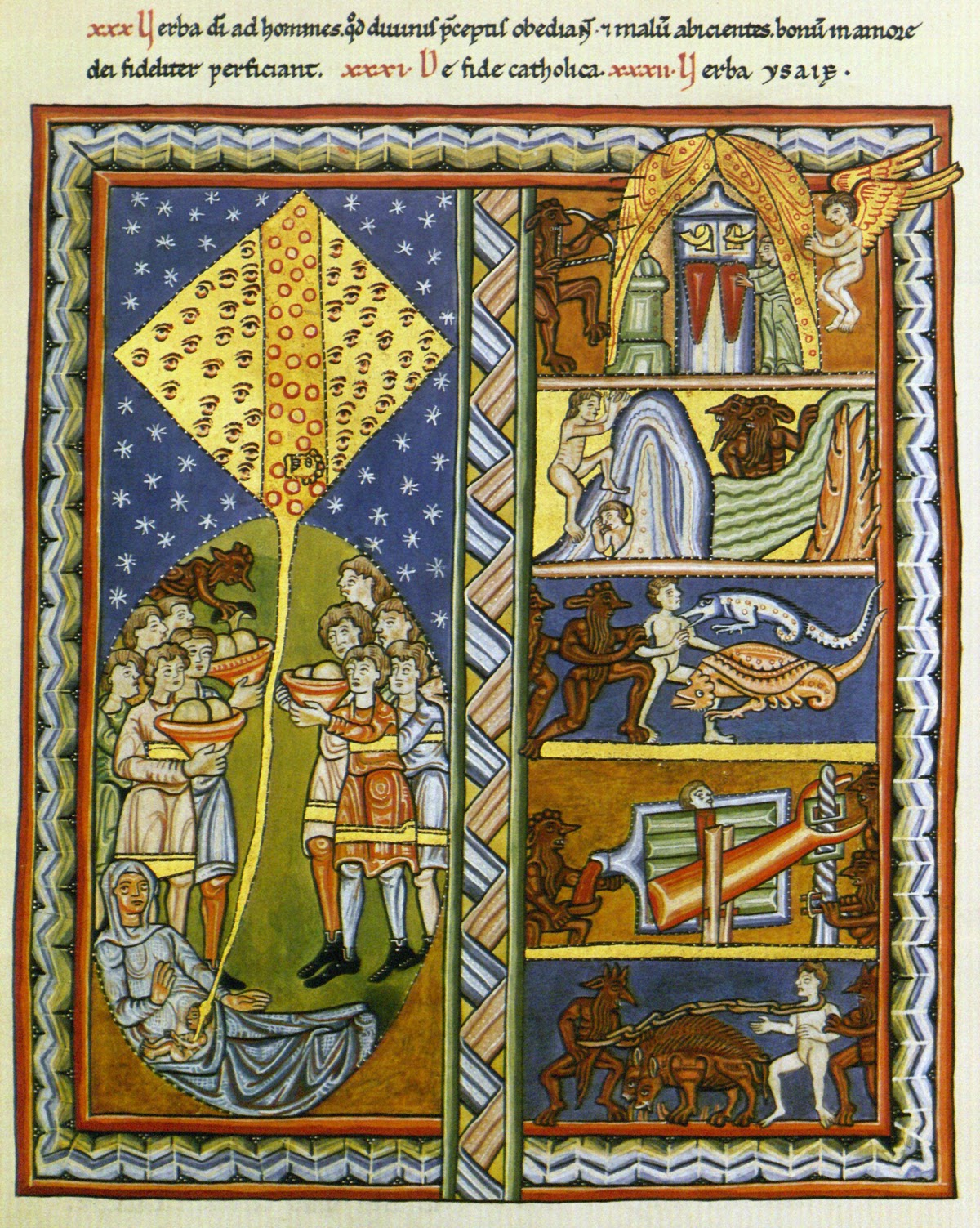
Still reading up on Hildegard of Bingen from the book “St. Hildegard of Bingen” by Carmen Acevedo Butcher (excellent, excellent read) and I found another section I would like to share. This translation of the first section of vision four from SCIVIAS sounds quite gnostic in nature. The painting I included in the post is from this section of the SCIVIAS.

Who am I?  A pilgrim wandering in death’s shadow.  What path am I on?  The wrong one.  What comfort can I get?  That given to pilgrims.

I know what I should have become. My body was designed as a sacred temple, a sanctuary shining with gems brighter than the sun and stars, because they radiate God’s magnificence. The roof and the walls should have all been made of gems. The stairs would have been crystal, and the streets gold. I was made to be friends with the angels because I’m a living breath God placed in mud. I was supposed to experience God. But no! When I saw I could focus on anything I wanted, my inmost self turned its attention to the sinister North.


I regret that so much now! For I was captured, robbed, blinded and violated. My garment was torn. I was dragged to a gruesome place and subjected to the worst kind of slavery. My captors hit me and made me eat with pigs. They put me on the rack and tortured me. They threw me outside and stung me with scorpions.


Then they shouted at me, laughing, “Where’s your honor now?”

Hildegard of Bingen: To Sophia…

The other week, youtube’s algorithm recommended to me some music written by Hildegard of (von) Bingen. I was not aware of who she was, but decided to give it a listen and really liked what I heard. Doing some research, I realized how amazing this person was. Yesterday while browsing through some books at a local store, I spotted one titled “St. Hildegard of Bingen: Doctor of the Church” by Carmen Acevedo Butcher. Flipping through it, I spotted a poem/song dedicated to Sophia (Wisdom). Being an advocate of Sophia, this really warmed my heart. So of course, I purchased the book and want to share this particular piece with you all. Browsing the net last night, I seen Hildegard also did a painting of Sophia, which I have included in this post as the main picture. I am looking forward to studying more about Hildegard as she seems to be quite fascinating. And as a synchronicity to all of this, just a few days ago was Hildegard’s Feast Day (Sept 17).

To Sophia
You soar, sustain, and animate,
climb, dive, and sing
Your way through this world,
giving life to every beating
heart.

You never end.
   You keep circling, crossing over us
on three wings----
   one speeds through heaven,
   one holds the earth together with a kiss as light as dew,
   and one whooshes over, under, and through our lives.
We praise You, Wisdom!

The Golden Legend of Mary Magdalene (3 of 3)

Here is the final part of my translation of the Golden Legend of Mary Magdalene. This sectionof the story includes her death and some legends relating to her. I found this exercise of modernizing the story to be quite enlightening. I plan on doing more in the future.


It happened that a priest, who desired to lead a solitary life, took a small residence for himself not far from the place of Mary Magdalene.  Then one day, our Lord opened the eyes of that priest and he saw in what manner the angels descended into the place where the blessed Mary Magdalene dwelt, and how they lifted her into the air, and after a hour, brought her again with divine praising to the same place.  And then the priest desired greatly to know the truth of this marvelous vision, and made his prayers to Almighty God, and went with great devotion unto the place.  When he approached a stone’s cast to it, his thighs began to swell and feel feeble.  His entrails within him began to lack breath and sigh for fear.  As soon as he returned, he had his thighs all whole and ready to go.  When he enforced himself to go to the place, his body began to feel weak and would not move.  He then understood that it was a secret celestial place where no human could enter.  He called out the name of Jesus and said “I conjure thee by our Lord, that if thou be a man or other reasonable creature, that dwell in this cave, answer me and tell me the truth.”  And when he had said this three times, the blessed Mary Magdalene answered “Come closer and thou shall know what thou desires.”  And then he came trembling unto the half way, and she said to him “Does thou not remember the gospel of Mary Magdalene, the renowned sinful woman, which washed the feet of our Saviour with her tears and dried them with the hair of her head, and desired to have forgiveness of her sins?”  And the priest said to her “I remember it well, that it has been more than thirty years that the holy church believed and confessed that it be done.”  And then she said “I am she that by the space of thirty years have been here without the company of any person, and like as it was suffered to thee yesterday to see me, in like wise, I am every day lifted up by the hands of angels into the air, and have deserved to hear with my bodily ears the sweet song of the celestial company.  And because it is showed to me of our Lord, that I shall depart out of this world.  Go to Maximin and say to him that the next day after the resurrection of our lord, in the same time that he is accustomed to arise and go to Matins, that he alone enter into his oratory, and that by the ministry and service of angels, he shall find me there.”  And the priest heard the voice of her, like as if it had been the voice of an angel, but saw nothing.  He then went to Saint Maximin and told to him by order.  Saint Maximin was replenished of great joy, and thanked greatly our Lord.  And on the said day and hour, he entered into his oratory and saw the blessed Mary Magdalene standing in a choir of angels, and whom was lifted from the earth about four feet.  Praying to our Lord, she held up her hands, and when Saint Maximin saw her, he was afraid to approach her.  She returned to him and said “Come toward mine own father and flee not thy daughter.”  When he approached her, as it is in the books of Saint Maximin, for the vision that she had of angels everyday, the cheer and visage of her shone as clear it had been the rays of the sun.  And then all the clerks and priests were called, and Mary Magdalene received the body and blood of our Lord of the hangs of the bishop with great abundance of tears.  Afterwards, she stretched her body toward the altar and her right blessed soul departed from the body and went to our Lord.  After it departed, there issued out of the body an odor so sweet smelling that it remained there for seven days.  The blessed Maximin anointed the body of Mary with precious ointments and buried it honorably, and after commanded that his body should be buried by hers after his death.

Legends after her death….

Hegesippus, with other books of Josephus accord enough with the said story, and Josephus said in his treatise that the blessed Mary Magdalene, after the ascension of our Lord, for the burning love that she had to Jesus Christ and for the grief and discomfort that she had for the absence of her master our Lord, she would never see any man.  But after she came into the country of Aix, she went into the desert and dwelt there for thirty years without knowing of any man or woman.  And he said that everyday at the seven hours canonical, she was lifted in the air of the angels.  But he said that when the priest came to her, he found her enclosed in her cell; and she required of him a vestment, and he delivered to her one, which she clothed and covered herself with.  She went with him to the church and received the communion, and then made her prayers with joined hands, and rested in peace.

In the time of Charles the great, in the year of our Lord, 771, Gerard, Duke of Burgundy, had no child by his wife, gave large alms to poor people and founded many churches and monasteries.  When he had the abbey of Vesoul, he and the abbot of the monastery sent a monk with a good reasonable fellowship into Aix, to bring back any relics of Saint Mary Magdalene.  When the monk arrived to said city, he found it all destroyed by non-Christians.  Then by adventure, he found the sepulchre, for the writing upon the sepulchre of marble showed well that the blessed lady Mary Magdalene rested and lay there, and the history of her was marvelously entailed and carved into the sepulchre.  The monk opened it that night and took the relics back to where he was lodging.  That same night Mary Magdalene appeared to that monk saying “Doubt thee nothing, make an end of the work.”  He then returned homeward until he came half a mile from the monastery.  He did not remove the relics until the abbot and monks came from the process, and he handed them over honestly.  Soon after, the duke’s wife had a child.

There was a knight that had a custom that every year, he would go on a pilgrimage to the body of Saint Mary Magdalene.  During a battle, the knight was slain.  As his friends wept for him, they said with sweet and devout quarrels, “Why did the servant of Mary Magdalene to die without confession and penance?”  Then suddenly the dead arose and called for a priest.  When the priest arrived, the knight confessed to him with great devotion, and received the blessed sacrament, and then rested in peace.

There was a ship with men and women that was sinking into the sea, and among them was a woman with child, who were about to be drowned.  The woman cried fast on Mary Magdalene for help, making a vow that if she might be saved by her merits, and escape the peril, if she had a son, she would give him to the monastery.  As soon as she made her vow, a woman of honorable habit and beauty appeared to her, and took her by the chin and brought her to the shore all safe, while the others in ship perished and drowned.  When the woman had her child, it was a son and she honored her vow.

Some say that Saint Mary Magdalene was wedded to Saint John the Evangelist when Christ called him from the wedding, and when he was called from her, she had been angered that her husband was taken from her, and went and gave herself to all delight.  Because it was not appropriate that the calling of Saint John should be the reason for her damnation, our Lord converted her mercifully to penance, and because he had taken from her sovereign delight of the flesh, he replenished her with sovereign delight spiritual before all other, that is the love of God.  It is said that he glorified Saint John before all others with the sweetness of his familiarity, because he had taken him from the preceding delight.

There was a blind man who was led to the monastery of the blessed Mary Magdalene to visit her body.  His leader said to him that he saw the church and then the blind man cried out and said in a high voice “O blessed Mary Magdalene, help me that I may deserve once to see thy church.”  And at once, his eyes were opened and was able to see all things clearly.

There was another man that wrote his sins in a journal and laid it under the coverture of the altar of Mary Magdalene, meekly praying to her seeking pardon and forgiveness.  After a short amount of time, he took his journal and found all his sins erased and struck out.  Another man was being held in prison, in chains, for debt of money.  He often called onto Mary Magdalene for help.  On one night, a fair woman appeared to him and broke all his chains, opened the door and commanded him to go his way.  When he saw himself loose, he fled away.

There was a clerk of Flanders named Stephen Rysen, a man of great immoral and entertained all manner of sins.  And such things concerning his health, he would not hear.  Nevertheless, he had great devotion in the blessed Mary Magdalene and fasted her vigil, and honored her feast.  During a visit to her tomb, he was not all asleep nor awake, when Mary Magdalene appeared to him as a fair woman, sustained with two angels, one on each side, and she said to him “Stephen, why does thou consider the deeds of my merits to be unworthy?  For what reason does thou not, at instance of my merits and prayers, be moved to penance?  For the time thou began to have devotion in me, I have always prayed to God for thee firmly.  Arise and repent, and I shall not leave you till you are reconciled to God.”  He felt his body fill with such great grace, that he renounced the world and entered into religion to live a perfect life.  Then at his death bed, Mary Magdalene was seen standing beside him with a choir of angels, which bared the soul up to heaven in the likeness of a white dove.  Let us pray to this blessed Mary Magdalene that she gives us grace to do penance her for our sins, that after this life, we may come to her in everlasting bliss in heaven.  Amen.

Check out the 1483 version at: https://sourcebooks.fordham.edu/basis/goldenlegend/goldenlegend-volume4.asp#Mary%20Magdalene

2021 version by Bill Piper

The Golden Legend of Mary Magdalene (2 of 3)

Here is the second post regarding my “modern” translation of the “Golden Legend of Mary Magdalene” from the Legenda sanctorum (Readings of the Saints) by Jacobus de Varagine. This section still follows the man and his wife from the previous post, and ends with Mary Magdalene going into solitude. I hope you enjoy this read and be sure to check back in a week (or so) when I have the final part of the story translated.

As always, I am not a scholar or some professional, so please bare with any mistakes I may have made. 😉


And when they made their course, sailing a day and night, there arose a great storm.  The wind increased and grew over hideous.  During the troubling of the sea and among the great waves, the lady gave birth to a son.  During his birth, the lady had died and the child, crying for his mother, made a piteous noise.  This brought great sorrow to the father, seeing his wife die and not knowing if the child will survive.

Alas!  What sorrow was this to the father, to have a son who’s birth caused the death of his wife, and the son may not live due to having none to nourish him.  Alas!  What shall this pilgrim do, seeing his wife dead and his son crying after the breast of his mother?  And the pilgrim wept strongly and said “Alas!  What shall I do?  I desired to have a son, and I have lost both the mother and possibly the son.”  And the mariners then said “This dead body must be cast into the sea, or else we all shall perish.  For as long as her body abides with us, this storm shall not cease.”  And when they had taken the body to cast into the sea, the husband said “Abide and suffer a little, and if you will not spare my wife, at least spare the crying child.  I pray you to wait awhile, for to know if the mother be reeling from the pain and might revive.”  And while he spoke to them, the ship men spotted a mountain not far from their ship.  They said that it was best to set the ship towards land and to bury there, to save the body from being devoured by sea creatures.  The man agreed with the mariners and they brought the body to the mountain.  On land, they tried to dig a pit for the body but found the ground was hard as rock thus they left the body lying on the ground and covered it with a mantle.  The father laid his little son at the breast of his dead wife and said weeping “O’ Mary Magdalene, why did you come to Marseille to cause great loss and set me upon this evil adventure?  Why did thou ask of God that my wife should conceive only to die during childbirth?  And now the child she conceived will perish because it has no way to nurse.  This I had by thy prayer, and to thee I commend them, to whom I have commended all my goods.  And also I commend to thy God, if he be mighty, that he remember the soul of the mother, that he by thy prayer have pity on the child that he does not perish.”  Then he covered his wife’s body, along with the child, with the mantle and returned to the ship and went forth with his journey.

When he came to Saint Peter, Saint Peter came against him.  When he saw the sign of the cross upon his shoulder, he demanded who he was and wherefore he came.  To whom Peter said “Peace be to thee, thou are welcomed and in good counsel.  Be not sadden by your wife’s sleep and the little child that rests with her, for our Lord is almighty, for to give to whom he will, and to take away that he has given, and to reestablish and give again that has taken, and to turn all heaviness and weeping into joy.”  Peter then led him into Jerusalem and showed him all the places where Jesus Christ preached and did miracles, the place where he suffered death, and where he ascended into heaven.  When he was well-informed of Saint Peter in the faith, and it had been two years since he had departed from Marseille, he took his ship to return to his county.  

As they sailed by the sea, they came, by the ordinance of God, by the rock where the body of his wife and son were left.  They arrived onto the mountain, the little child, whom was protected by Mary Magdalene, went to the seaside and started throwing stones into the sea.  When the man saw the little child playing, he was marveled at what he was.  When the child spotted them, he was afraid as he had never seen people before.  He ran to his mother’s breast and hid under the mantle.  The father went to find the child.  Upon pulling off the mantle, he found the child suckling the breast of his mother.  The father took the child into his arms and said “O’ Blessed Mary Magdalene, I would be so happy and blessed if my wife were alive, and might live again to come with me to my country.  I know certainly and believe that thou has given me back my son, and had fed and kept him safe for two years on this rock.  Please bring his mother back to full health.”  And with these words, his wife respired and took life, and as if she just woke up from a deep sleep, said “O’ Blessed Mary Magdalene, thou are of great merit and glorious, for in the pains of my deliverance, thou were my midwife, and in my necessities, thou has accomplished to me the service of a chambermaid.”  And when her husband heard that thing, he marveled as much and said “Does my dear and beloved wife live?”  To whom she said “Yes, certainly I live, and am now first coming from the pilgrimage from where you came, and all in like wise as Saint Peter led you in Jerusalem, and showed to you all the places where our Lord suffered death, was buried and ascended to heaven, and many other places, I was with you, with Mary Magdalene, which led and accompanied me, and showed to me all the places which I will remember and have in mind.”  And there, she recounted to him all the miracles that her husband had seen and never once failed in her recollections.

And then the good pilgrim received his wife and child, and went to the ship.  Soon after, they came to the port of Marseille and found the blessed Mary Magdalene preaching with her disciples.  They kneeled down to her feet and recounted to her all what had happened to them, and then received baptism of Saint Maximin.  They then destroyed all the temples of the idols in the city of Marseille, and made churches of Jesus Christ.  And with one accord, they chose the blessed Saint Lazarus to be bishop of that city.  Afterward, they came to the city of Aix, and by great miracles and preaching, they brought the people there to the faith of Jesus Christ.  There, Saint Maximin was ordained to be bishop.  In the meanwhile, the blessed Mary Magdalene, desirous of sovereign contemplation, sought a right sharp desert and took place there which was ordained by an angel of God, and to abode there for thirty years without knowledge of anyone.  In this place, she had no comfort of running water, no solace of trees and no herbs.  That was because our Redeemer had ordained for her to not partake of bodily meats but rather that of a celestial nature.  Everyday at each canonical hour, she was lifted up in the air of angels, and heard the glorious song of the heavenly companies with her bodily ears.  She was fed and filled with right sweet meats, and then was brought again by the angels to her proper place, in which she had no need of bodily nourishing.

Stay tuned for part 3!

Check out the 1483 version at: https://sourcebooks.fordham.edu/basis/goldenlegend/goldenlegend-volume4.asp#Mary%20Magdalene

2021 version by Bill Piper

The Golden Legend of Mary Magdalene (1 of 3)

I’ve heard of the legend of Mary Magdalene arriving in France after the death of Jesus but never did track the story down until recently. This legend comes from the the book titled  Legenda sanctorum (Readings of the Saints) by Jacobus de Varagine and released around 1260 CE-ish. The book is also known by the title, “The Golden Legend.” The book is a collection of stories relating to various saints that made it’s way around medieval Europe and was added to throughout that time period. I am focusing on the Mary Magdalene section. I looked online for a recent translation (originally published in Latin), but the only translation I could find was from 1483 and it’s in Middle English. I’m sure there are other translations but to view free online, that’s all I could find. So I decided to “modernize” this Middle English translation into something that is a bit easier to read. An exercise that I thought would be rather simple has turned into something a bit more time consuming. So I have to decided to present this legend in three separate blog posts. Please note, I am not a scholar/professor, etc… so excuse any errors I may make. This is a learning experience. I will provide a link to the text I am basing this translation on for those who want to read the 1483 version.

Be aware that this legend has medieval issues like Mary Magdalene being fused with the repentant woman and also being mis-identified as the sister of Lazarus and Martha. It also portrays Mary and her family living in castles. Now, I’m not a castle expert, but I don’t think castles, as we know them, were around during Mary’s time on this planet. But this is an apocrypha of medieval times, so just “go along with it.” I also decided to keep some of the language and not totally turn it into modern English. Hey, I like some of the phrases used. Some areas will resemble their 1483 counterpart very closely, while other areas, I reworked. At any rate, I hope you enjoy part 1 of 3 of my 2021 translation of “The Golden Legend of Mary Magdalene.”


Here follows the life of Saint Mary Magdalene, and first of her name.

Mary is as much to say as bitter, or a lighter, or lighted.  By this be understood, three things that be three, the best parts that she chose.  That is to say, part of penance, part of contemplation within forth, and part of heavenly glory.  And of this treble part is understood that is said by our Lord: Mary hath chosen the best part, which shall not be taken from her.  

The first part shall not be taken from her because of the end, which is the following of blessedness. 

The second because of continuance, for the continuance of her life is continued with the contemplation of her country.  

The third by reason of perdurableness; and for as much as she chose the best part of penance, she is said: a bitter sea, for therein she had much bitterness.  

And that appeared in that she wept so many tears that she washed therewith the feet of our Lord.  And for so much as she chose the part of contemplation within forth, she is a lighter, for there she took so largely that she spread it abundantly.  She took the light there, with which after she illuminated the other, and in that she chose the best part of the heavenly glory, she is called the light.  For then she was illuminated of perfect knowledge in thought, and with the light in clearness of body.  Magdalene is as much as to say as abiding culpable.  Or Magdalene is interpreted as closed or shut, or not to be overcome.  Or full of magnificence, by which is showed what she was before her conversion, and what in her conversion, and what after her conversion.  Before her conversion, she was abiding guilty by obligation to everlasting pain.  In the conversion, she was garnished by amour of penance.  She was in the best wise garnished with penance.  For as many delights as she had in her, so many sacrifices were found in her.  And after her conversion, she was praised by overabundance of grace.  For whereas sin abounded, grace over abounded, and was more.

Of Mary Magdalane

Mary Magdalene had her surname of Magdala, a castle, and was born of right noble lineage and parents, which were descended of the lineage of kings.  And her father was named Cyrus, and her mother Eucharis.  She, with her brother Lazarus, and her sister Martha, possessed the castle of Magdala, which is two miles from Nazareth, and Bethany, the castle which is nigh to Jerusalem, and also a great part of Jerusalem, which all these things they departed among them.  In such wise that Mary had the castle Magdala, whereof she had her name Magdalene.   And Lazarus had the part of the city of Jerusalem, and Martha had to her part Bethany.  And when Mary gave herself to all delights of the body, and Lazarus his all to knighthood, Martha, whom was wise, governed nobly her brother’s part and also her sister’s, as well as her own.  She administered to knights, her servants, and to poor men, such necessities as they needed.  Nevertheless, after the ascension of our Lord, they sold all these things, and brought the value thereof, and laid it at the feet of the apostles.  Then when Magdalene abounded in riches, and because delight is fellow to riches and abundance of things; and for so much as she shone in beauty greatly, and in riches, so much the more she submitted her body to delight, and therefore, she lost her right name and was called a sinner.  

And when our Lord Jesus Christ preached there and in other places, Mary was inspired with the Holy Ghost, and went into the house of Simon Ieprous, whereas our Lord dined.  Because she was a sinner, she did not appear before the just and good people but remained behind at the feet of our Lord, and washed his feet with the tears of her eyes and dried them with the hair from her head, and anointed them with precious ointments.  For the inhabitants of that region used baths and ointments for the over bearing heat of the sun.  And because that Simon the Pharisee thought in himself that, if our Lord had been a very prophet, he would not have allowed a sinful woman to have touched him.  Our Lord then reprimand him of his presumption, and forgave the woman all her sins.  And this is she, the same Mary Magdalene to whom our Lord gave so many great gifts.  And showed so great signs of love, that he took from her seven devils.  He embraced her all in his love, and made her right familiar with him.  She would be his hostess and procuress on his journey, and often times excused her sweetly; for he excused her against the Pharisee which said that she was not clean, and unto her sister that said she was idle, unto Judas, who said that she was careless with goods.  And when he saw her weep, he could not withhold his tears.  And for the love of her, he raised Lazarus, whom had been dead for four days, and healed her sister from the flux of blood which had held her seven years.  And by the merits of her, he made Marcelle, chamberer of her sister Martha, to say that sweet word: Blessed be the womb that bare thee, and the paps that gave thee suck.

Mary Magdalene is the one that washed the feet of our Lord and dried them with the hair of her head, and anointed them with precious ointment, and did solemn penance in the time of grace, and was the first that chose the best part, which was at the feet of our Lord, and heard his preaching.  She anointed his head; was night unto the cross at his passion; made ready ointments, and would anoint his body, and would not depart from the monument when his disciples departed.  To whom Jesus Christ appeared first after his resurrection, and was fellow to the apostles, and apostle to the apostles.  Fourteen years after the passion of our Lord, long after the Jews had slain Saint Stephen and cast out the other disciples into neighboring countries to preach the word of God.

There was that time with the apostles, Saint Maximin, which was one of the seventy-two disciples of our Lord, to whom the blessed Mary Magdalene was committed by Saint Peter, and then, when the disciples were departed, Saint Maximin, Mary Magdalene, Lazarus, Martha, Marcelle and Saint Cedony (who was born blind but was cured by our Lord) and other Christian men were put onto a ship and sent out into the sea without any tackle or rudder, for they were sent to be drowned.  But by the purveyance of Almighty God, the ship landed at Marseille, where no one would receive them to be lodged.  They dwelled and abode under a porch before a temple of the people of that country.  When the blessed Mary Magdalene saw the people assembled at this temple, whom were there to sacrifice to idols, she arose up peacefully with a glad visage, a discreet tongue and well speaking, and began to preach the faith and teachings of Jesus Christ, and the people withdrew from the worshipping of the idols.  They were marveled of the beauty, reason and fair speaking of her.  And it was no marvel that the mouth that had kissed the feet of our Lord so graciously, should be inspired with the word of God more than the other.  

And after that, it happened that the prince of the province and his wife made a sacrifice to the idols to have a child.  Mary Magdalene preached to them of Jesus Christ and forbade them those sacrifices.  And after a little while, Mary Magdalene appeared in a vision to that lady saying “Wherefore thou has so many riches and cause suffering among the poor people, to die from hunger and the cold?”  She doubted and was afraid to speak of this vision to her lord.  And then the second night, she appeared to her again and said in likewise, if she did not warn her husband to comfort the poor and needy, a great menace will overcome them.  Yet she said nothing to her husband.  And then Mary Magdalene appeared to her and her husband on third night when it was dark with a frowning and angry visage like fire, as if the house had burned, and said “Thou tyrant, who is in member with the devil, and whose wife who is a serpent, an enemy of the cross, who has filled thy belly with food while the people starve.  Whom live in a palace wrapped with clothes of silk but allows the people to live in discomfort, without harbour and takes no regard to them.  Thou shalt not escape without any punishment for living this way for so long.”  And when Mary Magdalene said this, she departed away.  Then the lady awoke and sighed.  The husband sighed strongly as well for the same cause, and trembled.  And then she said “Sir, have thou seen the vision that I have seen?”  “I have seen,” said he, “that I am greatly marveled of, and am afraid of what shall we do.”  And his wife said “It is more profitable for us to obey her, than to run into the ire of her God, whom she preached of.”  For which cause, they received them into their house, and ministered to them all that was necessary and needful to them.  Then as Mary Magdalene preached on a time, the said prince said to her “When will thou defend the law that thou preach?”  And she answered “Certainly, I am ready to defend it,” as she that is confirmed everyday by miracles, and by the predication of our master, Saint Peter, whom now sit at the seat of Rome.  To whom then the prince said “I and my wife are ready to obey thee in all things, if thou may get thy God whom you preach of, that might give us a child.”  And then Mary Magdalene said it could be done and then she prayed unto our Lord that he would of his grace give them a son.  And our Lord heard her prayers, and the lady conceived.  Then her husband would go to Saint Peter to see if Mary Magdalene was truly preaching of Jesus Christ.  Then his wife said to him “What will you do sir, will you go without me?  Or when you depart, I shall depart with you, and when you return, I shall return, and when when you rest and relax, I shall rest and relax.”  To whom her husband answered, “Madam, it shall not be so, for thou art great and the perils of the sea be without number.  Thou be safe, and stay at home and take care of our possessions.”  And the lady would not change her purpose, and fell to her knees, weeping at his feet, demanding he take her with him.  And at last, he consented and granted her request.  Then Mary Magdalene set the sign of the cross on their shoulders, to the end that the fiend might not stop them on their journey.  The couple obtained a ship that was large enough for them and left all their belongings in the keeping of Mary Magdalene, and went forth on their pilgrimage.

Part 2 will be out next week.

Check out the 1483 version at: https://sourcebooks.fordham.edu/basis/goldenlegend/goldenlegend-volume4.asp#Mary%20Magdalene

2021 version by Bill Piper